Home » Jazz Articles » Live Review » Jen Shyu, Luke Stewart, and Konjur Collective at Vision ...
Jen Shyu, Luke Stewart, and Konjur Collective at Vision Festival 2026
Courtesy ArtsforArt
Abrons Arts Center
Vision Festival
New York, NY
June 24, 2026
The inaugural night of Vision Festival, despite the massive variety of musicians and instruments on display, did not feature any vocalists. During night two, vocalists made up a strong majority. Jen Shyu's "Fertile Bodies, Fertile Lands" conducted an ensemble of three string artists, a percussionist, a flautist, and the multi-instrumentalist Shyu herself, all of which double as vocalists. In Konjur Collective, drummer Bashi Rose, keyboardist Emperor King Bishop and saxophonist David Diongue banded together, too, as vocalists, in a meditation dedicated to Huey P. Newton. Even Luke Stewart's Silt Trio had the bassist performing passages from James Baldwin. The first night was an expansive tribute to seminal artist Joe Morris, but night two represented a plurality of voices, and explored the poetics inherent in all improvised art.
Jen Shyu's performance was perhaps the most involved of the night: a diaristic exploration of three interwoven elements: memoir and poetry, voice and instrument. Shyu not only played piano throughout the work, but also gayageum and the Taiwanese moon lute. The former compels a highly percussive, sweltering bass, while the moon lute is plaintive and precise, the gayageum's ethereal mirror. Elizabeth Kate on cello and Kayla Williams on viola provided a strong, classical base for the piece, quickly charged by Alexandria DeWalt's haunting, sharply Eastern flute and the askew plucking of Layale Chaker on the violin. Under Shyu's guidance, the band moved to the tone of a volatile, transcontinental narrative, from the death of Shyu's mother to her family's flight from the American-backed East Timor genocide of the 1970s, her recent miscarriage, and finally her attempt at composing an opera in Rome. The lyrics crossed languages, from English, French, Italian, Latin, Arabic, and Mandarin, among others, often switching in a single breath. The result was a profound mixing of interpretation and origin. History, for these players, was both event and aftershock, point and counterpoint, composition and improvisation.
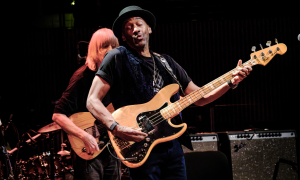
Luke Stewart's Silt Trio was joined by Angelica Sanchez on the piano and Chris Williams on trumpet for a rare tribute to the great composer-performer Wadada Leo Smith, himself penning a new piece around the work of James Baldwin. Smith has written many compositions with Baldwin in mind, the most recent perhaps "No Name in the Street" off his record Ancestors (TUM Records, 2012) with Louis Moholo-Moholo. It is hard to think of a finer fit of artist and author than the two of them: their lyricism and wit are met with an overwhelming social activism and minute study of societal justice. In this piece, enjoying its world premier by Stewart, Smith tackles the seminal essay "The Fire Next Time." Much like the essay, the performance was a sprawling, meditative, and at times fiercely provocative tone poem. Sanchez supplied the theoretician's touch. Her sharp, disjointed play style brought the central vitriol and sorrow in the essay to fruition, while Stewart and Chad Taylor's bluesy rhythm collapses into visceral improvisation. Williams was a complex, raw, and patient force in the new lineup, carefully oscillating between loud, quick licks and moaning ululation. Stewart drove this delicate balance up until he read from the essay, accompanied by Taylor and saxophonist Brian Settles, its final notes compelling the band into a fittingly biblical mass of volume.
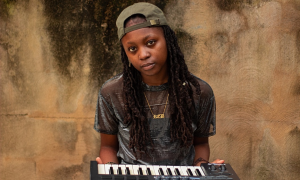
The night closed with a raucous and unpredictable set by the Konjur Collective, certainly one of the more innovative new groups in the city. Led by drummer Bashi Rose, the group continued their evocations into the spirit and artistry of Black revolutionary thinkers (following their 2022 release Blood in My Eye: A Soul Insurgent Guide (Astral Spirits, 2020) exploring the work of George Jackson) with "Revolutionary Suicide." Rose conducted a polyrhythmic blend of hip hop immediacy and more traditional free jazz mode, his searing vocals constantly countered by the mellifluous r&b signatures of Emperor King Bishop, along with spoken word from David Diongue. Jamal Moore was the only non-vocalist in the group, but it is important to note the personal quality of his alto saxophone: his tonguing was sharp and corrosive, paired with his blearing pedal work the audience was given a unique glimpse into his raw sound, not only reminiscent of the vocal interchange among the other players, but perhaps closer to the ancient East African techniques the Collective has employed across its work. Diongue and Bishop played a smooth saxophone riff by comparison, no less truthful and taut in its accompaniment of Rose's lyrics. Segments from Rose's videowork played in the background: stylized urban scenes and archival footage of police violence and social uprising compelled the group forward into further realms of revolutionary spirit.
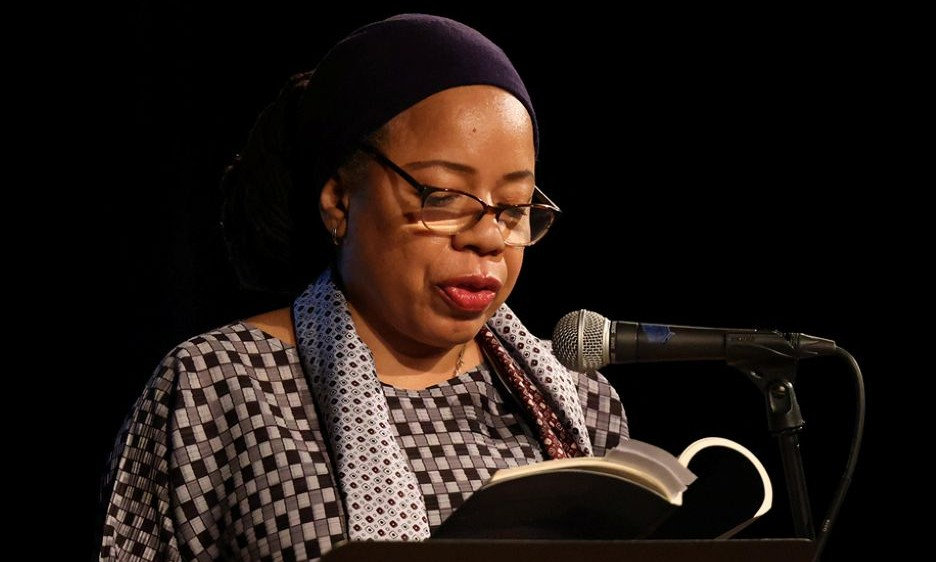
The connective tissue of the night, and the most complex vocal performance, was the poet Tracie Morris, who gave two readings in between sets. Her first set wished to congratulate Vision Fest on its thirty year milestone, and wish it well into the future, by reading both a poem from early in her career and one never before read. The first was a witty and caustic hip hop composition that showcased the full breadth of Morris's lyrical and political potential, scrapbooking lyrics from the radio hits of the day with the revolutionary slogans and slang that hung just underneath the surface. The second work was a vastly different number, a jilted repetition of stutters, moans, and half-phrases seeped into a massive ululation, like a concrete poem suddenly strewn out into the air. Between these two short interludes, there was the DNA of every performance that came before and after, represented in Morris' singular intellect and skill. In Morris' performance was also the realization of Vision Festival's most treasured goal: to create a space for the past and future of creative music to commune without constraint, an inner dialogue between tradition and innovation toward an expression decidedly original.
 FOLLOW Fran Kursztejn
and get notified whenever a new article published.
FOLLOW Fran Kursztejn
and get notified whenever a new article published.
Southern writer, filmmaker, & jazz freak.
About Jen Shyu

Tags
PREVIOUS / NEXT

Become a Sustaining Member

Since 1995, All About Jazz has championed jazz as an art form and supported the musicians who create it. Over three decades, it has grown into one of the world's leading jazz resources, serving hundreds of thousands of readers, musicians, presenters and industry professionals each month.
Help Build the Future of All About Jazz
Your support helps us continue building All About Jazz for the next generation—expanding our editorial coverage, preserving jazz history, developing new community features and creating better ways to discover the music and the people behind it.
Become a sustaining member for as little as $20 per year and you'll immediately enjoy an ad-free experience along with access to subscriber features and future articles for a full year.
Together, we're not simply sustaining All About Jazz—we're building its future. Thank you for being part of the journey.