Home » Jazz Articles » Album Review » Mick Goodrick: In Pas(s)ing
Mick Goodrick: In Pas(s)ing
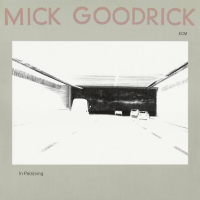
Mick Goodrick assembled the band quickly after Manfred Eicher reminded him that he still owed ECM an album. The group had one day of rehearsal and recorded all first takes the next day.
Released in 1979, this is an album that has gathered a reputation over the years. Subtle and understated, In Pas(s)ing is that rare album that rewards not just listening but the quality of attention you bring to it. Goodrick always put a special emphasis on accompaniment. His guitar tone here is beautiful and almost un-guitarish. He plays with a logic that is all his own. His phrases emerge deftly and then disappear before we have apprehended them. The title is a punning reference to ECM's first office address in Munich's Pasing district, a private joke between label and artist. "Passing" has a subtler meaning, a glancing reference, not head on, not confrontational, not direct, almost evasive, music glimpsed—the idea of musical ideas glimpsed rather than stated, of beauty encountered sideways rather than confronted head-on; almost but not quite evasive.
This was the debut of a man who, by temperament and philosophy, had little interest in fame. Goodrick had spent years working with Gary Burton and before that with Woody Herman, then he was an educator eventually called the "most influential mentor in the history of jazz guitar." Given his own album for the first time, he chose instead to listen, and to invite others into that listening with him.
Known throughout his career for his special attention to chord structures and harmonic control, Goodrick always put a special emphasis on accompaniment. His guitar tone here is never flashy, but airy and pensive. He plays with a flexible inner logic: His phrases appear not to begin or end so much as emerge from the surrounding music.
The four musicians assembled by Goodrick—or by Eicher—are not accompanists, they are conspirators. And to understand the album's achievement, one must understand what each brings to the room.
Jack DeJohnette had, by this point, worked with Miles Davis, Keith Jarrett, and Charles Lloyd, and brought all of that experience to a role that is as much about shaping as it is about rhythm. The drumming on the album is an object lesson in how great percussion playing can liberate. DeJohnette never dominates, but holds the music together so that the others can move freely. The dynamics are always present and consoling to the other players.
This is not an explosive showcase performances in the manner of his work with Jarrett or Davis, but its subtlety is deceptive. DeJohnette functions here as a colourist. His cymbal work is shimmering, metallic, and spatially precise. Rather than marking strict time, he brings momentum and tension through texture.
John Surman can be a commanding presence. However, his subtlety means that he does not dominate. The baritone saxophonist and bass clarinetist was in a time when he was producing some of the most original reed playing in jazz. Goodrick's fragility needs the power of Surman as a sympathetic counterbalance. On the baritone he is heavy and solid; on soprano, he soars and is lyrical; on bass clarinet, he brings a purple, other-worldly aspect.
It is Surman whose presence most decisively gives the album its distinctive personality. Goodrick's writing and playing could become delicate, too self-consciously atmospheric. Surman prevents this at every turn. Tender bass clarinet is heard in "Pedalpusher" with what can only be described as a slow richness. On the closing title track, Surman cuts free of restraints in favor of more visceral forms of communication.
His baritone playing on "Feebles, Fables and Ferns" and "Pedalpusher" is cavernous and mournful, capable of sounding simultaneously lyrical and earthy and rooted. He does not simply solo, he reshapes every piece.
On soprano sax, particularly during "In the Tavern of Ruin" and the collective improvisation "In Passing," Surman becomes almost expressionistic. He produces shrieks, fluttering overtones, birdlike cries, and breath-heavy smears that push the music toward free improvisation without abandoning its compositional coherence. The tension between Goodrick's cool abstraction and Surman's elemental emotionalism drives much of the album's drama.
Known for his work with Bill Evans, Eddie Gomez brings a singing, highly articulate bass language that constantly questions the rhythmic centre. His tone is bright and vocalized, almost human in its inflection on "Pedalpusher," where Gómez's bass lines move with elasticity under Goodrick's restrained guitar figures. He creates forward momentum, allowing the music to drift while never losing coherence. On "Summer Band Camp," he injects life and swing into the music. His playing constantly reminds the listener that this music is deeply rooted in jazz. On "Summer Band Camp," his doublings add a chorused, rhythmic quality that foreshadows an ecstatic close. And on "Pedalpusher" his work is simply inventive, rooted, and dazzling.
In Pas(s)ing consists almost entirely of Goodrick originals, save for the collectively improvised title piece. The compositions are modest in the best sense. They present unassuming, thoroughly considered themes that function less as showcases than as invitations. "Feebles, Fables and Ferns" opens the album in a kind of suspended time, the four voices locating each other gently. "Summer Band Camp" is the album's most immediately accessible piece, suffused with a warmth and playful nostalgia that never tips into sentimentality. "Pedalpusher" is perhaps the most harmonically complex moment, a slow-burning investigation of colour and space. And then, finally, the title track—free, open, with intense sentiment, the four musicians relinquishing individual authorship in favour of something genuinely collective.
Ultimately, In Pas(s)ing is less about individual virtuosity than collective intelligence. Goodrick contributes the harmonic philosophy and emotional restraint; Surman supplies the elemental force and dramatic urgency; Gómez provides melodic elasticity and lyrical grounding; DeJohnette shapes the music's internal weather. Remove any one of them, and the album loses its delicate equilibrium.
 FOLLOW Jack Kenny
and get notified whenever a new article published.
FOLLOW Jack Kenny
and get notified whenever a new article published.
Jack was turned on to jazz by a mixture of Stan Getz, Lee Konitz and Earl Bostic.
Track Listing
Feebles, Fables and Ferns; In the Tavern of Ruin; Summer Band Camp; Pedalpusher; In Passing.
Personnel




Album information
Title: In Pas(s)ing | Year Released: 1979 | Record Label: ECM Records
About Mick Goodrick
Tags
PREVIOUS / NEXT


Become a Sustaining Member

Since 1995, All About Jazz has championed jazz as an art form and supported the musicians who create it. Over three decades, it has grown into one of the world's leading jazz resources, serving hundreds of thousands of readers, musicians, presenters and industry professionals each month.
Help Build the Future of All About Jazz
Your support helps us continue building All About Jazz for the next generation—expanding our editorial coverage, preserving jazz history, developing new community features and creating better ways to discover the music and the people behind it.
Become a sustaining member for as little as $20 per year and you'll immediately enjoy an ad-free experience along with access to subscriber features and future articles for a full year.
Together, we're not simply sustaining All About Jazz—we're building its future. Thank you for being part of the journey.