Home » Jazz Articles » Live Review » Fergus McCreadie Solo: Brahms And Beyond At Islay Jazz Festival
Fergus McCreadie Solo: Brahms And Beyond At Islay Jazz Festival
Courtesy Mark McKergow
As the final notes died away (slowly—McCreadie likes to hold the sustain pedal down), the audience responded with a standing ovation. The cheers were long and loud.
Caol Ila Islay Jazz Festival
Islay, Scotland
September 12, 2026
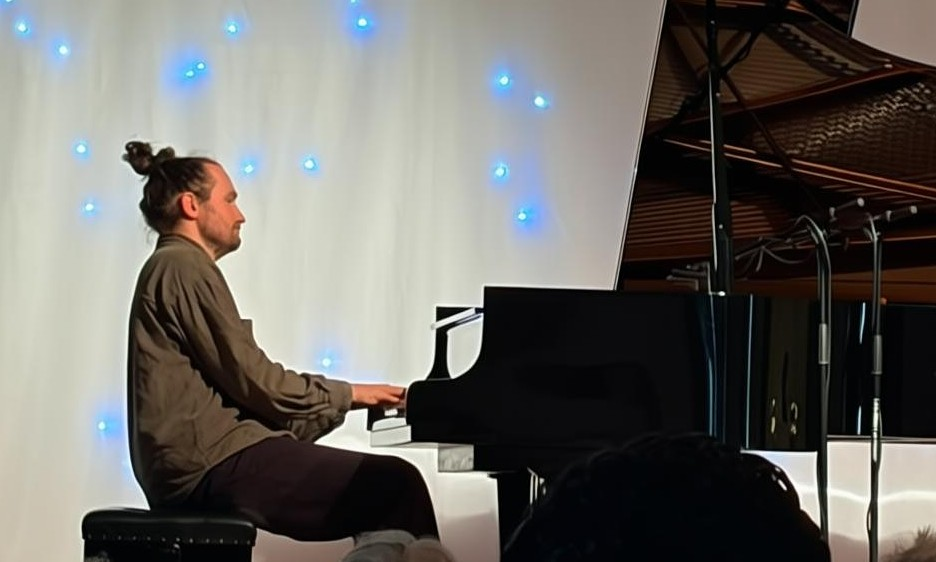
Piano virtuoso Fergus McCreadie stepped into new territory with this extraordinary solo performance, pairing Brahms' piano music with his own improvisation. The idea proved irresistible, drawing the largest ticket sales in the festival's history. The music will stay with everyone lucky enough to hear it.
McCreadie is a leading figure in the new wave of Scottish jazz. His award-winning albums Cairn (Edition Records, 2021), Forest Floor (Edition Records, 2022) and The Shieling (Edition Records, 2025) blend jazz and folk influences with a strong sense of place. His sound is distinctive, pastoral and fiery elements woven into something full of heart. Most of his work has been with his trio, but today he stood alone.
Well, not entirely. The concert opened with a short set of jazz standards performed as duets with tenor saxophonist Simon Herberholz. The two produced focused, engaging music. Herberholz played with a pure, restrained tone, as if Paul Desmond had spent his life on tenor instead of alto. "The More I See You" set the scene, with Billy Strayhorn and Duke Ellington's "Star Crossed Lovers" a highlight. George Shearing's "Conception" closed the set, the pair acing its tricky, fiddly theme in unison.
Since the pandemic lockdowns, McCreadie has been incorporating classical repertoire into his practice to expand both his musical awareness and his technique. He has felt a particular connection with Johannes Brahms (1833-1897). Brahms' Ballades (Op. 10), written when he was 21, are four lyrical solo piano works, each with its own architecture and emotional landscape. The first was inspired by the Scottish ballad "Edward." Each lasts five to six minutes, and the key signatures form a pattern: D minor, D major, B minor and B major.
McCreadie noticed that the sequence could continue: the relative minor of B major (A-flat minor), then A-flat major, F minor and F major. His plan was to play the Ballades in full, exactly as written, then follow them with four improvisations in the new keys. Sitting at the Bösendorfer 214 (brought from Edinburgh for the occasion; the high string tension gives a faster action), he took a moment to focus, then began. The performance of Brahms' Ballades was quite breathtaking, superbly phrased and articulated, with plenty of space and pace. He let the piano's sound work its magic.
After about 20 minutes, the Ballades concluded. McCreadie paused, centered himself, then launched into his improvisation with a strong, detailed opening. Others might have begun cautiously, but he jumped in headfirst and set out on a 40-minute musical journey.
Improvising in response to a pre-set provocation isn't new. Karlheinz Stockhausen's 1968 concept of "intuitive music" used verbal or graphic instructions as starting points, though Stockhausen aimed to strip away rules and style. McCreadie took a different path, drawing on Brahms and his own musical language to create something magical in real time.
The four key signatures gave both performer and audience a high-level structure. What followed was bewitching: reflective then energetic, stable then leaping forward. If standard jazz improvisation is short form, McCreadie's endeavor was closer to the long-form theater style pioneered by Ken Campbell and developed by groups like The Showstoppers, who have improvised more than a thousand full-length musicals. Campbell argued that improvisation could surpass scripted work, and McCreadie left us wondering whether this varied, stylish music could ever be bettered.
Jazz has been described by Charles Mingus and Misha Mengelberg as "instant composition." This performance doubled down on that idea, the pianist exposed for an hour with no safety net and never seeming to falter. Although technically "free," the music was far removed from the plinky-bonk school of contemporary improvisation. Phrases merged into segments and movements, becoming more McCreadie-like as the journey continued, evoking the island landscape with pentatonic harmonies.
As the final notes died away (slowly—McCreadie likes to hold the sustain pedal down), the audience responded with a standing ovation. The cheers were long and loud. McCreadie slipped offstage, then returned to play a short piece to settle the room and close the performance. No recording was made, which is a shame—the result might have been another Köln Concert (ECM Records, 1975).
As a musical event, this was a resounding success. It raises the question of what McCreadie might do next. The idea is too good to ignore yet repeating it risks turning inspiration into routine. Does he choose another classical work as a starting point, or is there enough in the Brahms for multiple explorations? Whatever comes next, one hopes a recording will be part of it.
Read a full round up of the 27th Caol Ila Islay Jazz Festival at Islay Jazz Festival 2026: Festival Round-Up.
 FOLLOW Mark McKergow
and get notified whenever a new article published.
FOLLOW Mark McKergow
and get notified whenever a new article published.
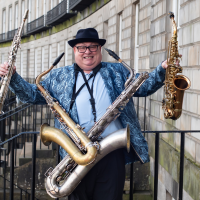
Saxophonist, clarinetist and writer living in Edinburgh, Scotland
About Fergus McCreadie

Tags
PREVIOUS / NEXT


Fergus McCreadie Concerts
Become a Sustaining Member

Since 1995, All About Jazz has championed jazz as an art form and supported the musicians who create it. Over three decades, it has grown into one of the world's leading jazz resources, serving hundreds of thousands of readers, musicians, presenters and industry professionals each month.
Help Build the Future of All About Jazz
Your support helps us continue building All About Jazz for the next generation—expanding our editorial coverage, preserving jazz history, developing new community features and creating better ways to discover the music and the people behind it.
Become a sustaining member for as little as $20 per year and you'll immediately enjoy an ad-free experience along with access to subscriber features and future articles for a full year.
Together, we're not simply sustaining All About Jazz—we're building its future. Thank you for being part of the journey.