Home » Jazz Articles » Live Review » Charles Gayle at the Red Rose Club, London
Charles Gayle at the Red Rose Club, London
Gayle, dressed all in black, in stark contrast to his white plastic alto saxophone, essayed a stream of falsetto ululations, becoming more choked and distorted with each onslaught
Red Rose Club
London, England
September 21, 2007
Charles Gayle was so keen to get started that he launched his opening salvo—a short repeated squeal of a motif—almost before drummer Mark Sanders had finished thanking promoters Birmingham Jazz for making this short English tour happen. Sanders' initiative had brought together free jazz legend Charles Gayle and long time collaborator, NYC bassist extraordinaire William Parker, to form a trio of unassuming power and unexpected sensitivity.

London's Red Rose Club hosted the final night of the six date English tour, in front of a standing- room- only full house, with BBC Radio 3 in attendance to record for posterity the 70-minute set of five freely improvised pieces plus an encore.
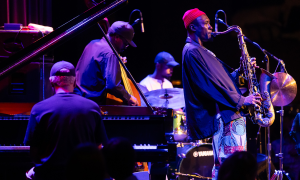
Parker's brawny bass squared up to Sander's busy percussive accompaniment to set up a dense wall of sound, matching the saxophonist's urgency. The tall thin rooted figure of Gayle, dressed all in black, in stark contrast to his white plastic alto saxophone, essayed a stream of falsetto ululations, becoming more choked and distorted with each onslaught. Gayle's excursions have become shorter with age — no longer the 50-minute marathons of some of his earlier live recordings, but they still wield an emotional heft which prompts allusions to prayer and speaking in tongues.
Even though Gayle was clearly the amen player, the rhythm team was in no way relegated to the chorus. Parker displayed his improvisational prowess in the second piece, which featured the bassist with an extended arco solo in an upper-register vocalised tone. Meanwhile Sanders, long one of the UK's foremost improvising percussionists, thrived in this fast company.
A Sanders tattoo led off the third piece in march time, drawing a two-beat bounce from the bassist. Gayle's initial response was a wavering cry evoking an out-of-focus take on some familiar themes, but he soon stamped his foot, demanding a swift acceleration from the drummer, matched by the alert Parker. As his long wavering, yelping lines drifted over the rhythm, he stamped again, summoning even greater intensity, before leaving Sanders to deliver a fierce polyrhythmic solo. Gayle's return to trade fours with Sanders provoked a fiery conclusion until a sudden halt saw both men mopping their brows.
Having recorded and gigged as a solo pianist, Gayle not surprisingly chose to recuperate at the Fazioli grand gracing the Red Rose stage, commencing in a fractured stride style. Gayle's pianistics are less iconoclastic than his saxophone playing but still proceed with abstracted abandon. Parker excelled in intimate accompaniment, culminating in a delicate solo cadenza. Head bowed, Gayle coaxed the familiar chords of "'Round Midnight" from the flow, then launched into another extemporization before yielding once more to the gravitational pull of Monk's tune. Sanders' sensitive cymbal work, his dampening resonances with his hand, and varying of the textures signaled a closing passage that became a delightful three-way invention.
Energies recharged, Gayle resumed for a final alto assault over breakneck drums and muscular bass. As his hands fluttered over the saxophone keys, the instrumentalist's high cries became ever more urgent, until a final crescendo that left the crowd wanting more. The prolonged applause eventually brought the trio back to the stage, with Gayle, sans alto, once more at the piano for an open conversational trio rounded out by Parker's arco sweeps and Sanders' timbral gestures, followed by a delicate conclusion that once more elicited enthusiastic shouts of approval. Gayle was much moved by the reception and modestly thanked the audience for their attention—though it would have taken a stronger will than mine not to attend to the glorious noise we had just witnessed.
 FOLLOW John Sharpe
and get notified whenever a new article published.
FOLLOW John Sharpe
and get notified whenever a new article published.
John first fell under the spell of free jazz in the 1970s when he wistfully regarded the loft jazz scene from across the Atlantic
About Charles Gayle

Tags
PREVIOUS / NEXT
Become a Sustaining Member

Since 1995, All About Jazz has championed jazz as an art form and supported the musicians who create it. Over three decades, it has grown into one of the world's leading jazz resources, serving hundreds of thousands of readers, musicians, presenters and industry professionals each month.
Help Build the Future of All About Jazz
Your support helps us continue building All About Jazz for the next generation—expanding our editorial coverage, preserving jazz history, developing new community features and creating better ways to discover the music and the people behind it.
Become a sustaining member for as little as $20 per year and you'll immediately enjoy an ad-free experience along with access to subscriber features and future articles for a full year.
Together, we're not simply sustaining All About Jazz—we're building its future. Thank you for being part of the journey.