Home » Jazz Articles » Book Review » Brad Mehldau: Formation: Building A Personal Canon, Part One
Brad Mehldau: Formation: Building A Personal Canon, Part One
...only Mehldau himself could have delivered a story so confessional, so searingly honest, that the very writing of it must have proven cathartic.
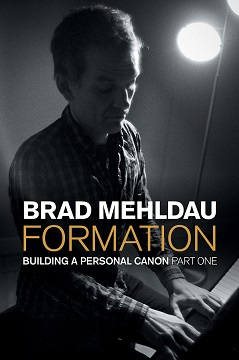 Formation: Building A Personal Canon, Part One
 Brad Mehldau
312 Pages
ISBN: 9781800503137
Equinox Publishing
2023
In the considerable wake of Keith Jarrett, it is hard to think of another pianist as influential or as widely imitated as Brad Mehldau.
Throughout a career that began in the early '90s, taking flight with his acclaimed Art Of The Trio albums, Mehldau has built his reputation—like Jarrett before him—as a jazz improvisor par excellence. And like Jarrett, Mehldau has explored other forms of music—classical, folk, electronic—that render the term "jazz musician" somewhat reductive. As the years have rolled by, it has become increasingly tricky to stick a label on Mehldau the artist.
Mehldau's search for, and his construction of, a personal musical identity is a leitmotif in Formation..., the first volume in a two-part autobiography. Mehldau traces the musical epiphanies that have shaped him, from Billy Joel, Supertramp and Rush to John Coltrane and The Three Bs—Beethoven, Brahms and Bach.
But Formation... is about so much more than purely musical identity.
In Mehldau's telling there is a sense of his striving to belong musically, intellectually and socially, yet feeling somehow apart—the outlier Man With No Name one moment, the team-playing Musketeer the next. His narrative veers between conversational and academic, between wittily anecdotal and painstakingly analytical-cum-philosophical.
These tensions and dualities seem to mirror, to some degree, Melhdau's internal struggles to reconcile different aspects of his personality, growing up in West Hartford, Connecticut in the '70s and '80s. Few jazz autobiographies are as candid in sharing details of insecurities, missteps and plain bad life choices.
As an adopted child, the young Mehldau struggled with a sense of who he was and where he came from—part of a "normal" family yet unable to relate to the more psychologically rooted tribe of his peers. His sexuality, somewhat fluid in his formative years, was another duality that provoked certain tensions in his lifestyle. Being sexually groomed as a schoolboy did not help matters.
Musically too, Mehldau seemed torn for a long time between being drawn to the life of the bohemian jazz musician and that of the high-brow classical pianist.
"I could not reconcile all of these identities as I tried to embody them," Mehldau admits. Hedonism ensued and a debilitating heroin habit almost cost him his life. But for the intervention of his nearest and dearest, Mehldau was surely hurtling towards self-destruction in his twenties.
Stylistically influenced by the Bildungsroman school of writing set in motion by Johann Wolfgang von Goethe, Mehldau's filters his formative experiences through moral, philosophical and, to a lesser extent, religious prisms. He refers to progressive rock's "moral code" and Led Zeppelin's "moral authority."
Literature and literary theory play as significant a role in Mehldau's artistic and personal growth as his musical journey has done. Whilst clearly important to the author in order to explain his development as both an artist and as a human being, the narrative around the influence of literary figures such as Thomas Mann or James Joyce, for example, often gets bogged down in dense, high-falutin' academic speak that may tempt a little page-skipping here and there.
Perhaps more revealing—and certainly more fun—are Mehldau's recollections of the New York jazz scene in the '80s, playing for tips, wood-shedding and forging musical bonds with Larry Grenadier, Jorge Rossy and Joshua Redman. Given how permanently stoned Mehldau seemed to be, it is a wonder that his recall of those times is as good as it is.
With a fair few of the old pioneers of modern jazz still around at the time, Mehldau describes his generation's struggle between feeling the need to respect the tradition and the urge to say something personal within the idiom. In that sense, Mehldau's story is the story of most jazz musicians throughout the past century.
Just as Bill Frisell talks about a recurring dream of perfect music in Philip Watson's acclaimed Frisell biography, Beautiful Dreamer (Faber & Faber, 2022), Mehldau also describes the gap/the bridge between dreams, reality and creativity.
"The dream and reality stand apart, but they're wrapped into each other at the same time. Music is not so much the gift itself, but the slow, endless unwrapping of it, and a hint of what might be under the wrapping."
After unwrapping Formation..., the allegory-infused Mehliana: Taming The Dragon (Nonesuch, 2014), perhaps the most stylistically unique album in Mehldau's discography, can be seen in an entirely new light.
Less scholarly—and more formulaic—biographies of Mehldau will no doubt eventually see the light of day, but only Mehldau himself could have delivered a story so confessional, so searingly honest, that the very writing of it must have proven cathartic. A self-portrait of a major artist that is revealing and frustrating, in roughly equal measure.
 FOLLOW Ian Patterson
and get notified whenever a new article published.
FOLLOW Ian Patterson
and get notified whenever a new article published.
Ian is dedicated to the promotion of jazz and all creative music all over the world, and to catching just a little piece of it for himself.
About Brad Mehldau
Tags
PREVIOUS / NEXT


Brad Mehldau Concerts

Become a Sustaining Member

Since 1995, All About Jazz has championed jazz as an art form and supported the musicians who create it. Over three decades, it has grown into one of the world's leading jazz resources, serving hundreds of thousands of readers, musicians, presenters and industry professionals each month.
Help Build the Future of All About Jazz
Your support helps us continue building All About Jazz for the next generation—expanding our editorial coverage, preserving jazz history, developing new community features and creating better ways to discover the music and the people behind it.
Become a sustaining member for as little as $20 per year and you'll immediately enjoy an ad-free experience along with access to subscriber features and future articles for a full year.
Together, we're not simply sustaining All About Jazz—we're building its future. Thank you for being part of the journey.