Home » Jazz Articles » Interview » A Fireside Chat with the Ramon Banda
A Fireside Chat with the Ramon Banda
We could go into a club and play swing and standards, which is what I really love to do, but as soon as you lay an Afro-Caribbean thing under it, people light up.
 Dabbling is effortless, inviting little labor. Commit-ment, however, is exhausting, demanding and often times complicated. The Banda Brothers (Ramon and Tony) are committed to Latin jazz. And having played it for 30 years, they require little practice. But their loyalty has afforded their music an audible truth. Commitment comes at a price, but its rewards can comfort a weary soul.
All About Jazz: Let's start from the beginning.
Ramon Banda: My mom played piano. Her brother was a tenor player. They originally grew up in a west Texas town and my uncle was a real jazz buff. He was into Coleman Hawkins and Ben Webster. They eventually got out here to California in the early '50s and he continued playing music. came along in '54 and my brother in '55. As soon as we were able to walk and talk, we became part of the family group. His sons also played. It was a guitar for myself and a bass for my brother. We were born and raised in Norwalk. There was music all the time in the house. Within the family group that we had, we played traditional Mexican music with a west Texas feel and we also played the R&B hits of the day. It was a constant growing thing for us. Eventually, my cousin Mike, who was a drummer, was drafted to Vietnam, so they switched me over to the drums.
AAJ: Norwalk native Poncho Sanchez and the Bandas goes back.
RB: He was singing in a neighborhood group with my two older cousins, who were the horn players. The drummer had to leave the band and I had just started playing the drums at that point. One night, there was a knock on the door and there were these two guys standing there and they needed a drummer. So I got dressed and loaded up my drums and I am sitting in the car with these two guys and it turned out to be Poncho and his older brother, who was driving. We became instant friends. He wasn't even playing congas at that point. We've been playing together since '66.
AAJ: Why leave a good thing?
RB: Honestly, my whole business experience with Poncho was not a good one. When we started out, we were all together, doing it and playing the dues. We're very family oriented, my brother and I. If you're family, you're family. But as things progressed business wise, we saw that we had paid some serious dues here and we assumed that since we had his best interests in mind, he would have ours. But it turned out not to be the case. It was not a good feeling to make music in that situation. Musically, it hadn't been rewarding, so I didn't need to be there.
AAJ: What fuels Latin jazz?
RB: It is the rhythmic thing. We could go into a club and play swing and standards, which is what I really love to do, but as soon as you lay an Afro-Caribbean thing under it, people light up. I don't know what it is, but we see it all over the world. Once it gets into your soul, it grabs you and you're a goner.
AAJ: The Banda Brothers have a regular night at Steamers, a consistent proving ground to work out material.
RB: Steamers and Terence Love has been a blessing. He was the guy who pushed us to start the group. Sometimes we would have so much fun, our first set would last two and a half hours. Francisco Torres was also very instrumental in starting our group. The group is a very mutual thing. We don't have to deal with any personality vibes or ego trips. We just go in there and play music. Sometimes we have nights where things are not happening, but when we are taking chances, that's going to happen. We do one Tuesday a month and we get to play new tunes. Francisco Torres wrote a song in the last couple of days and he brought it in and on a break, we went out to the alley in the back and we put the music on the hood of a car, figured it out, and went on stage and played it. We try the stuff and they love it. They're into it.
 AAJ: Acting Up! is the new Banda Brothers record.
RB: One night, we were playing at a club in L.A. and Willie Jones III came in and wanted to buy a CD. I told him that there was no CD and we talked and he came up with this great deal for us. We went in the studio and recorded live, just the way we play the gigs. Nobody does that anymore. I encouraged the fellas in the band to come up with some new material and we took a fresh approach to the music. I'm really happy with it. Chris Barron, the way he accompanies a soloist is unbelievable. We did the whole record in five hours.
AAJ: Tony plays shekere (chekere), which looks similar to a gourd?
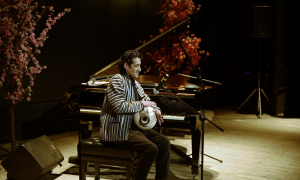
RB: It is an instrument that originated in West Africa. It is a big gourd, which is used in many indigenous cultures for various things for centuries. The shekere in Africa was a hollowed out gourd and they would string it with seeds or shells to make a shaking sound on the outside like netting. But when you hit the bottom of the gourd, because it is hollow, you also get a tone. With the slave trade, it went to Cuba and Brazil and I've always loved that sound. There is a record that my brother and Poncho and I used to listen to when we were growing up by Mongo Santamaria. And the shekere was always prominent in Mongo's music. This thing was live at the Village Gate and the great Julio Collazo plays shekere and sings a chant in this one song. When he sings and the way he plays that shekere touches me. One day, I was sitting around with a bunch of friends of mine and we were trying to figure out how to pay the rent and my friend Tambu, who is a great percussionist in his own right, offered to show me how to make a shekere. He passed the knowledge onto me and in turn, I passed it onto my brother and we started making them.
AAJ: And the future?
RB: Tony is still a major part of Poncho's group and is on the road constantly. Myself, I have been really blessed to work with Joey DeFranceso a lot and Bill Cunliffe. I am just starting to get into a whole other scene and am playing drums, not timbales.
Visit Band Bros on the web at www.bandabros.com .
 FOLLOW AAJ Staff
and get notified whenever a new article published.
FOLLOW AAJ Staff
and get notified whenever a new article published.
Various staff members.
About Ramon Banda

Tags
PREVIOUS / NEXT
Become a Sustaining Member

Since 1995, All About Jazz has championed jazz as an art form and supported the musicians who create it. Over three decades, it has grown into one of the world's leading jazz resources, serving hundreds of thousands of readers, musicians, presenters and industry professionals each month.
Help Build the Future of All About Jazz
Your support helps us continue building All About Jazz for the next generation—expanding our editorial coverage, preserving jazz history, developing new community features and creating better ways to discover the music and the people behind it.
Become a sustaining member for as little as $20 per year and you'll immediately enjoy an ad-free experience along with access to subscriber features and future articles for a full year.
Together, we're not simply sustaining All About Jazz—we're building its future. Thank you for being part of the journey.