Home » Jazz Articles » Album Review » Alden Hellmuth: Tether
Alden Hellmuth: Tether
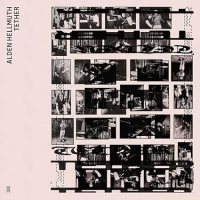
Alden Hellmuth, a saxophonist, composer, and improviser based in New York City, offers one compelling answer: by forging her own path. A graduate of the Herbie Hancock Institute of Jazz, she was awarded the 2025 German Jazz Prize for Debut Album of the Year and has appeared internationally at major venues and festivals, including the NYC Winter Jazz Festival, the Hollywood Bowl, the Blue Note Jazz Festival, and International Jazz Day events in Morocco and Abu Dhabi.
Hellmuth's discography charts a clear artistic trajectory—from acoustic, texturally nuanced jazz toward increasingly exploratory and experimental terrain. Tiny Windows (2022), released with the Focusyear Band on the German label Neuklang, documents her early compositional voice, featuring works developed during her fellowship. Her leader debut, Good Intentions (2024) on Fresh Sound New Talent, introduced her core quintet and foregrounds an aesthetic concerned with "sonic intention and dissonance in the absence of resolution," a concept realized with notable clarity and control.
With Tether, Hellmuth advances further into a high-energy, open-form language. The project is distinguished by its unconventional instrumentation: a rhythm section comprising two double basses—Logan Kane and Miller Wrenn —and drummer Justin Brown. Drawing structural inspiration from dual-bass configurations associated with figures such as Ornette Coleman (in expanded ensembles) and, more obliquely, Andrew Hill's layered rhythmic concepts, Hellmuth constructs a dense and highly elastic foundation for improvisation.
The stereo separation of Kane and Wrenn—positioned left and right—allows the listener to track their contrasting timbres, arco and pizzicato articulations, and independent rhythmic trajectories. Brown, known for his work with Ambrose Akinmusire, brings a volatile, hyper-dynamic approach that both anchors and destabilizes the ensemble. The result is a low-frequency field of considerable weight and mobility: a grounding force that paradoxically enables the music to approach the brink of abstraction without losing coherence.
The album opener, "Microfictions," establishes this language immediately. A quick, fragmented rhythmic figure from Brown sets events in motion before the twin basses interweave a dense contrapuntal lattice. Hellmuth's entrance is similarly agile—her line fractured, angular, and continuously mutating.
"Guesswork" demonstrates her capacity for restraint, scaling back intensity to focus on sparse, tension-filled detail and micro-gestural interplay. In contrast, "Satellite" reimagines the John Coltrane composition not as repertory homage but as a site of transformation— retaining its kinetic core while subjecting it to Hellmuth's more fractured, textural logic.
At the album's center, "Face the Wall" channels a raw, almost punk-inflected energy. The rhythm section surges with unruly momentum, provoking Hellmuth into one of her most uncompromising performances on record. Her alto lines, saturated with extended techniques and sharp intervallic leaps, cut through the ensemble's density with striking precision.
"Holding Pattern" shifts the emphasis toward composition and sonority. The reduced tempo allows the resonance of the two basses to bloom and merge, creating a dark, enveloping backdrop for Hellmuth's more measured, at times wryly lyrical improvisation.
Tether is a demanding but deeply rewarding listen—music that tests the limits of collective improvisation without collapsing into chaos. Hellmuth's approach is not about domination but about tension: how far the ensemble can stretch before the tether gives way. For listeners attuned to contemporary avant-garde jazz and the possibilities of group telepathy, it stands as one of the most vital releases of the year.
 FOLLOW Jack Kenny
and get notified whenever a new article published.
Jack was turned on to jazz by a mixture of Stan Getz, Lee Konitz and Earl Bostic.
Track Listing
Microfictions; Fake(rs); Definitely Not Friends; Guesswork; Supply Chain; Satellite; Witness; Face The Wall.
Personnel

Alden Hellmuth
saxophone
Justin Brown
drums
Logan Kane
bassMiller Wenn
bass, acoustic
Paul Cornish
pianoYakiv Tsvietinsky
trumpetAlbum information
Title: Tether | Year Released: 2026 | Record Label: Leiter
About Alden Hellmuth
Tags
PREVIOUS / NEXT


Become a Sustaining Member

Since 1995, All About Jazz has championed jazz as an art form and supported the musicians who create it. Over three decades, it has grown into one of the world's leading jazz resources, serving hundreds of thousands of readers, musicians, presenters and industry professionals each month.
Help Build the Future of All About Jazz
Your support helps us continue building All About Jazz for the next generation—expanding our editorial coverage, preserving jazz history, developing new community features and creating better ways to discover the music and the people behind it.
Become a sustaining member for as little as $20 per year and you'll immediately enjoy an ad-free experience along with access to subscriber features and future articles for a full year.
Together, we're not simply sustaining All About Jazz—we're building its future. Thank you for being part of the journey.