Home » Jazz Articles » Album Review » Art Blakey & The Jazz Messengers: Blue Moon Over Paris: ...
Art Blakey & The Jazz Messengers: Blue Moon Over Paris: ORTF Recordings 1963 - 1968
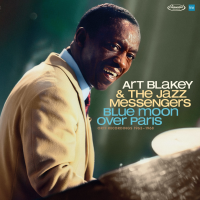
The limited-edition 180-gram two-LP set, also available on two CDs and in digital formats, brings together performances recorded on April 25, 1963, at Paris's Olympia Theatre and on November 6, 1968, at Salle Pleyel. The package includes rare photographs, extensive liner notes, recollections from participating musicians, and other personal reflections.
The 1963 sextet was among the Messengers' strongest and most celebrated. Trumpeter Freddie Hubbard, tenor saxophonist Wayne Shorter, trombonist Curtis Fuller, and bassist Reggie Workman were relative newcomers, yet each was already building their credentials and positioning themselves to become stars. Together, they were something special.
The opening "Moon River" is a wonderful surprise. Henry Mancini's familiar melody is taken at a decidedly un-Mancini-like pace and transformed into an extended hard-bop workout. Hubbard's brilliant trumpet, Shorter's more searching tenor, Fuller's robust trombone and Walton's piano excursion provide contrasting voices. Meanwhile, Workman and Blakey keep the river tumbling with energy. Blakey's own composition, "Buhaina's Delight," is a burner that lets you hear the drummer in his element. After Walton's and Workman's masterly runs, Blakey takes on an extended solo filled with explosive energy, as if designed to demolish his kit.
The mood shifts considerably with "That Old Feeling," as Walton delivers a commanding technical improvisation with sleek contours and an atmospheric sheen. It serves as a welcome counterweight to the horn players' more assertive contributions. "I Didn't Know What Time It Was" offers another welcome tempo shift, with a ballad interpretation. Shorter brings his distinctive lyrical sensibility to the melody. He spins out his solo with his low, glossy tone and an elliptical sense of phrase. In this extended version, the entire sextet has room to explore every nook and cranny, building tension and excitement without losing sight of the composition's underlying pulse.
Five and a half years later, at the Fifth Annual Paris Jazz Festival, Blakey led a much less familiar sextet. The 1968 lineup featured trumpeter Bill Hardman, tenor saxophonist Billy Harper, trombonist Julian Priester, pianist Ronnie Mathews, and bassist Lawrence Evans. It was one of the least-documented Messenger editions, but it still had no shortage of firepower.
The performance opens with Slide Hampton's "Slide No. 1," an extended warm-up for the band that showcases its muscular approach. While Priester's trombone suits the ensemble's forceful character, Harper, Hardman, and Mathews aren't prepared to take a back seat; instead, they deliver solos that keep pace with Blakey's vision for the group. Blakey brings his own composition, "Blues For Eros," another lengthy improvisation opportunity. With its blues foundation and Blakey's buoyant, complex drum attack, Harper and Hardman deliver a geyser of energetic grooves. And Priester, no slouch, packs his notes with weight and force.
Switching gears, there's a breather in "You Don't Know What Love Is." Harper brings an expressive quality to this familiar ballad, with sleek, insinuating phrasing rooted in a modern harmonic language. Matthew is fully supportive, with a particularly attractive piano statement. However, the respite is short-lived. Bobby Timmons's "Moanin,'" one of the Messengers' signature pieces, receives an epic-length interpretation. It opens with a familiar gospel-inflected theme, then gives way to extended soloing from Hardman, Harper, and Mathews that is technically outstanding and full of self-possession. Priester stands out for an especially strong impression, as does the unheralded Evans, who delivers a remarkable unaccompanied solo.
The segue is the brief but engaging "Blue Moon," a showcase for Hardman that demonstrates tone, fingering, and restraint, making every note count. The band closes the album with "The Theme."
In both performances, Blakey's contribution goes far beyond keeping time. His inexhaustible rhythmic imagination gives the music its driving impact. Two different bands, two different eras, yet one unmistakable force at the center of it all. Blakey was, quite simply, a Jazz Messenger to the end.
 FOLLOW Pierre Giroux
and get notified whenever a new article published.
A former international financial executive with a long term fascination with jazz and its artists
Track Listing
Moor River; Buhaina's Delight; That Old Feeling; I Didn't Know What Time It Was; Caravan; Slide No.1; Blues For Eros; You Don't Know What Love Is; Moanin'; Blue Moon; The Theme.
Personnel

Art Blakey
drums
Freddie Hubbard
trumpet
Curtis Fuller
trombone
Wayne Shorter
saxophone
Cedar Walton
piano
Reggie Workman
bass
Bill Hardman
trumpet
Julian Priester
trombone
Billy Harper
saxophone
Ronnie Mathews
pianoLawrence Evans
bassAlbum information
Title: Blue Moon Over Paris: ORTF Recordings 1963 - 1968 | Year Released: 2026 | Record Label: Elemental Music
PREVIOUS / NEXT

About Art Blakey
Tags
Become a Sustaining Member

Since 1995, All About Jazz has championed jazz as an art form and supported the musicians who create it. Over three decades, it has grown into one of the world's leading jazz resources, serving hundreds of thousands of readers, musicians, presenters and industry professionals each month.
Help Build the Future of All About Jazz
Your support helps us continue building All About Jazz for the next generation—expanding our editorial coverage, preserving jazz history, developing new community features and creating better ways to discover the music and the people behind it.
Become a sustaining member for as little as $20 per year and you'll immediately enjoy an ad-free experience along with access to subscriber features and future articles for a full year.
Together, we're not simply sustaining All About Jazz—we're building its future. Thank you for being part of the journey.