Home » Jazz Articles » Take Five With... » Take Five with Guitarist Joey Stuckey
Take Five with Guitarist Joey Stuckey
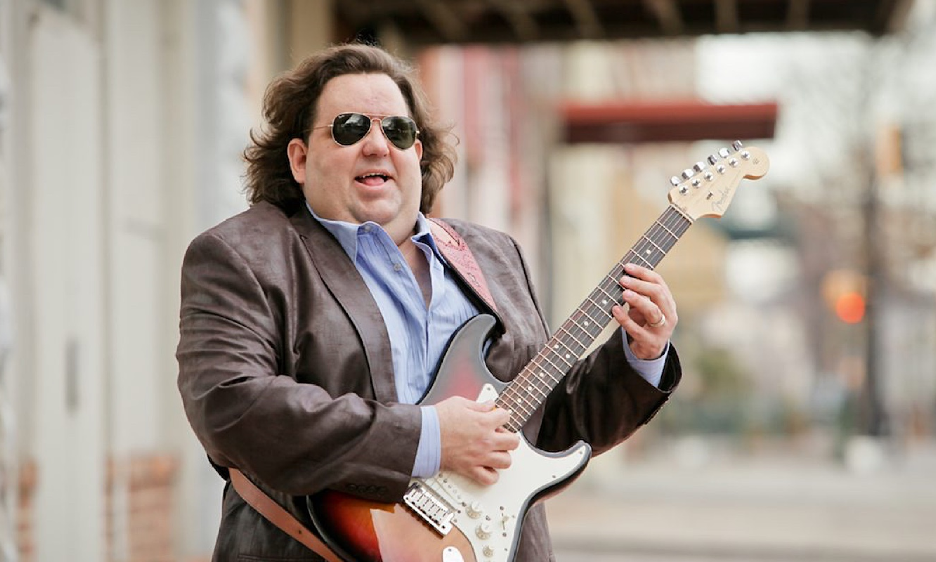
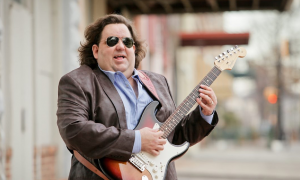
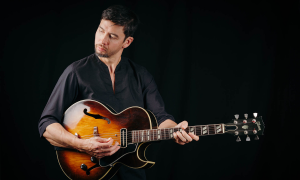
An inspirational, award-winning artist, producer, and podcast host, Joey Stuckey blazed a trail for three decades before his untimely passing last month.
Blind since age two, Stuckey made sound his calling card with Alan Parsons dubbing him, "the best ears in the business." For 30 years at his Shadow Sound Studios, Joey worked with countless musicians, from indie artists to all-time greats like Chuck Leavell (Allman Brothers), Ed Roland (Collective Soul), Mike Mills (R.E.M.), Paul "Mad Dog" McGuinness (The Pogues), and Chris Hicks (Marshall Tucker Band).
From his debut in 1993 to his 2026 King of Strings EP, recorded at the iconic Les Paul Recording Studio in Hollywood, Stuckey was acclaimed for his guitar prowess but also his sense of melody. Live, he shared stages with the likes of James Brown, the B-52s, and Bad Company.
A Music Ambassador for Macon, Georgia, education was at the core of everything he did. From being a Professor of Music Technology at Mercer University to a music technology consultant for Middle Georgia State University to a Dream Ambassador for The Recording Academy to speaking passionately on ADA topics and Accessibility for All, Joey was well-regarded by colleagues and industry professionals.
All About Jazz: What instrument(s) do you play?
Joey Stuckey: At a highly competitive level, I play guitar, bass and vocal. At a low side of adequate level, At a slightly less than adequate level, I play keys and percussion. I am a great drum programmer but I haven't sat down behind the kit in about 20 years.
AAJ: Who are your teachers, mentors and influences?
JS: My first and most profound education in music came from Terry Cantwell. He trained my mind and my ear to replace the advantages of being sighted as I am a blind brain tumor survivor.
Terry even drew the shapes of the notes that the sighted practitioner sees on the page in a box of sand so that I would, at least conceptually, understand what people were looking at and they could describe it to me and I would then know what was on the page. Practically speaking, this isn't a day-to-day way to learn music, but it did help solidify my communication skills with other musicians. I also had a couple of lessons with Stanley Jordan. My other major education came from Alan Parsons. His support and belief in my talent means an awful lot and I'm always thrilled when I remember that he called me "the best ears in the business"—look on my YouTube channel and it's there on video so you don't have to take my word for it LOL. My musical influences range from Johnny Marr to Miles Davis to Pavarotti to Van Morrison and beyond.
AAJ: When did you know you wanted to be a musician?
JS: Most of my early life was taken up with surviving the damage caused by the brain tumor from when I was two years old. Music was always a source of joy and solace but in the early years it was a one-day-at-a-time kind of existence. I discovered the recording sciences first and became obsessed with recording everything. I didn't realize I wanted to communicate using my own music until I was around 17 years old, but from that moment on, I have never had another career. While I've worn a lot of different hats, I've always been in the music business in some capacity.
AAJ: How would you describe your sound and your approach to making music?
JS: Eclectic. I don't think art should ever be forced into a box. It is a powerful human experience to create and to absorb art in its myriad forms. I've always had trouble defining my music and traditionally that has made it somewhat difficult to market. But essentially, I play what interests me. While a lot of my music is blues or rock based, there's just as much jazz in the DNA of my compositions. I enjoy compound time signatures, expanded harmonies and the exploration of consonance versus dissonance. I've used a lot of different terms to try and explain my music in a way that makes it more digestible (i.e., to target my audience) so currently I am calling what I create "Progressive Americana." I do have two exclusively jazz recordings, Mixture and Oceanside, with a third all-jazz record about 60% completed.
AAJ: If you teach, what is your approach or philosophy?
JS: First, we relentlessly train our mind and our body with all the traditional pedagogy, scales to build up our hands, theory and ear training to build our minds. I am a perfectionist who doesn't believe perfection exists, but I value the pursuit of it as that is how you grow. I also want students to give themselves grace while working hard. This is exemplified in my other philosophical conviction—if you're practicing and it sounds good, you aren't practicing, you are performing. When you practice, you're working on something you haven't yet mastered, so, of course, it shouldn't sound that great.
AAJ: What's your best or worst road story?
JS: Two vivid memories here. The first was a hotel in New Mexico. We were on a tight budget and it was not a well-made structure. The floor was slanted but the worst part was that apparently in the room above us there were a number of people practicing gymnastics for the Olympics (LOL) because there was constant jumping, clunking, and thumping at all hours of the day and night. We complained about this on multiple occasions but the situation never improved. On the extreme other end of the spectrum, when I was on tour in Hawaii on the island of Oahu, we stayed at the Kahala Mandarin. We had an amazing suite with a lanai that overlooked the dolphin lagoon. We would enjoy breakfast as the dolphins swam right up to the edge of the lanai to say good morning. The chattiest one's name was Lono. He would often pose for pictures.
AAJ: What is your favorite recording in your discography and why?
JS: That is a tricky question. There are a lot of things that have been captured in a studio that I'm pleased with and for a lot of different reasons. I really love the song "My Sociology" off my first album Take A Walk In The Shadows, where I blend slinky Chicago-style jazz with heavy metal. It entertains me and I used to play it at a lot of my shows just to see how the audience would react. I never thought it would get played on radio but a DJ in one of the markets we were touring through actually played it because he thought it was so interesting. I really think I captured my inner funk/Gino Vannelli on my second album Ironies, Pain, and the Light That Guides on the track "Narrow Minded."
On my jazz EP Oceanside, I am particularly pleased with the title track. I really dig the groove and the melody. On my jazz album Mixture, there are a number of high points, but I think that the opening track, "We'll See," has a lot of nice moments. I've released too many singles to cover here, but I think my In The Shadow of The Sun album, tracked at the famous Sun Studio in Memphis, has a lot to recommend it. It's three guys in a room, recording a complete album in three hours. I continued that type of live, in-studio exploration with my next record, which is just acoustic guitar and vocal, called Live From Macon. It is a mixture of covers and originals that go down well at my solo shows.
Currently, I am really excited about my 2026 EP King of Strings. I was the first artist allowed to record at the Les Paul Recording Studio in Hollywood, CA. We tracked on an 8-channel console with over 100 tubes, initially commissioned in 1957, featuring my friends Dusty Wakeman on bass, David Raven on drums, Tom Camuso as the recording and mix engineer, and Jessica Thompson as mastering engineer. We recorded and mixed the entire thing in 12 hours. It was a live, in-studio album. We also made a mini-documentary of our time there thanks to Szu Wang (Producer/Director), Jack Hackett (Director of Photography/Editor), Greg Furman (Camera Operator), Jay Yowler (Gaffer) and Haley Spence Brown (Production Support). This is some of my finest work to date and a great joy to listen to.
The project's opening track, "Temple in the Wind," I wrote in about 15 minutes. Literally, as I was putting my guitar down to go to bed and stopped working for the day, this song came out. I basically have two speeds—full speed ahead and off. So either I'm creating or I'm asleep. And honestly, I resent having to sleep. "Temple in the Wind" is about that sanctuary in life where no matter what's going on all around you, you're safe in that place. And for me, that place is a person... my lovely wife Jennifer.
AAJ: What do you hope listeners take away from your music?
JS: Community is always my wish with everything I do. Bringing people together through listening has been my goal. Telling someone my story and then listening to theirs is one of the greatest gifts in life. I take joy in everything I do. And since sound is my whole world, I want listeners to take away a sense of the hard work but also the joy of creating the music.
AAJ: What's something people might be surprised to learn about you?
JS: My wife taught me about baseball using Twizzlers, checkers and Gummy Bears. It started my love of baseball and my goal to see a game in every major league park. So far, we've been to 12.
AAJ: What was the first jazz album you bought?
JS: Miles Davis' Kind of Blue.
AAJ: What music are you listening to now?
JS: I am always listening to music, from the time I wake up until I go to bed. Obviously, in the studio, I am working on either my music or music for my clients. Currently, I'm going back through the R.E.M. catalog and listening to Document as well as to Doja Cat and Lady Gaga.
AAJ: What are your desert island picks?
JS: Kind of Blue: Miles Davis; Giant Steps: John Coltrane; Anne-Sophie Mutter: East Meets West; Automatic For the People: REM; The White Album: The Beatles.
AAJ: What would you like to see more of in today's jazz world?
JS: As an educator and someone who loves to work with children and those just starting their musical journey, I would love to see more young people in today's jazz world. Maybe the veterans mentoring the students would be something to strive for.
AAJ: What do you listen for when you listen to music?
JS: Sometimes when I listen to music, I'm just listening as a fan. Sometimes I am listening for the techniques of the musicians and the techniques of the engineers and producers. If I'm listening to music that clients have sent me, I really try to go to either a rehearsal or hopefully a live show to hear what the band or artist really wants to be. Then I try to bring that unique sound out of them in the studio.
AAJ: What have you learned about music that took you a long time to understand?
JS: When the mix transmits the feeling that you intended, you're done. You can mix a track forever and constantly make tiny changes that no one else would probably even notice and then you never finish it.
I've also learned that if I start writing a song and it's not going well, I still finish the song. If I don't, then it's something that's left undone. Even if you don't like the song and have no intention of ever recording it and releasing it, finish it. You may write a lyric or come up with a melody that you can use in another song.
AAJ: What makes you want to play with someone again?
JS: I love playing with other musicians who love their craft and enjoy playing in an ensemble. I love trading solos with great musicians who are giving and enjoy involving everyone in the creation of the music.
AAJ: Is there something about being a working musician that audiences rarely see or understand?
JS: There is always so much that goes on behind the scenes. Sometimes you're sick or sometimes you're exhausted because your schedule is insanely full. Or sometimes there may be times when you or members of the band aren't having the best day—but we always go on and give 110% and we never show the audience any of that.
AAJ: What is your favorite song to whistle or sing in the shower?
JS: The theme song for Winnie the Pooh.
AAJ: What song would you like played at your funeral?
JS: Amazing Grace—the version that I recorded with my good friend and genius percussionist Miguel Castro for a world music album.
AAJ: What do you do by day?
JS: Music. Always music.
AAJ: If you weren't a jazz musician, what would you be?
JS: A music teacher.
AAJ: What's the song or piece of music you wish you could hear again for the first time?
JS: "Giant Steps" by John Coltrane.
 FOLLOW AAJ Staff
and get notified whenever a new article published.
Various staff members.
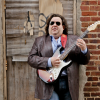
About Joey Stuckey
Tags
PREVIOUS / NEXT
Become a Sustaining Member

Since 1995, All About Jazz has championed jazz as an art form and supported the musicians who create it. Over three decades, it has grown into one of the world's leading jazz resources, serving hundreds of thousands of readers, musicians, presenters and industry professionals each month.
Help Build the Future of All About Jazz
Your support helps us continue building All About Jazz for the next generation—expanding our editorial coverage, preserving jazz history, developing new community features and creating better ways to discover the music and the people behind it.
Become a sustaining member for as little as $20 per year and you'll immediately enjoy an ad-free experience along with access to subscriber features and future articles for a full year.
Together, we're not simply sustaining All About Jazz—we're building its future. Thank you for being part of the journey.