Home » Jazz Articles » Album Review » Sal Mosca: For Lennie Tristano
Sal Mosca: For Lennie Tristano
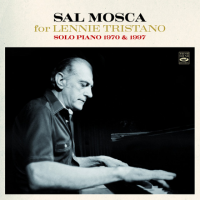
Don Messina produced this Sal Mosca album together with Kathy Mosca. Messina completed a seven-year project to transfer all of Mosca's personal recordings to the Institute of Jazz Studies (Rutgers University, Newark New Jersey). It was in the course of that work that Messina discovered a real-to-reel tape separated from all the other tapes. It was labelled " Solo Tape for Lennie Tristano February 2 1970."
Messina had a dilemma. What was Mosca's intention? Should he release it? The date suggested that the music predated Mosca's first solo release. Messina decided that this was one great pianist paying homage to another great pianist. Messina argued that if Mosca felt that his music was good enough to give to Lennie Tristano, then it should be good enough to share with an audience..
The album notes are extensive and Illuminating. Messina completes the notes by interviewing saxophonist Jimmy Halperin. Halperin studied with Tristano for two years and with Mosca until the mid-90s. Both Messina and Halperin offer important, unique insights into the playing of Mosca.
Part of the appeal of Sal Mosca is his mystery, his integrity and his independence. Throughout his musical life, he rejected recording deals and most of his output was for small labels. He preferred to work at his Mt. Vernon studio, where he played and taught. The attraction of someone with obvious integrity, especially when contrasted with a world where venality is commonplace, appealed.
Technique is important, and Mosca had that in abundance, using his skill to develop Tristano's "stretching out" principles, emphasizing freedom.
Sal Mosca is not an in-your-face improviser. Mosca is a different kind of player, and he asks for a different kind of listening. The intricacy of his playing matches the complexity of his thought. Mosca's playing is marked by linear invention—long, intricate melodic lines. He displayed a remarkably advanced sense of improvisation. Mosca primarily favored popular standards using the simple melody as his guide beneath the abstruse improvising. His work also showed a deep respect for jazz figures like Art Tatum. Mosca's touch was deft, and his lines were admired for their clarity.
"All The Things You Are." The melody is only faintly present but it is there through the rococo variations and the supportive left hand. This is a fine example of the way that Mosca avoids the obvious as he unreeels his ideas. It is a mistake to concentrate on the right hand; his left is just as creative, especially towards the end of the piece as the pressure increases. The fugal nature of the interpretation becomes more obvious with a finale that is almost Bach.
The exquisite variations on "Sweet and Lovely" move into an almost Erroll Garner moment and are increasingly. bluesy, as they dissolve into Debussy fragments. Another example of the range of influences that can be found in Mosca.
Mosca treats the beautiful impressionistic melody of Bix Beiderbecke's "In A Mist" (1927) with reverence before he sets out to gently overlay it, subtly, with a George Gershwin 1920s tinge.
The daring off-kilter improvisation on "Talk of The Town" is beyond Art Tatum, whom Mosca obviously admires. Tatum runs come through. Mosca does things here that Tristano would never have attempted, such as the change of tempo and the movement into almost abstraction.
The whole album is a delight, illustrating the contention of Don Messina: "Nothing is cliche, and nothing is superfluous; the unexpected always happens."
 FOLLOW Jack Kenny
and get notified whenever a new article published.
FOLLOW Jack Kenny
and get notified whenever a new article published.
Jack was turned on to jazz by a mixture of Stan Getz, Lee Konitz and Earl Bostic.
Track Listing
(Medley 1: You Go To My Head; Sweet Georgia Brown; It’s The Talk Of The Town; All The Things You Are; Prelude To A Kiss; Medley 2: Night And Day; These Foolish Things; That Old Feeling; Sweet And Lovely; (2) In A Mist; Stella By Starlight.
Personnel

Sal Mosca
pianoAlbum information
Title: For Lennie Tristano | Year Released: 2025 | Record Label: Fresh Sounds Records
About Sal Mosca
Tags
PREVIOUS / NEXT


Become a Sustaining Member

Since 1995, All About Jazz has championed jazz as an art form and supported the musicians who create it. Over three decades, it has grown into one of the world's leading jazz resources, serving hundreds of thousands of readers, musicians, presenters and industry professionals each month.
Help Build the Future of All About Jazz
Your support helps us continue building All About Jazz for the next generation—expanding our editorial coverage, preserving jazz history, developing new community features and creating better ways to discover the music and the people behind it.
Become a sustaining member for as little as $20 per year and you'll immediately enjoy an ad-free experience along with access to subscriber features and future articles for a full year.
Together, we're not simply sustaining All About Jazz—we're building its future. Thank you for being part of the journey.