Home » Jazz Articles » Festivals Talking » Moers Festival Interviews: Evi Filippou
Moers Festival Interviews: Evi Filippou
Courtesy Hans Walter Kropp

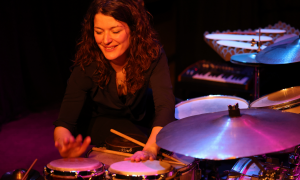
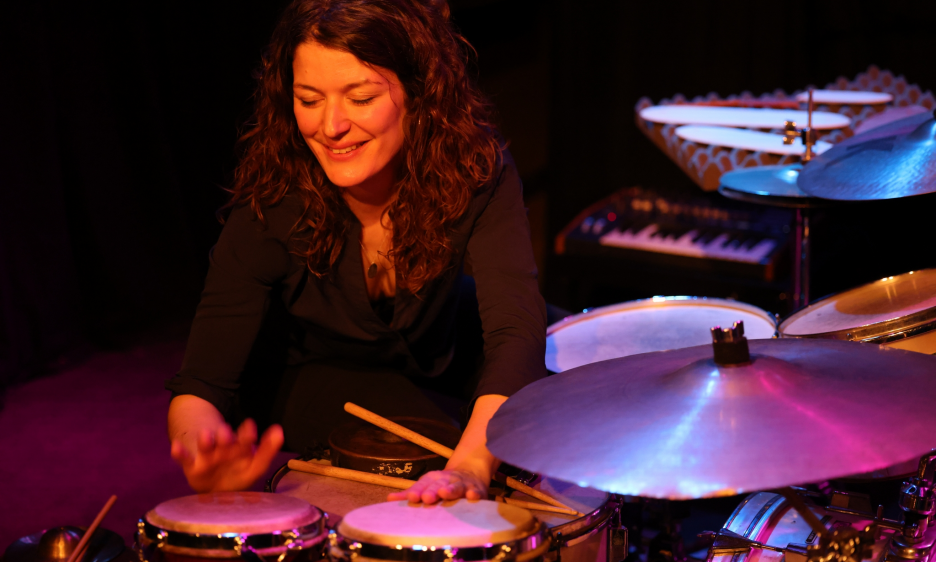
The 2026 improviser is the Greek vibraphonist Evi Filippou , who has long been resident in Berlin. She already has a recent history with the Moers Festival, impressing last year as a member of the expanded Spinifex Maxximus, a mighty crew who mostly revolve around Amsterdam. The regular-sized Spinifex has provided a steady presence at this festival, always bringing their unsteady sonic disruptions. There is also another continuity in place, as the 2025 Improviser In Residence was Bart Maris, the Belgian trumpeter from that band.
These free-core, riff-oid complexity-freaks invited three guests for their 2025 appearance, Filippou also joined by violist Jessica Pavone from New York City and cellist Elisabeth Coudoux from Cologne. Partially, this led to a more regimented, composed aura, cutting back on the manic stutters and crazed soloing, with the Spinifex energies altered, recalibrated towards a new form of tension, beyond the horns-and-guitar duelling.
"I'm having a great time," said Filippou, from her Improviser headquarters. "I left Berlin for the first time in 15 years, so it's kind of an interesting experience." Of course, the sudden switch from Berlin to Moers could be traumatic. "I do come from a small [Greek] town myself, so it's pretty much the same, but the German version. No scene close by, but I love this place, its quietness—until the festival arrives! I'm reading Virginia Woolf's A Room Of One's Own, and it's kind of the vibe here."
Filippou invited Michael Attias, Shannon Barnett and Fabian Dudek, among others, to the first wave of gigs in Moers, which have taken place in haunts from grand churches down to dark bar corners, and of course the Improviser's home base. "I've been here since January, and I'm throwing concerts and listening sessions, and it's this very open, cultural audience," Filippou continued. "They always come to everything, and they're curious; they have questions. They've told me their tales, how they weren't into the music, but they got into it because of the festival. This is a hundred people maybe. It's very cool. They're from different age groups. The younger people found it kind of weird, or not cool enough."
Perhaps these younger folks could benefit from a tutoring in the fundamental natures of cool and uncool. In actuality, hardcore improvised music has lately garnered a more vital, dynamic sense of respect than ever before, probably due to its availability via streaming, allied with a general listener openness to strange extremities, compared to the age-old rut-stuck attitudes of yore.
"Besides that, the people of the city, I like talking to them," Filippou said. "There is definitely the opportunity to make people more interested in this music, and I think maybe it's my weird Greek opinion, but I think it happens because you engage with people, and have personal contact. I feel like I'm trying to do this here, and I'm trying to do it everywhere. I'm constantly asking Why play this music?. The obvious is not obvious. Nobody is talking about Why this music, now?. We all like music, we all like The Beatles, and we all like songs. Why do we choose this? I always say that there's a certain kind of absurdity in life. Everything is inexplicable. We try to control everything, and it's absolutely impossible."
Filippou raises more doubts than certainty, but it must be observed that the instant song-form is allowed within free improvisation, the nature of this beastly freedom can curve from very faint violin up to a speaker-threshing laptop overload. Its antecedents are now at their broadest, having evolved from the traditional jazz core, eventually inviting rock guitaring, cracked folk, modern asceticism, turntablism, and even ambient pedal steel country sliding.
"We try to play as many venues in the city as possible, art galleries, home concerts, even going to nearby Duisburg. You have a free pass to do what you want, basically. I've invited a lot of guests from Berlin, from Cologne, lots of my personal collaborators," Filippou said. "We also have musicians who live around here that I've always wanted to play with, so now it's a good chance to call them. I usually book double bills at the concerts, I like to mix it up a bit, so there is always an experimental band, and then one more, usually easy listening."
Filippou's 2026 album on the Budapest Music Centre label, Love At Last Sight, inhabits a completely different sphere, being a fairly jazzed and melodic duo with the Berlin bassist Robert Lucaciu. They enjoy an intimate dialogue, Filippou placing herself well within the environs of jazz tradition. Your scribe had previously heard her playing in quite extreme free improvising situations, so Filippou's range is clearly very wide, and she has also emerged from a formative spell of classical training in her early years.
Filippou's central gig during the Moers Festival, over May's Whitsun holiday weekend, will involve her Inevitable Extended, which features Lucaciu, guitarist Keisuke Matsuno and drummer Jim Hart amongst its octet roster. Filippou will also appear during saxophonist Jan Klare's improvising Moers Sessions, happening daily, usually at 11:30 a.m.
"My education is classical contemporary, but at the same time I always improvised, and I always wrote music, songs, and instrumentals. You come here for a year, and you have your own ideas about music and art, and then you come, and you see the city has completely different needs," Filippou said. "My wish for the second wave of the residency is to do things that the city needs, perhaps away from the center, to parts where people don't listen to this kind of music, connecting and telling stories, for provoking or shocking. I think that improvised music is a very good tool to have when you don't have money, because it's a beautiful outlet for frustrations. Sometimes, at my home gatherings, there are five people; sometimes, there are 35. It's interesting to keep these things going, to see what's going to come."
About Evi Filippou
Tags
PREVIOUS / NEXT

Evi Filippou Concerts
Become a Sustaining Member

Since 1995, All About Jazz has championed jazz as an art form and supported the musicians who create it. Over three decades, it has grown into one of the world's leading jazz resources, serving hundreds of thousands of readers, musicians, presenters and industry professionals each month.
Help Build the Future of All About Jazz
Your support helps us continue building All About Jazz for the next generation—expanding our editorial coverage, preserving jazz history, developing new community features and creating better ways to discover the music and the people behind it.
Become a sustaining member for as little as $20 per year and you'll immediately enjoy an ad-free experience along with access to subscriber features and future articles for a full year.
Together, we're not simply sustaining All About Jazz—we're building its future. Thank you for being part of the journey.