Home » Jazz Articles » Journey into Jazz » Miles & Trane: Another Jazz Journey
Miles & Trane: Another Jazz Journey
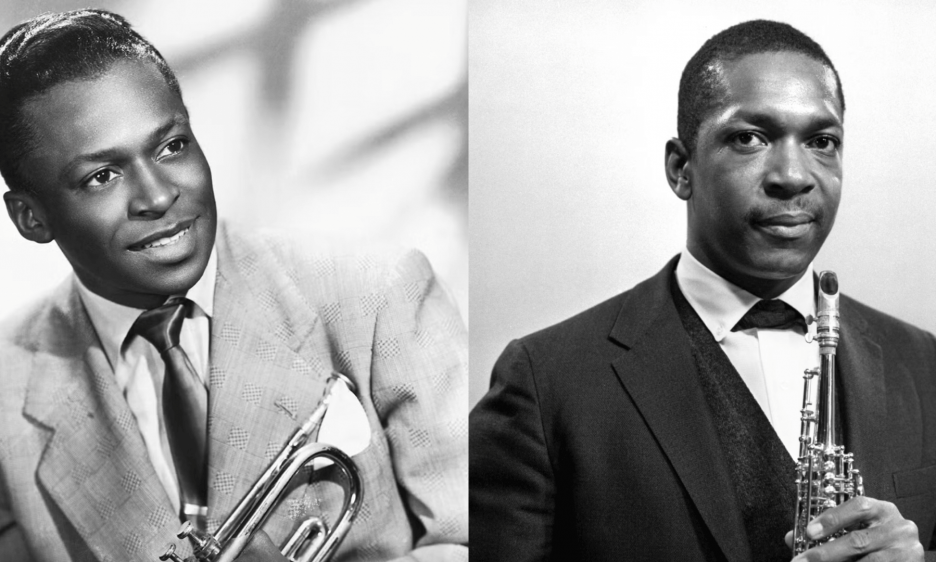
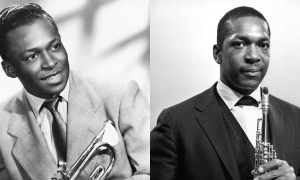
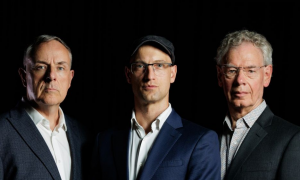
Coltrane was easier to get into initially. And it started with another trio of jazz giants, Stanley Clarke, Chick Corea, and John McLaughlin. On Clarke's album Journey to Love (Nemperor, 1975), he wrote a piece called "Song to John," which was dedicated to Coltrane. It is now considered a classic—I've heard multiple covers of this piece. My partner in crime, Terry M, asked a simple question: Who is "John?" Later, the New York City jazz station, WRVR—106.7 FM, played "Song to John" and mentioned that it was for Coltrane. That is what started my interest. It caught my attention.
In high school, there was a bookstore on 165th Street in Jamaica, New York. In it, I saw a biography titled Chasin' the Trane by J. C. Thomas. I purchased it and read it. What fascinated me were the testimonies of people who saw him in concert and befriended him. That led me to purchase a few of his albums, such as My Favorite Things (Atlantic, 1961), Africa/Brass (Impulse!, 1961), and Giant Steps (Atlantic, 1960). During the Christmas holidays, I played "Greensleeves," arranged by Eric Dolphy. It also led me to McCoy Tyner, but that is for another story.
The album that meant the most to me was A Love Supreme (Impulse!, 1965). It opened the spiritual side of jazz to me. One of my first shows on WUSB-FM—90.1 FM was on A Love Supreme, which was played in its entirety. I listened to it every Sunday with headphones on in my dorm. As a member of the Renegades Band at Trinity Cathedral in Trenton, New Jersey, during our Jazz Eucharist, we chanted "A Love Supreme" before and after playing "Amazing Grace."
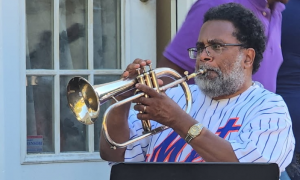
On vacation at Cape May, New Jersey, I went on the boardwalk with my flugelhorn and practiced "Naima"—got a few bucks in the case but not enough to quit my day job.
Getting into Miles Davis was an interesting journey. I heard about a jazz musician playing classical music, specifically Spanish classical music. I heard the whole "Concierto de Aranjuez" on PBS first, then heard Miles play it on Sketches of Spain (Columbia, 1960) with Gil Evans. It really knocked me out. Later, I heard "Milestones" and "So What" on WRVR, and I was hooked.
As a freshman at Stony Brook, I read about Bitches Brew (Columbia, 1970) and was curious what the big fuss was all about. A good friend's Jamaican father said to me, "Lee have you heard Bitches Brew? Miles he done gone crazy. Can't tap your feet to it. Can't dance to it. What good is it?" I found a copy in the Stony Brook music library, and it blew my mind. I picked it up but could not play it in my dorm—my suitemate required me to wear headphones whenever I played it. It was too abstract for him. In retrospect, his reaction probably was similar to when Igor Stravinsky premiered "The Rite of Spring" or when Bob Dylan went electric at Newport.
It still amazes me how many phases of jazz Miles either created or was a major influence on: bebop, cool jazz, hard bop, third stream, modal jazz, avant-garde jazz, jazz fusion, new age, and hip-hop. Even some of his albums like In a Silent Way (Columbia, 1969) and Filles de Kilimanjaro (Columbia, 1969) had the label "Directions in Music by Miles Davis." I loved and appreciated all of his music and its different phases. I played "Right Off" from A Tribute to Jack Johnson (Columbia, 1971), his soundtrack to a Jack Johnson documentary, multiple times on WUSB-FM 90.1. I ended my final show with "Yesternow," with Brock Peters saying, "I'm Jack Johnson. Heavyweight champion of the world. I'm black. They never let me forget it. I'm black all right! I'll never let them forget it!"
When Miles passed away, Public Enemy held a moment of silence on Saturday Night Live before they performed. As I said multiple times on Facebook, there is only one unit of measure of music—Miles.
When I picked up my trumpet, I had to get a Harmon mute to sound like Miles. I still have the horn and mute after over 40 years of playing and practicing. I saw Miles in concert a few times, and it always amazed me. Brenda and I almost met him when he played at the Dr Pepper Music Festival on a pier in New York City after his hiatus—we followed him into a diner after his gig but were escorted out.
Coltrane passed away on July 17, 1967, at 40. Miles left us on September 28, 1991, at 65. At our annual jam session on Labor Day weekend, we celebrated the music of Miles and Coltrane. Several of their CDs were in the CD player in the house, playing in the background. The musicians played "Four" and "All Blues." But that was the tip of the iceberg for two innovative musicians who will always be remembered.
 FOLLOW Lee Whiteman
and get notified whenever a new article published.
Lee was a contributing member of the Washington Township Council of the Arts in New Jersey, the Episcopal Church and the Visual Arts (ECVA), and is a member of the Princeton Photography Club.
Tags
PREVIOUS / NEXT

Become a Sustaining Member

Since 1995, All About Jazz has championed jazz as an art form and supported the musicians who create it. Over three decades, it has grown into one of the world's leading jazz resources, serving hundreds of thousands of readers, musicians, presenters and industry professionals each month.
Help Build the Future of All About Jazz
Your support helps us continue building All About Jazz for the next generation—expanding our editorial coverage, preserving jazz history, developing new community features and creating better ways to discover the music and the people behind it.
Become a sustaining member for as little as $20 per year and you'll immediately enjoy an ad-free experience along with access to subscriber features and future articles for a full year.
Together, we're not simply sustaining All About Jazz—we're building its future. Thank you for being part of the journey.