Home » Jazz Articles » Miles Ahead: A Jazz Road Trip » Part 11: The Jazz Cruise - Boarding
Part 11: The Jazz Cruise - Boarding
Courtesy Billie Eidson
Chapters
1 | 2 | 3 | 4 | 5 | 6 | 7 | 8 | 9 | 10 | 11 | 12 | 13 | 14 | 15 | 16 | 17 | 18A drive from Oregon to Florida, to experience music and living across the USA, and ultimately join a jazz cruise. AKA, a listening practice, unfolding in real time—written on the road, in the spaces between cities and notes.
Day Nineteen
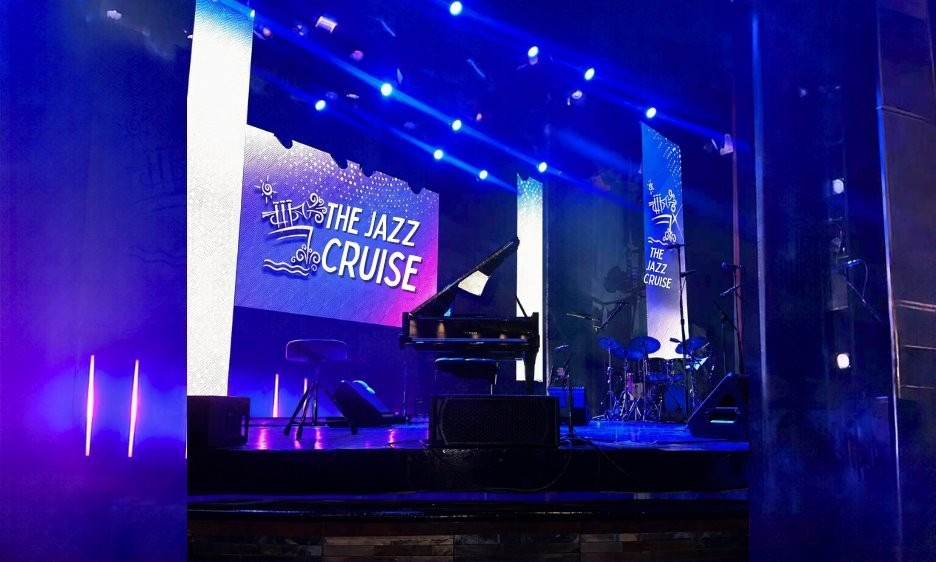
The Jazz Cruise—BoardingThe second I step on board, the pace changes. Not slower. Faster.
Before I even find my cabin, the week is already mapped out. Charts. Sets. Sound checks. Coffee talks. Late-night jams. Three rooms I want to be in at once. Big band upstairs. Trio downstairs. Q&A over coffee. Something that won't end before midnight. Somewhere in there—eat, sleep, move my body, be human.
I stand in the hallway staring at the schedule like it might rearrange itself out of mercy. How am I supposed to be everywhere and still actually listen? Because that's why I'm here. Not to collect moments. To be inside them.
Instrument cases roll past like airport luggage. A bass on a cart. A trumpet tucked under an arm. Music leaks from every doorway. A clarinet warming up. Brushes whispering on a snare. Scales rising and falling. The whole ship sounds like it's tuning. Not performing. Tuning. Like a city clearing its throat.
It hits me—This isn't a vacation. It's immersion. Morning to midnight. Listening as a full-time job. Too much. Exactly enough.
So I stop trying to solve the week. One room at a time. One set at a time. Just show up. Just listen. Let it unfold.
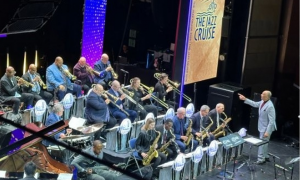
By night, the evening's last big band set fills the theater. John Clayton leads the Clayton-Hamilton Jazz Orchestra, with guests including Kurt Elling and Veronica Swift. Grammy winners standing a few steps away. Playing like it's any other Tuesday. Which somehow makes it land harder. Not presentation. Practice. Loose. Precise. Alive.
John conducts with his whole body—small elbow nudges shaping the brass, shoulders opening to invite the reeds forward, his torso breathing dynamics into existence before a single player responds. It looks less like directing and more like choreography. A physical conversation between intention and sound.
Later, Benny Benack III steps forward. His presence reorganizes the room. Not louder. Clearer. Trumpet in hand, he moves with the band even when he isn't playing—shoulders leaning into the piano's phrasing, knees softening with the drummer's time, his whole body listening. When he sings, the ingenuity feels conversational. Elastic. Unforced. Then the trumpet—focused, buoyant, exact. Between his own entrances, he turns toward the others, smiling openly, affirming their sound with visible delight. Leadership without distance. Joy as structure. The effect travels outward.
Later in the set, he introduces Bria Skonberg. Young. Precise. Fully inside herself. She steps forward with trumpet in hand, voice already present in her posture before a note is released. He doesn't step back to make space. He stays. Not crowding. Not receding. Supporting. His body angled toward her, listening as actively as he had led only moments before.
When she sings, he watches—not to evaluate, but to receive. When she plays, he meets her there—not above, not behind. Alongside. The introduction he offered wasn't ornamental. It was structural. He wasn't presenting her. He was standing with her. Two musicians fluent in the same language, allowing authorship to move freely between them.
What becomes visible in that exchange is something rarer than virtuosity. Trust without hierarchy. Authority without possession. Lineage, continuing itself.
I realize I am watching something I had misunderstood for most of my life. Support is not withdrawal. It is presence without interference. First the band. Then the room. He isn't managing the moment. He's inside it. And in doing so, invites everyone else to follow.
Then something quieter threads through the night. One of the guiding spirits of the event—Ken Peplowski—has just played what will become his final performance. None of us know it yet. No announcement. No marker separating this set from any other. Just another tune. Another solo. Another bow.
Later, John Clayton speaks softly about him. The friendship. The history. Ken wouldn't want us to stop. So we don't. We play. Because sometimes the most loving thing you can do is let the song continue.
Down the hall, the energy shifts again. Smaller room. Lower ceiling. Tables almost touching. Closer to the Village Vanguard than a concert hall.
This is where Jeff Hamilton sets the pocket. Brushes instead of sticks. Conversation instead of volume. At the piano, Tadataka Unno—Tadaki—all air and space. Dynamics. Precision. Touch. On bass, Jon Hamar. No amp. Just wood. Wire. Breath. You can hear everything. The grain of the bass. Fingers on string. The vibration between notes.
Tadaki plays one of his originals. Simple. Unhurried. The room leans in without being asked.
Then Jeff takes a solo. Brush on brass. Cymbal shimmer. Wire on skin. Nothing flashy. Just time passing through his hands. The sticks barely rise, barely fall. Everything essential. Nothing extra.
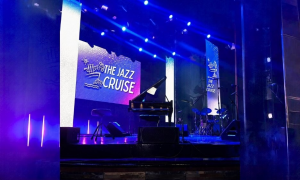
Upstairs, a full orchestra. Downstairs, a room barely bigger than a living room. Music everywhere.
I notice something settle in me. I'm not chasing sets anymore. Not measuring. Not behind. Just here.
For the first time, I stop trying to locate myself within the hierarchy of the room. Listening becomes sufficient orientation. Not knowing exactly where I fit no longer feels like a problem.
Miles ahead.
To Be Continued / See Chapter List At Top
 FOLLOW Billie Eidson
and get notified whenever a new article published.
Portland-based jazz vocalist and 25-year trial attorney completing her memoir, Miles Ahead: A Jazz Road Trip.
About Billie Eidson

Tags
PREVIOUS / NEXT

Billie Eidson Concerts
Become a Sustaining Member

Since 1995, All About Jazz has championed jazz as an art form and supported the musicians who create it. Over three decades, it has grown into one of the world's leading jazz resources, serving hundreds of thousands of readers, musicians, presenters and industry professionals each month.
Help Build the Future of All About Jazz
Your support helps us continue building All About Jazz for the next generation—expanding our editorial coverage, preserving jazz history, developing new community features and creating better ways to discover the music and the people behind it.
Become a sustaining member for as little as $20 per year and you'll immediately enjoy an ad-free experience along with access to subscriber features and future articles for a full year.
Together, we're not simply sustaining All About Jazz—we're building its future. Thank you for being part of the journey.