Home » Jazz Articles » Album Review » Thelonious Monk: Live In Paris 1967 Volume One
Thelonious Monk: Live In Paris 1967 Volume One
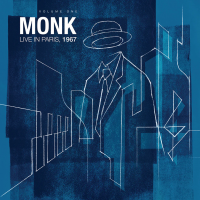
Though the sparse liner notes do not indicate it, the album comes from a pristine archival tape reel recorded at the Salle Pleyel on November 3, 1967. Following a brief introductory announcement in French, the band lays into "Epistrophy," a 32-bar masterpiece of rhythmic syncopation and melodic discontinuity. Most jazz listeners have heard the tune many times, but not quite like this. Following the theme statement by the full band, tenor man Johnny Griffin unfolds a typically muscular and harmonically sophisticated solo, beautifully punctuated by drummer Ben Riley and occasional piano stabs from the leader himself. As Ray Copeland steps up to the microphone, Monk comes back in, commenting continually on the trumpeter's more lyrical solo before taking his own, which features his trademark trills, rhythmic bending of the theme and dissonant interjections. The excitement builds as the horn section blasts through the theme over Riley's swinging drums to take the tune out.
With nary a pause, Monk begins what will be a 15-minute rendition of "Evidence." This time, it is Monk's longtime right-hand man, Charlie Rouse, who takes pride of solo place. Rouse's inimitable sound, featuring upward bluesy swoops and slurs, is a perfect fit for Monk's unique tunes, and by this point he sounds completely at home. Copeland solos briefly again, followed by alto saxophonist Phil Woods, whose swinging, high-energy solo is punctuated by interjections from the horn section with trombonist Jimmy Cleveland to the fore, ably supported by Larry Gales's walking bass. Gales gets his own brief chance to solo after Monk, before Riley lets loose with a rousing drum fusillade before the horns come back in to take the tune out. "Evidence" is so swinging and exciting that a quarter-hour goes by in a flash.
The proceedings calm down a bit for Monk's ballad "Ruby My Dear," featuring just the core quartet. It is beautiful as always, with Rouse's sensitive playing weaving in and out of Monk's rhythmic piano architecture. With a 14-minute "We See," though, the album ends in high gear again. Rouse rips off a fluid solo, which nevertheless is immediately outdone by Copeland, who begins with fragmentary interjections before building up to a constant stream of high-octane melodic invention around the harmonic structure. Monk follows with his best solo of the set, avoiding mannerisms to spin out a series of playful variations on the theme before giving Gales another chance to shine, Riley moving to the brushes to provide quiet but firm swinging support. The drummer stays on brushes for his own excellent solo, after which Rouse and Copeland come back in with another short set of exciting solos as Riley moves back on the sticks for a closing restatement of the head.
Beautifully recorded, this fascinating addition to Monk's musical story will be self-recommending for fans. With Volume Two of the concert due out in October 2026—which will feature tracks that complete the nonet with trumpet legend Clark Terry—there is thankfully already more to look forward to from Rhythm-A-Ning Enterprises. Live In Paris 1967 Volume One is an important step forward for the Monk Estate as it reclaims ownership of one of the most important legacies in the history of jazz.
 FOLLOW Joshua Weiner
and get notified whenever a new article published.
FOLLOW Joshua Weiner
and get notified whenever a new article published.
Joshua Weiner enjoys his day job as a professor and dean but wishes it left more time for music.
Track Listing
Artist Introduction; Epistrophy; Evidence; Ruby My Dear; We See
Personnel

Thelonious Monk
piano
Charlie Rouse
saxophone, tenor
Larry Gales
bass
Ben Riley
drumsRay Copeland
trumpet
Phil Woods
saxophone, alto
Johnny Griffin
saxophone, tenor
Jimmy Cleveland
tromboneAlbum information
Title: Live In Paris 1967 Volume One | Year Released: 2026 | Record Label: Rhythm-A-Ning Enterprises
About Thelonious Monk
Tags
PREVIOUS / NEXT

Become a Sustaining Member

Since 1995, All About Jazz has championed jazz as an art form and supported the musicians who create it. Over three decades, it has grown into one of the world's leading jazz resources, serving hundreds of thousands of readers, musicians, presenters and industry professionals each month.
Help Build the Future of All About Jazz
Your support helps us continue building All About Jazz for the next generation—expanding our editorial coverage, preserving jazz history, developing new community features and creating better ways to discover the music and the people behind it.
Become a sustaining member for as little as $20 per year and you'll immediately enjoy an ad-free experience along with access to subscriber features and future articles for a full year.
Together, we're not simply sustaining All About Jazz—we're building its future. Thank you for being part of the journey.