Home » Jazz Articles » Live Review » Kenny Garrett at Dazzle
Kenny Garrett at Dazzle
Dazzle
Denver
July 25, 2008
Kenny Garrett is restless. Over his 20 or so year career, he's explored a good piece of the jazz territory. Consequently, a Kenny Garrett concert is a little like a random parachute jump; you could land just about anywhere. Friday night at Dazzle, Garrett traveled through the terrain of fusion, funk and a little space jazz. Those hoping for some bebop didn't necessarily go home happy. On the other hand, those willing to follow Garrett into the land beyond bebop had some groovalicous fun.
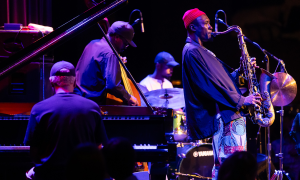
It was obvious right from the start that the Garrett and his band wouldn't be playing a typical straight ahead set. Garrett, known for his alto and soprano sax playing didn't even start the evening on reeds, but rather on keyboard synthesizer. That was even more surprising considering the band included Jeff Motley on Hammond B-3 and additional keyboards. After some spacey noodling, the rhythm section hit a one chord groove and Garrett put his alto to his lips which he played simultaneously with the keyboard. Eventually he turned his attention completely to the alto, running it through a synthesizer which yielded a harmonic sound, as if two saxophones were playing in unison.
The one chord groove turned out to be a theme for the set. A couple of the unnamed tunes had more traditional chord progressions, but the band devoted the majority of its time to extended jams. One of the longer tunes of the set started with Garrett playing a Rhodes electric piano. The band backed him with an understated but persistent rhythm which together sounded a little like the early 70s British band Soft Machine. Garrett eventually switched to his alto and the intensity increased. By this time, bassist Kwanee Kasue was deep into a trance-like groove. Motley on the B-3, was layering on some spacey chords borrowed directly from 1970s progressive rock. Meanwhile, in stark contrast, drummer Justin Brown and Garrett were simultaneously and intensively soloing. The effect was at once hypnotic and dramatic.
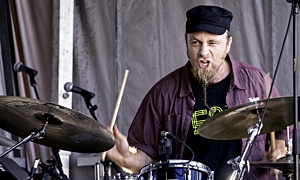
Brown evoked Who drummer Keith Moon, not only with his manic and constant runs across the entire drum kit, but also because of his destruction of his own instrument. The difference was that Brown didn't intend to smash the drums, it was simply a side effect of his exuberance. At one point, he knocked over a floor tom, but, fortuitously Garrett was standing right in front of it and he righted the falling drum. A few minutes later Brown broke his kick drum pedal necessitating a mid song repair job by a roadie. Not surprisingly, Brown's drumsticks did not all survive the set in one piece. The next tune was again anchored by a one chord groove, only this one was funky, channeling James Brown from his heyday. Garrett's alto substituted for James Brown's manic vocals. The band didn't stay exclusively with the one chord groove motif, but threw in a couple ballads, including a tender closer with Garrett switching to soprano.
Motley rarely soloed, instead he provided a swirling synthesizer backdrop or a chunky supplemental foundation (along with the bass) on the classic B-3 running through a Leslie. Kasue, of course, being the bassist, was the primary mason constructing the solid foundation, but not stepping up for a solo. Brown, on drums, simply soloed a good bit of the time the entire ensemble was playing. This left the spotlight (mainly) on Garrett whose solos ranged from way out there to quoting Frere Jacques with stops at most points in between.
Garrett spent several years in Miles Davis' band toward the end of the latter's life. The influence of the late 60s/early 70s electric period was apparent throughout much of the evening. Garrett has adopted some of his prior employer's old habits such as spending a good percentage of his time playing with his back to the audience. On the other hand, unlike Davis, Garrett was generous in repeatedly introducing his band mates.
In one of the loudest shows at Dazzle in recent times, the jazz purists may not have had much fun, but for those with a taste for a little electricity, Garrett provided the spark.
 FOLLOW Geoff Anderson
and get notified whenever a new article published.
FOLLOW Geoff Anderson
and get notified whenever a new article published.
Geoff Anderson digs jazz in the Denver area and is a DJ Tuesday nights from 8 to 10 MT playing jazz and every other Saturday from 4 to 6 playing blues on KUVO; kuvo.org.
About Kenny Garrett

Tags
PREVIOUS / NEXT
Kenny Garrett Concerts
Become a Sustaining Member

Since 1995, All About Jazz has championed jazz as an art form and supported the musicians who create it. Over three decades, it has grown into one of the world's leading jazz resources, serving hundreds of thousands of readers, musicians, presenters and industry professionals each month.
Help Build the Future of All About Jazz
Your support helps us continue building All About Jazz for the next generation—expanding our editorial coverage, preserving jazz history, developing new community features and creating better ways to discover the music and the people behind it.
Become a sustaining member for as little as $20 per year and you'll immediately enjoy an ad-free experience along with access to subscriber features and future articles for a full year.
Together, we're not simply sustaining All About Jazz—we're building its future. Thank you for being part of the journey.