Home » Jazz Articles » Live Review » Jazz Without Borders: The France–Balkans Network Confere...
Jazz Without Borders: The France–Balkans Network Conference in Dijon, France
Dijon Conservatory & Cour de Bar at the Palace of the Dukes
Dijon, France (Burgundian capital)
May 14-15, 2026
Arrival: From Skopje to Burgundy
The distance separating North Macedonia from the historical heart of Burgundy cannot be measured by the mere mechanics of flight hours or transit connections. It represents, more fundamentally, a profound shift in landscape, a deliberate recalibration of cultural registers, and, ultimately, the illuminating discovery of an unexpected geopolitical and artistic common ground. Traveling from Skopje alongside the members of the Sašo Popovski Trio—guitarist Popovski, bassist Ivan Bejkov, and drummer Alek Sekulovski—together with Emilija Sarafska, an official at the municipality of Bitola and a moderator at the panels at the conference, this journey to the culmination of the Jazz France-Balkans Network project unfolded across several distinct intellectual layers. It was simultaneously an immersive cultural travelogue, an analytical conference dispatch, and a series of rigorous live performance critiques.The physical itinerary traced a jagged, demanding line across the contemporary European map. A flight to Vienna was followed by a connection to Geneva, which then gave way to a long drive in a rented van across the Swiss frontier into the rolling expanses of eastern France. As the dramatic alpine peaks gradually flattened into an undulating countryside, a curious moment of psychological alignment occurred through the rain-streaked glass. The landscape slipping past the vehicle looked, for a fleeting moment, unmistakably like the topography of western Macedonia: the same dense, ancient forestry, the same abrupt and commanding hills, and those characteristic, tucked-away valleys that appear entirely insulated from the rapid march of the current decade.
By the time the van arrived in Dijon after three hours of navigation, the evening sky had dissolved into a steady, unyielding rain. Yet the logistical fatigue mattered little; the traveling party operated on a collective momentum sustained by coffee, accumulated jet lag, and that singular, heightened alertness that invariably precedes an ambitious cultural undertaking. Word of an active jam session already underway in the historic city center immediately drew the arriving cohort straight into the urban core.
A City Carved in Stone: Dijon After Dark
First Night: The Jam at Ducks
The true, visceral introduction to Dijon manifested within the confines of Ducks, an atmospheric local enclave nestled deeply within the architectural grid of the old city. Inside, the damp chill of the French night was instantly forgotten, replaced by the dense, localized warmth of a packed room, the rich aromas of a traditional kitchen, and the unmistakable, magnetic pull of an improvisational groove already in motion on the stand. Here, music students originating from both France and the Balkan states—active participants in the network's localized workshop initiatives—were collaboratively navigating jazz standards.Guitarists, saxophonists, and drummers communicated through precise eye contact, subtle nods of the head, and shared micro-rhythms, demonstrating a profound lack of need for a common spoken language when the foundational syntax of the music is fully understood. Observing these nascent professionals find an authentic, collective footing over dinner served as an ideal ideological framing for the entirety of the proceedings that were to follow.
Stepping back out onto the slick, rain-wet streets, the nocturnal atmosphere invited an extended, contemplative walk. Moving through central Dijon after dark forces an encounter with several distinct centuries simultaneously. Long before the city's name became a global shorthand for commercial mustard or the celebrated viticulture of Burgundy, this settlement existed as Divio—a strategic Roman garrison town positioned deliberately on the lucrative trade routes crossing eastern Gaul.
The metropolis encountered its true historical apex, however, during the fourteenth and fifteenth centuries under the Valois Dukes of Burgundy. During this golden age, Dijon operated not as a mere provincial outpost of the French crown but as the sovereign capital of a staggeringly wealthy, politically assertive, and autonomous state structure. Under the successive reigns of four iconic dukes—Philip the Bold, John the Fearless, Philip the Good, and Charles the Bold—the Burgundian court actively attracted the finest architects, master sculptors such as Claus Sluter, and the preeminent polyphonic musicians of the era. The contemporary city still bears the weight and grandeur of that massive cultural investment deep within its architectural bones.
One reads this heritage clearly in the structural vernacular. The monumental Palace of the Dukes (Palais des Ducs) serves as the anchor for the urban center: a medieval fortress subject to centuries of sophisticated reconstruction. Its formidable Tour Philippe le Bon survives as a testament to the Valois period, while its sweeping classical facade, appended in the late seventeenth century by Jules Hardouin-Mansart—the master architect responsible for Versailles—symbolizes the definitive historical handover from an independent ducal seat to a grand piece of French royal property.
A few avenues deeper, the Church of Notre-Dame stands as a radical departure from the familiar tropes of regional Gothic architecture. Its stunning facade is stacked in rigorous horizontal rows of meticulously carved gargoyles, aligned with a precision that feels almost mechanical in its execution. On the building's northern wall, the iconic Chouette—a small stone owl worn smooth and polished by generations of passing hands—remains a focal point of local lore, said to grant a wish if touched traditionally with the left hand.
Turning sharply onto the Rue de la Chouette or the Rue Verrerie, the imposing stone gives way to remarkably preserved half-timbered colombage residences dating from the fifteenth and sixteenth centuries. Their upper floors jut precariously out over the narrow thoroughfares, their heavy structural beams carved with small, enigmatic figures—offering a vivid historical snapshot of the affluent merchant class that directly financed Dijon's meteoric historical rise. The municipality has defended its historic core against the corrosive influence of generic modern redevelopment with an admirable, stubborn persistence. It is a city that requires a measure of patience before it truly unveils itself to the outsider, but it rewards that patience with intellectual depth.
The Conference: Synchronizing Rhythms
On May 14 and 15, the analytical focus of the trip shifted decisively from the city's ancient scenery to the cultural actors attempting to build sustainable infrastructure within it. The occasion marked the crucial closing summit of the Jazz France-Balkans Network (Réseau Jazz France Balkans), an institutional project originally conceptualized and launched in 2019 with critical backing from the French Ministry for Europe and Foreign Affairs. Rather than operating through the often detached, bureaucratic channels of state embassies and regional cultural attachés, this network functions as a direct, pragmatic conduit connecting municipal administrations, conservatory music schools, and active working musicians across a highly specific geography of urban centers: Dijon and Chambéry within France; Bitola within North Macedonia; Tirana and Korçë within Albania; Podgorica within Montenegro; and Niš within Serbia.Following a series of foundational meetings previously staged in Chambéry, Tirana, Podgorica's annual JAM Festival, and the historic Nišville Jazz Festival, the 2026 Dijon gathering served as a vital stress test for Phase II of the initiative. The core inquiry questioned what concrete artistic realities occur when highly disparate regional music scenes attempt to achieve genuine systemic and aesthetic synchronization. The intensive two-day conference migrated between two vastly different spatial environments: the highly formal, historic Salle de l'Ancien Conseil situated inside City Hall, and the modern, functional architecture of the Auditorium OIV on Rue Monge. What set the tone immediately and definitively for these debates was the refreshing absence of typical conference-circuit self-congratulation; participants displayed an institutional willingness to candidly articulate exactly what mechanisms were failing to perform.
The opening panel presentation, chaired with precision by Bertrand Fort (Director of International Relations for the City of Dijon), brought together the esteemed historian Anne Legrand, Couleur Jazz Radio director Jacques Pauper, and Saša Miljković (Honorary Consul of France in Niš). The panel aggressively pushed back against the simplistic, soft-cultural claim that music inherently unifies disparate populations in ways that formal politics cannot. Utilizing Cold War-era state jazz exchanges as a rigorous historical case study, the speakers questioned whether that idealized, cross-border diplomatic function remains a tangible reality today, or if it has merely devolved into a comforting narrative the contemporary cultural sector repeats to justify its own existence. While the panel bypassed clean, reductive conclusions, a unanimous consensus emerged: when creative improvisers from nations burdened by a complex, difficult shared history share a stage, the profound act of listening required by real-time musical improvisation ceases to be a metaphor and becomes a literal act of socio-political coexistence.
This provocative thematic thread led directly into a media-centric roundtable discussion moderated by Pauper, in which this writer participated alongside the prominent Serbian academic Danica Popović and the astute Dutch communications specialist Arlette Hovinga. The session took its initial cue from keynote speaker Andrew Read's blunt, foundational observation that no music scene can hope to survive without a functioning, rigorous critical culture surrounding it. From that starting point, the conversation zeroed in on the massive amount of media real estate that has been systematically lost—within traditional print newspapers, public radio broadcasting, and the broader contemporary media landscape—for analytical writing that treats jazz with serious aesthetic dignity on its own terms.
The dialogue criticized how modern algorithmic platforms consistently reward broad digital reach and sheer speed over critical depth. The working conclusion formulated by the panel suggested that those critics and broadcasters who continue to produce high-level work have largely abandoned the exhausting chase for algorithmic scale, choosing instead to cultivate direct, sustained, and intellectually honest relationships with a dedicated audience. The structural realities of media consumption have fundamentally shifted, and the critical writing corps must adapt its methodologies accordingly.
The pedagogical session, moderated with insight by Emilija Sarafska, delved into the permanent philosophical contradiction lying at the core of formalized jazz education: how does an institution effectively teach an artistic discipline that is, at its historical and systemic foundation, designed to resist the explicitly taught? Panelists Gentian Rushi (University of Arts, Tirana), Bertrand Furic (APEJS Chambéry), Benoît Lallemand (Jazz'On Dijon), and Read returned repeatedly in their remarks to the professional cliff edge that awaits young artists immediately following graduation—that precise point where institutional conservatory support drops away entirely and no professional framework has been constructed to take its place. The broad agreement reached highlighted that while modern training programs perform their educational duties admirably, their utility is severely limited if the municipalities surrounding them fail to build the independent venues, cultivate the local audiences, and sustain the professional networks that afford young players a viable environment in which to practice their craft.
A subsequent panel addressed the stark, systemic gender disparity that continues to characterize jazz infrastructure across both Western Europe and the Balkan peninsula. The discourse revealed the troubling reality that certain prominent regional big bands still feature entirely male lineups, revealing that mere administrative good intentions and occasional token visibility are wholly insufficient metrics for real progress. Led by Maja Popović (Jazz Art, Podgorica) and featuring valuable insights from Dr. Jasna Jovićević, Dr. Iva Nenić, and Read, the panel made it clear that institutional equity requires sustained, structurally integrated policy changes rather than periodic performative gestures.
The Concert: Cour de Bar, May 15
The France Balkans Jazz Band
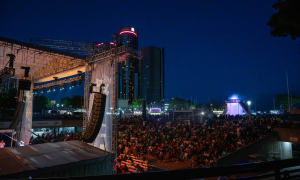
Whatever theoretical parameters the conference sessions succeeded in establishing on paper, the definitive test of the initiative's validity occurred on the evening of May 15 within the historic courtyard of the Cour de Bar at the Palace of the Dukes. Staged as a featured presentation of the D'Jazz dans la Ville festival—engineered by MediaMusic Dijon—the event was confronted by a sharp, unseasonably biting cold of 8°C that had settled over the open-air stone quadrangle. Despite the hostile weather, a dedicated audience filled the space to capacity.The opening performance frame belonged to the France Balkans Jazz Band, a specialized student ensemble assembled from premier music conservatories across all six participating network municipalities. The group had been forged through a mere three days of intensive, immersive rehearsal sessions at the Jean-Philippe Rameau Regional Conservatory under the co-direction of Gentian Rushi and Julien Vuillaume. The international lineup featured Elsa Donon on saxophone and Gabriel Zanlonghi on trumpet representing France; Iris Sula on flute and vocals representing Albania; Mina Stojanović on keyboards representing Serbia; Tezan Hayrettin on guitar representing North Macedonia; Nikolina Strugar on double bass representing Montenegro; and Johrim Triomphe on drums representing France.
The primary element that commanded immediate critical attention was not merely the sonic output, but the progressive demographic composition of the ensemble itself. That five of the seven performing musicians were women stood as a refreshing testament to the project's actualized socio-artistic priorities, contrasting sharply with the lip-service often paid to diversity elsewhere in the industry.
Aesthetically, the performance suite covered a remarkably diverse stylistic territory. Sophisticated modal jazz standards, including a highly confident, texturally mature reading of Miles Davis's seminal "Milestones," were programmed alongside compelling original works penned by contemporary composers from Montenegro, North Macedonia, and Albania. Sula delivered a commanding, highly charismatic front-line performance; her fluid flute lines and assured vocal delivery lent a striking melodic clarity to the arrangements, floating effortlessly above the deeply grounded, rhythmically propulsive engine room maintained by Strugar's double bass and Triomphe's drums.
Hayrettin demonstrated an articulate, unhurried improvisational maturity on the guitar, trading clean, insightful solo statements with Donon and Zanlonghi in a front-line horn configuration that pushed and pulled dynamically without any single voice attempting to dominate the collective texture. Stojanović anchored the harmonic center with great stability. The entire set crackled with an authentic communicative energy that stemmed not from clinical academic polish, but from a group of young artists who had spent three days truly learning to listen to one another. After forty-eight hours of abstract academic debate regarding what international jazz exchange might theoretically achieve, it was a profound relief to hear those ideals made audible. As the performance advanced into the night, their collective execution grew steadily sharper, and their shared artistic confidence expanded visibly.
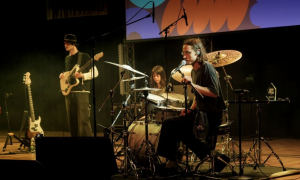
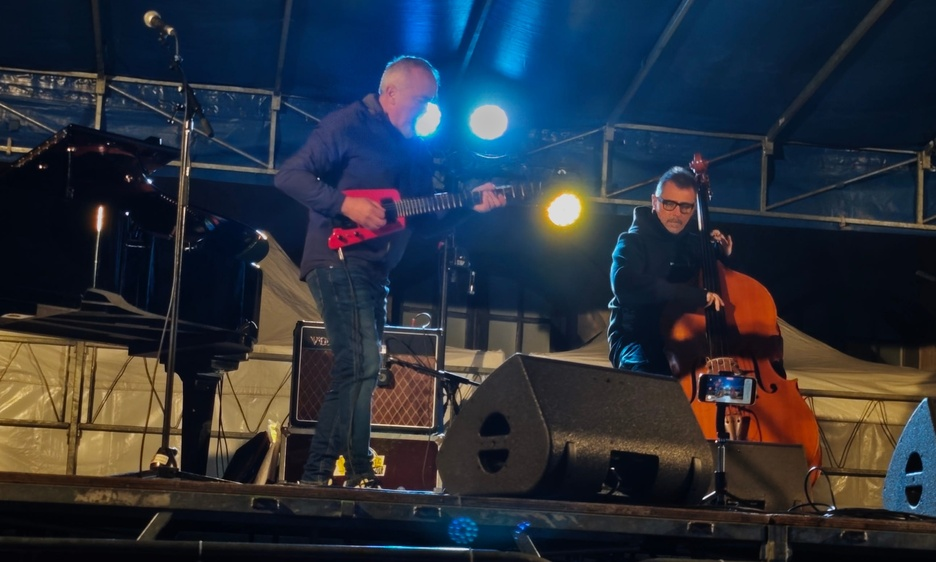
The Sašo Popovski Trio
As the nocturnal chill deepened, the stage was cleared for the evening's main presentation featuring the Saso Popovski Trio, a highly polished professional unit featuring Popovski on guitar, Ivan Bejkov on double bass, and Alek Sekulovski on drums. The trio initiated their performance with the distinct brand of focus, narrative economy, and aesthetic ease that belongs exclusively to an ensemble possessing an ironclad understanding of its own identity. This is a mature, professional outfit consisting of seasoned improvisers and composers who have worked together extensively; consequently, the music carried an inherent weight without ever appearing to strain for it. The material presented was structurally complex enough to thoroughly command intellectual attention, yet remained beautifully open, feeling like a spontaneous phenomenon occurring in real-time rather than a rehearsed reproduction.Set against a stark backdrop of eight-century-old stone architecture, at the conclusion of a weekend spent debating the pragmatic limitations of the art form, this performance stood as the absolute, definitive justification for the genre's continuation. They initiated their set with "Kom Dipsan," a composition built upon a loose, subtly rock-inflected shuffle. Popovski's guitar lines charted an independent, searching course above the rhythm section until the precise thematic juncture where the entire trio locked into a unified groove—an effect less akin to a traditional song beginning and more representative of a dense fog suddenly lifting to reveal a sharp vista. This specific sense of structural cohesion, earned organically rather than imposed synthetically, characterized the entirety of their stage time.
The trio discovered its emotional center with the performance of "Poem for Teo." Here, Sekulovski drove the narrative trajectory forward utilizing highly angular, asymmetric rhythms that paradoxically left vast amounts of breathing space in the air. Popovski interrogated the central melodic line as though carefully tracing a complex philosophical thought rather than merely stating a musical theme, while Bejkov provided a powerful, highly resonant anchor that grounded every microtonal exploration happening above him.
"Night in the Desert" emerged as the most arresting sonic landscape of the evening. The composition featured modal melodies circling with a distinct North African tonal quality, during which Sekulovski subtly transitioned from traditional drumsticks to utilizing his bare hands directly upon the snare drum skin. This delicate shift thinned the acoustic texture down to a whisper before systematically rebuilding it from the ground up—the precise type of masterclass moment that reminds an audience of exactly how much dynamic space an elite drummer commands.
The trio brought their set to a close with "We Have Met"—a title that, given the specific institutional context of the weekend, carried significant symbolic weight. For forty-five uninterrupted minutes, the trio had gathered fragmented musical ideas that began in total isolation and wove them into a singular, highly coherent narrative tapestry without ever exposing the structural seams. There was no trace of genre anxiety, and no descent into empty technical grandstanding. It was simply three master musicians who possessed a highly specific aesthetic destination and understood precisely how to arrive there together.
The Long Way Home
Reflecting upon the experience from an analytical distance, those intensive days spent in Dijon represented an exceptional cultural milestone. The trip offered a vital forum to engage with an international cohort of peers, exchange structural methodologies, and witness firsthand the precise alignment of passionate grassroots organizations and robust institutional backing that grants European jazz its genuine systemic force. The experience served as an essential reminder that creative music does not generate itself within a vacuum; it requires an army of dedicated, culturally literate actors operating tirelessly behind the scenes to build and maintain these fragile cross-border bridges.The return journey to Skopje proved to be an extension of the trip's overarching spirit of regional exploration, transforming into an architectural and geographic adventure of its own. The traveling party elected to navigate the contemporary European rail network, the securement of transit requiring two distinct train connections: initially journeying from Dijon to the industrial hub of Lyon, and subsequently catching a trans-national connection from Lyon across the Swiss border into Geneva. This overland methodology provided a far superior vantage point for absorbing the topographic reality of France than the closed environment of the rental van had offered during the inbound trip.
Sitting by the train window with the rare luxury of unstructured time, the expansive French countryside finally obtained the spatial room required to register deeply on the senses: vast tracts of agricultural farmland, dense patches of ancient forest, historic villages centered around pointed church spires, and hills that gradually flattened as the train rolled south toward the Rhône valley. Three days prior, this identical landscape had flickered past the vision too rapidly to be integrated; this time, it left a permanent impression.
A scheduled layover in Geneva granted the travelers a few hours between rail connections, providing an ideal temporal window to experience the Swiss city. Geneva revealed itself as a highly accessible, surprisingly tranquil urban environment characterized by clean, orderly avenues, intuitive urban planning, and an atmosphere entirely devoid of aggressive self-assertion. After depositing their luggage at the central station, the group walked directly toward the shoreline of Lac Léman.
The lake presented a scene of natural beauty that is remarkably difficult to overstate: wide, perfectly calm, and radiating a deep, crystalline blue-green hue. The distant shore remained just visible on the horizon, framed majestically by the massive silhouette of the Alps sitting silently behind the entire panorama. After four consecutive days defined by dense conference debates, freezing outdoor concerts, and exhausting transcontinental travel, sitting quietly by that vast expanse of water provided the exact measure of psychological equilibrium required to bring the project to its close.
 FOLLOW Nenad Georgievski
and get notified whenever a new article published.
FOLLOW Nenad Georgievski
and get notified whenever a new article published.
For as long I can remember music has been a focal point in my life.
Tags
PREVIOUS / NEXT


Become a Sustaining Member

Since 1995, All About Jazz has championed jazz as an art form and supported the musicians who create it. Over three decades, it has grown into one of the world's leading jazz resources, serving hundreds of thousands of readers, musicians, presenters and industry professionals each month.
Help Build the Future of All About Jazz
Your support helps us continue building All About Jazz for the next generation—expanding our editorial coverage, preserving jazz history, developing new community features and creating better ways to discover the music and the people behind it.
Become a sustaining member for as little as $20 per year and you'll immediately enjoy an ad-free experience along with access to subscriber features and future articles for a full year.
Together, we're not simply sustaining All About Jazz—we're building its future. Thank you for being part of the journey.