Home » Jazz Articles » Book Review » Jazz for Dummies, 2nd Edition
Jazz for Dummies, 2nd Edition

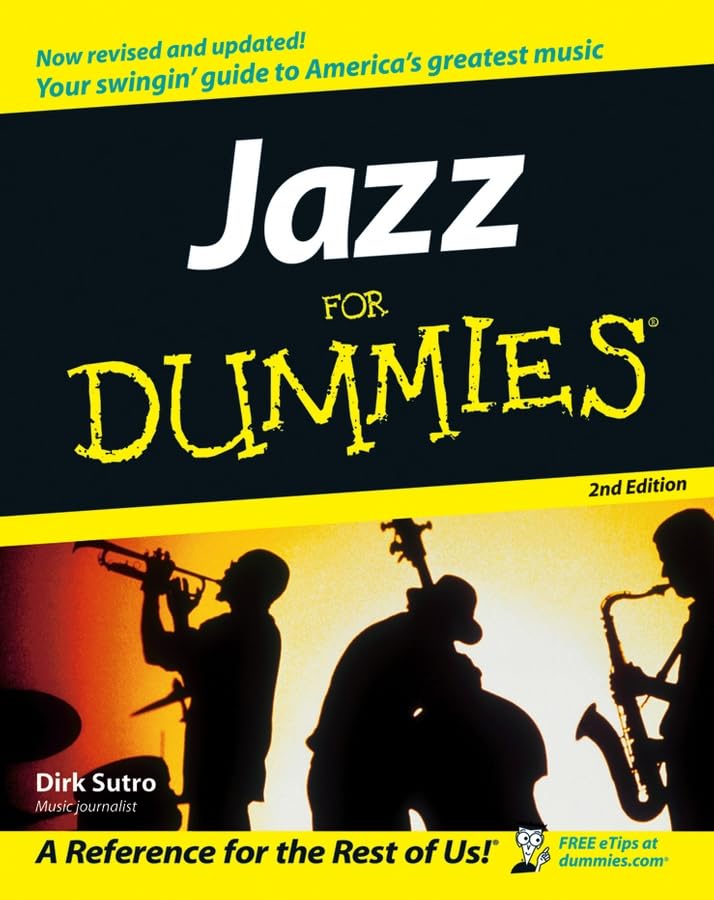 Jazz for Dummies
 Dirk Sutro
Paperback; 384 pages
ISBN: 0-471-76844-8
Wiley
2006
First, please understand that Jazz for Dummies mostly isn't. Sure, Dirk Sutro's approach is partially for total newcomers, but he also provides advice for aspiring musicians and even jazz fanatics in search of new information.
Jazz is not an easy thing to explain, yet Sutro does a good job defining improvisation, individual voices, swing, syncopation, measures, beats, spaces and song structures. Familiar songs are used to explain the blues form, accents, swing and syncopation. Sutro's on target when he describes jazz as a language with a huge vocabulary, rules of grammar, punctuation and dictionary full of slang. He provides useful tips for newcomers: listening to the same songs six times in a row and listening to different versions of the same standard song by various artists (with specific CD's recommended). He intriguingly follows David Letterman's gimmick of lists of 10, including a guide to jazz in ten cities and ten tips to building a jazz collection. The resources Sutro provides are great, including over 100 recommended album titles, plus movies about jazz.
I have some problems with Sutro's "facts" and omissions. He states that jazz has "never been music for the masses." I get the point, but what about the Swing Era, and the many periods in which jazz has been popular among the African-American masses? He states that "swing and syncopation can't be captured in notation." Not true. "Saxophones have six keys." In fact they have many more, keeping all eight fingers quite busy. "A few sax players prefer metal mouthpieces." No, it's far more. It's not "Dave Brubeck's "Take Five". Remember Paul Desmond? Where, in the discussion of bossa nova, is Charlie Byrd? Sutro's "Advice to Aspiring Players" should have included play-along records, software such as Band in a Box, high school jazz bands, jazz on the radio and jam sessions.
Sutro's work here is impressive in breadth, detail and creativity. However, there's no substitute for aural example. This book cries out for an accompanying CD.
Tags
PREVIOUS / NEXT
Become a Sustaining Member

Since 1995, All About Jazz has championed jazz as an art form and supported the musicians who create it. Over three decades, it has grown into one of the world's leading jazz resources, serving hundreds of thousands of readers, musicians, presenters and industry professionals each month.
Help Build the Future of All About Jazz
Your support helps us continue building All About Jazz for the next generation—expanding our editorial coverage, preserving jazz history, developing new community features and creating better ways to discover the music and the people behind it.
Become a sustaining member for as little as $20 per year and you'll immediately enjoy an ad-free experience along with access to subscriber features and future articles for a full year.
Together, we're not simply sustaining All About Jazz—we're building its future. Thank you for being part of the journey.