Home » Jazz Articles » Film Review » Grateful Dead: Meet-Up at the Movies 2026 - 6/17/91 at G...
Grateful Dead: Meet-Up at the Movies 2026 - 6/17/91 at Giants Stadium
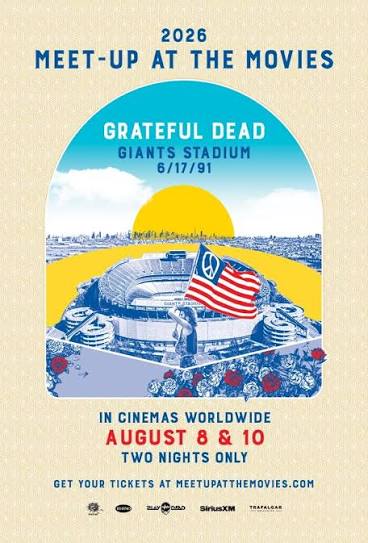 Grateful Dead
Meet-Up at the Movies 2026: 6/17/91 at Giants Stadium
Majestic 10, Williston, VT
August 20, 2026
Rhino Records/Trafalgar Releasing
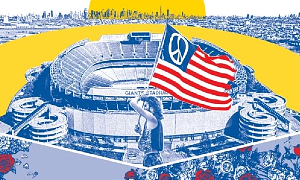
In the fifteen years since its inception in 2011, the annual Grateful Dead community event dubbed 'Meetup at the Movies' has included more than one repeat of content. Not surprisingly, The Grateful Dead Movie (Rhino, 2004) has been screened more than once—after all, the film documents an inflection point in the iconic band's history—but the re-run of 6/17/91 at Giants Stadium is something of a conundrum.
When originally featured in 2019, the deceptively vigorous and well-paced two hours was a component of the customary 'big' release of the year: featured within the box set, Shall We Go, You and I, While We Can? (Rhino, 2019), a three-CD set was also issued as a stand-alone titled Saint of Circumstance (Rhino, 2019).
As in the previous showing, chief archivist David Lemieux appeared briefly this year to extoll the virtues of the set, but only after what amounts to advertising for this year's twenty-CD Summer Magic 1985 compendium as well as the Good Ol' Grateful Dead podcast and thePlay Deadstreaming app.
The effervescent Canadian successor to the late Dick Latvala might better have discussed, at least superficially, the notable technical aspects of the recording he was introducing. June 17,1991 was one of only two Grateful Dead shows recorded using a 48-track setup, mixed by Jeffrey Norman, while the video footage uses a clean multi-camera live edit directed by Len Dell'Amico.
In addition, the video and audio captures the rare touring lineup that crystallized in the wake of Brent Mydland's passing in mid-summer of the year prior. The core of the psychedelic warriors lineup—guitarist-vocalists Jerry Garcia and Bob Weir, bassist (and occasional singer) Phil Lesh plus 'Rhythm Devils' percussionists Bill Kreutzmann and Mickey Hart—enjoy capable and sometimes scintillating support from keyboardists/vocalists Bruce Hornsby, a temporary enlistment favored by Garcia, and Vince Welnick, the official replacement in the role vacated by the deceased.
The whole ensemble acquits itself with style and panache throughout a broad and eclectic selection of both originals and cover songs (oddly minus the encore of The Band's "The Weight). Lightweight fare such as "Loose Lucy" and "Might As Well" resides next to the more substantial likes of "New Speedway Boogie" and "China Doll," but the band doesn't differentiate in its engagement with the tunes.
On the contrary, weaving "Dark Star" in and out of the second set, encircling the "Drums" and "Space," sets up an exalting "Uncle John's Band" where, at one point near the conclusion, everyone in the band is smiling (notably including the hirsute titular leader beaming around the stage).
Subsequent teases of "The Other One" lead into a "Sugar Magnolia" so rousing lead vocalist Weir begins to lose his voice as the band slams it to a close. Prior to that, the circuitous instrumental route of the musicians' came through the Majestic 10 theater's surround sound system with depth and detail. Courtesy the savvy staff on duty that night, extra volume added to the effect to be sure, but the twenty or so lively attendees no doubt more readily appreciated the fidelity in which they were ensconced.
All the way from Son House's "Walkin' Blues" to Bob Dylan's "When I Paint My Masterpiece," the sonic clarity is as striking as that of the visual (even when not presented in extreme close-ups). The deep rumbles of Lesh's bass on "Eyes of the World" are as easy to pick out in the mix as Hornsby's accordion on the aforementioned anthem from Workingman's Dead (Warner Bros., 1970) (though not so much on the latter number of the Nobel Laureate's).
And while it is fascinating to watch Hornsby pick and choose his moments for the invariably pristine decoration he coaxed from his grand piano, it is no less so to notice his camaraderie with Garcia; it was a connection all too reminiscent of the bond of the latter with Mydland, the late keyboardist/vocalist whose ten-year tenure with the Dead was the longest such interval in their history.
Hornsby's positioning stage left relegated Welnick to a spot further back from the front of the stage. And notwithstanding the occasionally flimsy tones of his electric keyboards—reminiscent of the Grateful Dead's fascination with MIDI effects in the '80s—the enlistment of this refugee from the eccentric San Francisco band The Tubes, carries a certain logic, if not a readily discernible one.
Still, that puzzle was hardly front and center during this performance. More to the point was the fluency of the nucleus of the band and the emotional investment of the veterans. History has and will continue to depict how the quality of latter-day Grateful Dead performances deteriorated til the passing of Garcia, and his hefty physical presence here. markedly different from his bearing of years just prior, was indicative of the decline.
The contrast and comparisons from the July 7, 1989 stopover in Philadelphia—released as Crimson, White and Indigo (Rhino, 2010) on CD and DVD—and the Foxborough Massachusetts show just days prior—the Meetup feature of 2016—hardly figured into the eruptions of applause at various intervals. Quite the contrary, Garcia's serpentine guitar lines during "Truckin'" evoked a most hearty response(s) in the select room of the Williston, Vermont multi-plex hosting this screening.
As a result, on the first of two nights for 2026's Grateful Dead Meetup at the Movies—something of an encore for the dates earlier the same month— what is now the now sole source for presentations of the cinematic arts in the greater Burlington, Vermont area became the focal point of exactly that all-encompassing, transportative experience commonly known as "going to the movies."
 FOLLOW Doug Collette
and get notified whenever a new article published.
FOLLOW Doug Collette
and get notified whenever a new article published.
DC writes regularly about jazz and blues plus rock and roll, composing reviews of CDs, DVDs, live performances, books and films.
About Grateful Dead

Tags
PREVIOUS / NEXT
Become a Sustaining Member

Since 1995, All About Jazz has championed jazz as an art form and supported the musicians who create it. Over three decades, it has grown into one of the world's leading jazz resources, serving hundreds of thousands of readers, musicians, presenters and industry professionals each month.
Help Build the Future of All About Jazz
Your support helps us continue building All About Jazz for the next generation—expanding our editorial coverage, preserving jazz history, developing new community features and creating better ways to discover the music and the people behind it.
Become a sustaining member for as little as $20 per year and you'll immediately enjoy an ad-free experience along with access to subscriber features and future articles for a full year.
Together, we're not simply sustaining All About Jazz—we're building its future. Thank you for being part of the journey.