Home » Jazz Articles » Live Review » Ethno Port 2026
Ethno Port 2026
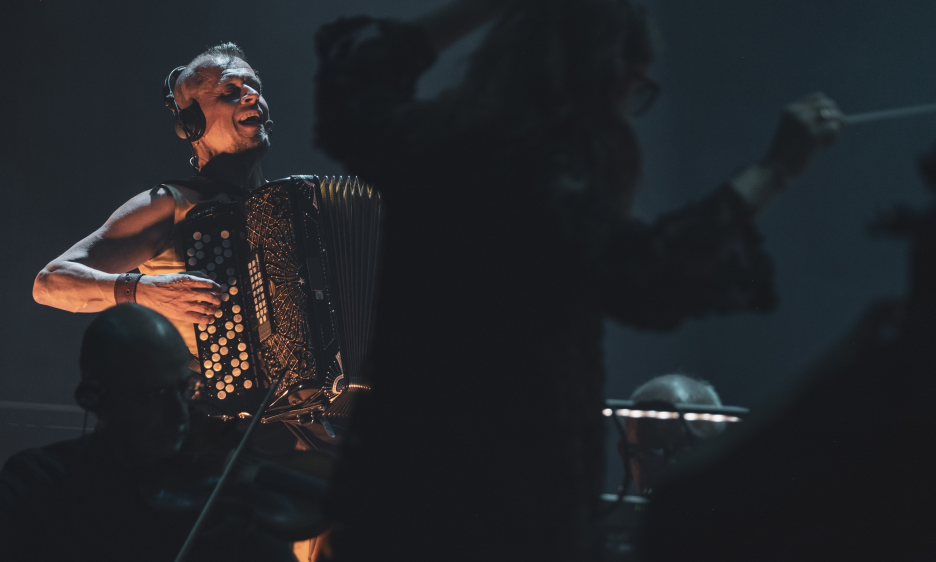
Courtesy Ma'in Mheidat
Poznań, Poland
June 11-14, 2026
Ethno Port is one of the outstanding global-folkloric festivals around the world, and your scribe attempts to impress this upon the media scene with each passing year. It transpires in the Zamek cultural centre, which had its construction completed (as the Imperial Castle) in 1910. It was internally bastardised in 1939, as an intended residence for Adolf Hitler, but it seems like he never quite made it to Poznań. Here, eight decades later, we find ourselves in a more genetically-welcoming castle climate, as musicians from all around the globe unite in expression, intricacy, imagination and dance-prompting. Zamek utilises its glorious spaces to suit differing styles, from its formal concert hall to the outdoor free- admission stage in its surrounding park-space. Its courtyard gigs inhabit a halfway setting, with bench-seating, rain canopies and a semi-informal layout.
The opening concert had the Finnish electroacoustic accordionist Kimmo Pohjonen fronting the Amadeus Chamber Orchestra, playing works first commissioned by the Kronos Quartet. Openings are left in the score for Pohjonen's improvising inserts, following a measured ambient beginning. Soon, it takes up a lilting gait, very soon escalating to a boot-thumping gallop, with enhanced bass-range thunder. Sour strings make up the majority of Amadeus, with even their streaks of joy taking on a melancholy, wistful hue. A scurrying section emerges, as conducted chaos rises. Your scribe is perched right in front of the bass bins, a turbulent ride ahead, as Pohjonen manipulates his electronic underbelly. Stripped percussion leads a rousingly melodic riff-theme, very filmic in its endless expanses of visualised deserts, plains, peaks or troughs. And then Pohjonen begins to croon! It sounds like he's singing in tongues rather than Finnish, splicing two voices, low and high in ranges, as the strings break out again, in a massed pizzicato strike. It's an epic evisceration of the composer's psyche, with multiple false endings in this extended work, often fooling the audience into applauding (but what's wrong with that, in breaking classical performance rules?).
And now comes the hardcore Polish folk, seasoned with some traditional stylings from the Belarusian borderlands. Hajda Banda have been amassing quite a touring presence in the last few years, leading to a higher profile all around. Not least because they deliver the goods, stomping in celebratory fashion, prompting dances amongst the crowds, but also crafting tunes via an unusual instrumentation that includes cimbalom, jaw harp, fiddle, three-row accordion, and a large frame drum, matched with exuberant group vocals.
They merrily swung across a cimbalom web, its zithery strings shimmering and vibrating as Hajda Banda made their trotting bounce, the fiddling founder Daria Butskaya tending to take the lead vocal parts. The dancers down at the front of the castle courtyard showed off their floppy-boot stomping. The songs often have a high velocity resolution, but this foursome can also sweep out a slow ballad.
The following dance session, led by Kapela Odloty (Odloty Band: fiddle, accordion, drums) took the evening late, but was notable for a remarkable sequence as we neared the end, a haunting slow-parade to an unusual ever-repeating melody. The usually-circling dancers switched into a funereal procession, all in couples, negotiating with a hop-step daintiness, a subtlety not so far seen during the night. This had been a very substantial opening run which the festival had a hard time matching, as its programme opened up into the longer days ahead.
The following afternoon, Vigüela arrived from the Toledo region in Spain, singing and playing various exotic old string instruments, as well as the bowed rebec and an assortment of small percussion. Their music sounded like flamenco, but more of a concert hall variant, with joint handclaps and castanets or metal percussion, as well as a frame drum. A run of stripped songs sounded closer to the rougher traditional flamenco style, with detailed fingerings on 12-string guitar, spirited strumming for the rest of this string- loaded crew.
The Turkish multi-instrumentalist Deniz Mahir Kartal resides in Berlin, and plays tunes from the Anatolian repertoire, coming on to the courtyard stage towards the end of the evening. His feelers also extend out to the musics of the Balkans and the Middle East, often coated with an electronic atmosphere. He can blow a mean duduk (Armenian double reeder), or clarinet, and spangle on a long-necked saz, introducing a slug of techno backing. Perhaps he's too much of a dabbler, but Kartal did proceed to paint an effective atmosphere.
On the third day, the seven-piece Rastak opened the afternoon, representing a troubled and beset Iran. Their set was determinedly optimistic and sometimes even joyous. This gig was in the park behind the castle, a setting that was to suffer from various degrees of rainfall during the last two days of the festival. Rastak employed oud, qanun, upright fiddle (kamancheh), a pair of Western violins, two thin-necked lute variants and drums/percussion. The band have been together since 1997, so possess an expected rapport. Despite an abstract traditional introduction their sound is quite accessible to a non-Persian crowd, often underpinned by a softly stomping beat. Some of the vocals ululated with glottal effects, and some of the tunes held an Egyptian character, particularly in their string-sweeps. The goblet drummer owned an impressively high-vaulting voice, when taking the lead, and the electric bass led a deep funk line, as the amped-up fiddles scorched, Rastak's songbook being admirably addictive on the tune-front.
Indoors, safely out of the rain, Stringed Compass explored Syrian and Colombian spaces, in one of the most unusual collaborative combinations, arising when oud player Thabet Azzawi met up with guitarist Max Loeb Garcia in their adopted city of Dresden. There are touches of cajon and frame drum added, from their respective lands, but the pair have largely wrung out the hardcore elements of their national musics to forge a different entity that is open to tune titles such as "Migrant Migraine." Here we have a close-string fleetness, born out of shimmering runs, with perhaps the Syrian side being a touch more dominant.
Further fusions appeared back in the courtyard, as the Warsaw band Alameda and Noums Dembele (from Burkina Faso) convened, the latter playing solo kora, initially, followed by the band entering, with acoustic guitar, keyboards, electric bass, drums and percussion. Slow moods unspooled, with dubby low end, swirling synths and mbira (thumb piano). A spangly kaleidoscope, heading towards a sped-up variant, with squirts of electro-ether surrounding a back-in-focus kora. Cyclic lines intersected.
The Turbans took to the park stage, apparently convened in England, although enjoying a very international membership. This was an underground coup for Ethno Port, a scarce opportunity to catch this combo in action, as they don't often get added to festival line-ups. The Turbans certainly delivered on their promise, overriding the continuing dull weather conditions, as a heavy storm hit, just as they were due to come onstage. After a short postponement, they shrugged off the downpour for a heated feast of tunes inspired by the traditions of the Balkans, Turkey and the global reaching of klezmer. Oud and guitar solos vied for ecstatic levels, leaping up from convoluted riffs, these being surprisingly avant- Eastern at times, as if The Magic Band had totally circled around from California. Trumpet solos also began to take charge, and the only flaw was a spell of circle-dance crowd control on behalf of the band.
The Romany singer-poet and acoustic guitarist Teresa Mirga was joined by the flamenco guitar, bass, accordion and cajon of Kałe Bała (her band founded in 1992, emanating a Greek feel, with a swirling acceleration, subsequently patchworking musical styles. Then the Kujawski Ansambl combined folk and jazz, with (probably too many) singers who held varying degrees of folk articulation. The bass and drums shone strongly, with understated trumpet, violin and hammered dulcimer. Keyboards were dominant, although sounding unusual in their sonic textures.
Still raining, still transcending, the old Senegalese (although technically born in Burkina Faso) master Cheikh Lô topped off the weekend with an almost-relaxed set of warming grooves, aided by guitar, bass, keyboards, congas and drum set, opening with a slow ballad, but slowly heading towards a more meaningful climax. This was one of Lô's more intimate and introverted sets, but still acting as an impressive conclusion to the long weekend.
 FOLLOW Martin Longley
and get notified whenever a new article published.
Martin Longley also writes for Jazzwise, Songlines, Downbeat, We Jazz, Qwest TV, The New York City Jazz Record & The Brooklyn Rail
About Kimmo Pohjonen
Tags
PREVIOUS / NEXT

Become a Sustaining Member

Since 1995, All About Jazz has championed jazz as an art form and supported the musicians who create it. Over three decades, it has grown into one of the world's leading jazz resources, serving hundreds of thousands of readers, musicians, presenters and industry professionals each month.
Help Build the Future of All About Jazz
Your support helps us continue building All About Jazz for the next generation—expanding our editorial coverage, preserving jazz history, developing new community features and creating better ways to discover the music and the people behind it.
Become a sustaining member for as little as $20 per year and you'll immediately enjoy an ad-free experience along with access to subscriber features and future articles for a full year.
Together, we're not simply sustaining All About Jazz—we're building its future. Thank you for being part of the journey.