Home » Jazz Articles » Album Review » Peggy Lee: Too Marvelous for Words
Peggy Lee: Too Marvelous for Words
—pianist Lou Levy, as quoted by James Gavin in Is That All There Is?: The Strange Life of Peggy Lee (Atria Books, 2014)
Born Norma Deloris Egstrom in Jamestown, North Dakota, in 1920, Peggy Lee survived a harsh childhood through music. In 1936, she began singing on KOVC radio in Valley City, North Dakota. She later hosted her own 15-minute Saturday show on Fargo's Powers Hotel station—paid primarily in meals from the hotel coffee shop. In 1937, WDAY radio personality Ken Kennedy auditioned the 17-year-old and put her on air that same day, on the condition she change her name to Peggy Lee. By 1940, Lee had moved to Palm Springs, California, where a residency at The Doll House taught her that lowering her voice to a soft, seductive purr could silence noisy crowds, instinctively forging her trademark minimalist style.
Her national breakthrough came in 1941 when Benny Goodman hired her as lead vocalist, yielding the million-selling wartime hit "Why Don't You Do Right?" As a Capitol Records solo artist for decades, she transformed popular music with masterpieces like 1958's "Fever" and her haunting 1969 Grammy-winner "Is That All There Is?"
Lee was also an assertive, behind-the-scenes innovator. Long before the 1970s singer-songwriter movement, she co-wrote over 270 songs as a creative equal with Duke Ellington and Quincy Jones. She secured her multimedia visionary status in 1955, co-writing the score and voicing multiple characters for Disney's Lady and the Tramp while earning an Oscar nomination for her role in Pete Kelly's Blues.
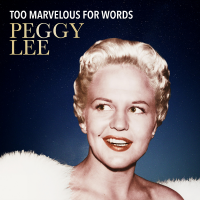
This creative peak is captured on the archival release Too Marvelous for Words. The 49 tracks emerged from a unique mid-century industry framework: the radio transcription service. During February and August 1955, amid her Disney and Hollywood successes, Lee recorded material only for the World Broadcasting System, which supplied hundreds of local stations with high-quality music on oversized 16-inch discs, creating the illusion of live performances for hometown audiences.
The syndication format demanded efficiency: Lee recorded all 49 tracks across just four sessions, totaling 14 hours, capturing most songs in one or two takes with minimal post-production. Crucially, this removed the pressure to produce Billboard hits, granting her creative freedom unavailable on her retail LPs.
Treating the studio like an intimate jazz club, Lee fronted a seasoned West Coast ensemble featuring pianist Gene DiNovi and percussionist Jack Costanzo with relaxed, improvisational looseness. Half of these performances are the only studio recordings Lee ever made of those songs, making these sessions an essential, otherwise-lost chapter of her discography.
These uninhibited performances strip away the polished pop veneer to reveal Lee as an accomplished improviser. Like her contemporary Frank Sinatra, she was a "song stylist," capable of singing any genre effortlessly—a rare talent matched in modern times by artists like Van Morrison and Willie Nelson.
Freed from chart expectations, Lee treats every melody as an open-ended conversation with her band. On the title track "Too Marvelous for Words," she channels Billie Holiday's elastic phrasing, lagging behind the beat to refashion Johnny Mercer's lyric into a rhythmic dance with DiNovi—all in just 89 seconds. On "I Gotta Right to Sing the Blues," she trades big-band bombast for minimalist intimacy anchored by Bob Whitlock's subtle bass. Her "That Old Black Magic" strips away manic up-tempo arrangements for a humid, polyrhythmic groove courtesy of Costanzo, showcasing exceptional breath control and deceptive vocal restraint.
The compilation also illuminates historical rarities. "Autumn in New York" represents Lee's only studio recording of the Vernon Duke classic—stark and haunting without the cloying strings typical of 1950s interpretations. Her "Try a Little Tenderness" predates Otis Redding's soul anthem, treating the melody as an exercise in dynamic control, whispering verses with a vulnerability few contemporaries could capture unedited. A single take of Cole Porter's "What Is This Thing Called Love?" demonstrates the quartet's telepathy as Lee playfully alters harmonic structure, trusting her musicians to pivot instantly—a risky maneuver rarely attempted on her official albums.
The technical restoration matches the performance's brilliance. While bootlegs have circulated for decades, Too Marvelous for Words presents pristine transfers from the original 16-inch discs. Archival producer James Sáez—renowned for his work with Nat King Cole and Dean Martin—has restored all 49 tracks, removing surface crackle and tape hiss while preserving organic analog warmth. The soundstage reveals details previously unavailable: the snap of Bob Whitlock's bass strings, the metallic shimmer of Costanzo's percussion, and Lee's voice with a clear, present fidelity that collapses seven decades into an event horizon.
More than an archival curiosity, Too Marvelous for Words is essential to understanding Lee's legacy. Capturing her at the pinnacle of multimedia fame yet isolated from commercial machinery, it offers an unfiltered view of her pure jazz chops. This meticulous restoration makes the intimate, late-night sessions feel nakedly immediate, revealing a fearless artist who needed only her signature whisper, a tight band, and deep knowledge of the Great American Songbook to command a room.
Track Listing
Too Marvelous for Words; My Ideal; My Future Just Passed; Somebody Loves Me; I Never Knew; Taking a Chance on Love; I May Be Wrong (But I Think You Are Wonderful); ’Deed I Do; Button Up Your Overcoat; You’re Mine, You; Mean to Me; What Can I Say After I Say I’m Sorry?; Try a Little Tenderness; I Got It Bad (And That Ain’t Good); I Gotta Right to Sing the Blues; Don’t Worry ’Bout Me; Let’s Call It a Day; It’s a Good Day; Oh, What a Beautiful Morning; Mountain Greenery; The Surrey with the Fringe on Top; People Will Say We’re in Love; Almost Like Being in Love; The Best Things in Life Are Free; Let There Be Love; Come Rain or Come Shine; Fools Rush In; My Romance; We Kiss in a Shadow; Speak Low; What’s New?; Bye Bye Blackbird; Autumn in New York; I Feel a Song Coming On; You; Me; From This Moment On; Them There Eyes; That Old Black Magic; You Do Something to Me; I Get a Kick Out of You; What Is This Thing Called Love?; Love Me or Leave Me; Just One of Those Things; Sans Souci; Hard-Hearted Hannah (The Vamp of Savannah); It Ain’t Necessarily So; Between the Devil and the Deep Blue Sea; Ac-cent-tchu-ate the Positive.
Personnel

Peggy Lee
vocals
Gene DiNovi
piano
Bob Whitlock
bassDon Prell
bass
Larry Bunker
drumsRay Rivera
drumsBill Pittman
guitar
Jack Costanzo
bongos
Pete Candoli
trumpetStella Castellucci
harpAlbum information
Title: Too Marvelous for Words | Year Released: 2026 | Record Label: Peggy Lee
About Peggy Lee
Tags
PREVIOUS / NEXT

Become a Sustaining Member

Since 1995, All About Jazz has championed jazz as an art form and supported the musicians who create it. Over three decades, it has grown into one of the world's leading jazz resources, serving hundreds of thousands of readers, musicians, presenters and industry professionals each month.
Help Build the Future of All About Jazz
Your support helps us continue building All About Jazz for the next generation—expanding our editorial coverage, preserving jazz history, developing new community features and creating better ways to discover the music and the people behind it.
Become a sustaining member for as little as $20 per year and you'll immediately enjoy an ad-free experience along with access to subscriber features and future articles for a full year.
Together, we're not simply sustaining All About Jazz—we're building its future. Thank you for being part of the journey.