Home » Jazz Articles » Album Review » Thelonious Monk: Bremen 1965
Thelonious Monk: Bremen 1965
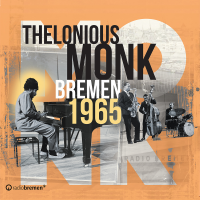
Historically, this concert fits within Monk's European Tours of the mid-1960s, a period when his quartet had achieved both technical mastery and telepathic connection. Audiences abroad, particularly in Germany, France, and Scandinavia, received Monk with a seriousness that sometimes eluded him in North America. The Bremen performance captures that receptive atmosphere.
"Criss Cross" opens the set with a confidence that is at once casual and carved. Monk's prickly chordal punctures outline the tune's odd angles as Rouse responds with linear lines as if straightening Monk's oblique phrases into a tenor narrative. The solos are long, exploratory, but not indulgent. Gales anchors with patient intonation, and Riley keeps the rhythmic horizon moving. Monk approaches "Sweet and Lovely" with the slow deliberation of an architect reexamining familiar ground. He lingers on the melody's intervals, breaking its genteel romanticism into blocks of tone that expose its harmonic bones. Rouse, ever the lyrical partner, restores tenderness to the line, his warm phrasing balancing Monk's abstraction.
For pure Monk, the pianist takes a solo turn on "Don't Blame Me" as he transforms the standard's sentimental plea into a meditation on voicing and timing. His phrasing, hesitant yet deeply assured, transforms the number into a conversation with silence itself, yielding a devotional result. The Monk and Kenny Clarke composition "Epistrophy" is developed with a blustering flair as the quartet embraces the number's angularity as a communal game. The head is stated with principal clarity. The improvisations are episodic, often returning to rhythmically furtive motifs that Monk plants like beacons. Rouse and Monk duel lightly, not so much as combatants but as old friends trading aphorisms.
"Just You Just Me" takes on a brighter hue, brisk, playful and imbued with that asymmetrical swing that only Monk could manage. The familiar head becomes an exercise in displacement with Monk sliding in and out of the beat, nudging the melody off-center before snapping it back into focus. Rouse dances alongside him, his phrasing delightfully elastic. The rhythm section, attuned to the game, keeps the tune buoyant and conversational while delivering solo excursions perfectly in keeping with the composition's aesthetic.
The remaining Monk composition is "Rhythm-a-ning," which proceeds as a study in swing that feels both loose and inexorably forward. Monk plays with a sly sense of timing, fragmenting the theme, allowing the syncopations to breathe and punctuating his right-hand flurries with jabbing left-hand chords that land like knowing asides. Rouse, in turn, delivers fluid solos, full of warmth, humor and rhythmic daring. Gales and Riley are particularly alive here, providing rhythmic threads that bind the ensemble, indicating that this is a band entirely at ease in its shared language. The album confirms once again that Monk's singular world, askew, unerring, and full of grace, remains central to modern jazz's sense of history and possibility.
 FOLLOW Pierre Giroux
and get notified whenever a new article published.
FOLLOW Pierre Giroux
and get notified whenever a new article published.
A former international financial executive with a long term fascination with jazz and its artists
Track Listing
Chris Cross; Sweet and Lovely; Well You Needn't; Don't Blame Me; Epistrophy; Just You, Just Me; I'm Getting Sentimental Over You; Rhythm a Ning; Epistrophy.
Personnel


Album information
Title: Bremen 1965 | Year Released: 2025 | Record Label: Sunnyside Records
About Thelonious Monk
Tags
PREVIOUS / NEXT


Become a Sustaining Member

Since 1995, All About Jazz has championed jazz as an art form and supported the musicians who create it. Over three decades, it has grown into one of the world's leading jazz resources, serving hundreds of thousands of readers, musicians, presenters and industry professionals each month.
Help Build the Future of All About Jazz
Your support helps us continue building All About Jazz for the next generation—expanding our editorial coverage, preserving jazz history, developing new community features and creating better ways to discover the music and the people behind it.
Become a sustaining member for as little as $20 per year and you'll immediately enjoy an ad-free experience along with access to subscriber features and future articles for a full year.
Together, we're not simply sustaining All About Jazz—we're building its future. Thank you for being part of the journey.