Home » Jazz Articles » Book Review » Blow By Blow: The Jeff Beck Story by Brad Tolinski And Chris Gill
Blow By Blow: The Jeff Beck Story by Brad Tolinski And Chris Gill
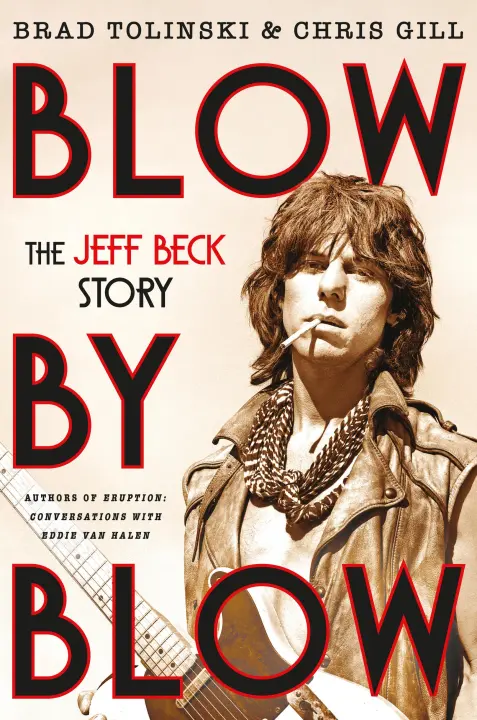 Blow By Blow: The Jeff Beck Story
 Brad Tolinski And Chris Gill
400 pages
ISBN: #978-0306836589
Da Capo
2026
Brad Tolinski & Chris Gill do not just tell The Jeff Beck Story in their biography of the maverick guitar genius. Very early in its four-hundred pages, Blow By Blow becomes a virtual history of the evolution of '60s and '70s rock, blues and fusion music and, in turn, a discerning view into the twists and turns of contemporary music at large. The biographers are careful to keep Beck at the very center of their narrative however. From his early and impassioned infatuation with music and the guitar to the formation of his earliest bands, then on to joining the British band The Yardbirds—taking the place of none other than Eric Clapton—Beck is a man driven.
Yet his motivation is grounded less in ambition for fame than the elusive satisfaction derived from creating new and different sounds on the guitar, rudimentary versions of which instrument he actually made himself. The portrait the authors paint is a vivid one, depicted in leaps and bounds of text that, at least in the early going, carry an infectious enthusiasm. Juxtaposed with the prose, an impressive range of photographs show Beck often in a space all his own, even in group settings that are most notable when on stage mid-performance.
That later stages of this tome turn somewhat dry and rote only becomes apparent in contrast to Annette Carson's authorized biography Crazy Fingers (Backbeat Books, 2001). Yet throughout Blow By Blow—knowingly titled after Beck's landmark fusion album of 1975—the burgeoning guitar hero is clearly loathe to endure obstacles and delays that get in the way of making (new) music.
His frustration with less-than-professional accommodations and travel afforded the aforementioned visionary band of the '60s, even after they garner some measure of success, is only the earliest instance of peculiar behavior that, later in life, manifested itself in abrupt cancellations of live dates and recording sessions.
Tolinski and Gill supply the underlying source of the perception of Jeff Beck as an undoubtedly gifted but erratic soul. The two document physical afflictions arising directly from illnesses as well as multiple accidents causing serious injuries dating back to childhood: suggesting those debilitations as a reasonable rationale for Jeff Beck's slow but sure metamorphosis into an impatient cantankerous sort, they are nevertheless careful to note he is one who could often laugh at himself, as in more than a few excerpts from their conversations with him over the years.
It is to their credit these authors do not conjecture much, but simply allow their observations and those of significant collaborators such as Rod Stewart speak for themselves. The co-scribes' is a discerning but nonetheless empathetic perspective, pointing out ever-so-subtly how Jeff Beck's confidence in himself all too often tended to falter, even in the wake of (finally) garnering Grammy Awards.
They are slightly more explicit in rendering at least some nuances of his emotional attachments to a series of female partners. More important, however, are their accounts of how, in returning from one hiatus or another, self-imposed and otherwise, Jeff Beck doesn't exactly follow a straight line in forming a band and securing management to further the fortunes of the ensemble.
It is a fascinating interval indeed to read about how Beck's old friend Jimmy Page's assumption of guitar duties and de facto leadership of the Yardbirds inexorably led to the latter's alignment with manager Peter Grant and the subsequent formation of and promotion of Led Zeppelin. If not for the tempestuous machinations of The Jeff Beck—including future Rolling Stone Ronnie Wood and vocalist extraordinaire Rod Stewart—that original quartet may well have occupied the famous space inhabited by their aforementioned peers, shepherded by the very same mentor Grant.
Instead, the addition of keyboard savant Nicky Hopkins to the Beck ensemble actually signalled its death knell as the imaginative presence of the man who played with The Beatles, The Who and the The Rolling Stones only pointed up the lack of songwriting capabilities within the unit. Exacerbating that set of debilitating circumstances is Rod The Mod's moves to record a solo album (with Woody as a close collaborator).
Add to that the bandleader's materialist tendencies which more than once interrupted his creative progression and those of the collaborators working with him. A long-time fondness for cars rivalled Jeff Beck's devotion to his chosen instrument, dueling loyalties that more than once led him to digress from the pursuit of mainstream acceptance for himself and his efforts. Again, quotes from the writers' multiple interviews with their subject are crucial.
In evidence of their experience at Guitar World magazine, Brad Tolinski and Chris Gill do not belabor any sequences of events as they trace the creative and personal history of Jeff Beck in Blow By Blow. That said, their fascination with their subject and his work belies some egregious omissions. The pair make only passing mention of the iconoclast's 2010 arena tour with long-time rival Eric Clapton and likewise skip any exploration of the mechanics involved in the publication of El Becko's autobiography Beck 01 (Genesis Publications, 2016).
And while it only makes sense that affiliates from a periodical devoted to the fretboard would include an appendix overflowing with detail about the various instruments Beck used over the course of his career, it begs credulity there is no discography appended as well. In contrast, while there is a very extensive one in the aforementioned Carson book, such information begs an update from a quarter-century ago.
It is but a third of the way through this book that Brad Tolinski and Chris Gill have ever-so-subtly established the long-term pattern of Jeff Beck's career. Yet his often fitful absorption with his own endeavors was very often interrupted and/or delayed by his generous and frequent contributions to the efforts of others (hence the resource of a checklist).
The late British guitar hero worked for and with famous artists as disparate as Tina Turner and Luciano Pavarotti, while potential alliances that never came to fruition, such as one with a young Elton John, also constituted absences from his own recording and touring that might well have established him as the household name he deserved to be.
Nevertheless, 'El Becko' benefitted in various ways from his work with Stevie Wonder on Talking Book (Tamla 1972) and so too in his discovery of a kindred spirit in actor/musician Johnny Depp: the two produced the final entry in The British native's discography 18 (Rhino Records, 2022). And during the those later years, the guidance of new management led to more sustained activity including an all-star show in 2016 at the Hollywood Bowl in celebration of of a fifty-year plus career an all-star show in 2016 at the Hollywood Bowl, a microcosm of how Jeff Beck continued to hone his wildly unconventional approach to guitar on his own records and others. due to the relative inactivity of his far more commercially successful peers in his homeland's guitar triumvirate (Clapton and Page), there is no denying the validity of these biographers' understated implication: the restless soul formally named Geoffrey Arnold Beck had attained some measure of inner peace to accompany that widening celebrity.
It is thus an instance of poetic justice turned tragically ironic that, in one more instance of defying accepted norms and expectations, the stability this master experienced only continued to fuel the flow of imagination so abruptly stilled in early 2023.
 FOLLOW Doug Collette
and get notified whenever a new article published.
FOLLOW Doug Collette
and get notified whenever a new article published.
DC writes regularly about jazz and blues plus rock and roll, composing reviews of CDs, DVDs, live performances, books and films.
About Jeff Beck

Tags
PREVIOUS / NEXT
Become a Sustaining Member

Since 1995, All About Jazz has championed jazz as an art form and supported the musicians who create it. Over three decades, it has grown into one of the world's leading jazz resources, serving hundreds of thousands of readers, musicians, presenters and industry professionals each month.
Help Build the Future of All About Jazz
Your support helps us continue building All About Jazz for the next generation—expanding our editorial coverage, preserving jazz history, developing new community features and creating better ways to discover the music and the people behind it.
Become a sustaining member for as little as $20 per year and you'll immediately enjoy an ad-free experience along with access to subscriber features and future articles for a full year.
Together, we're not simply sustaining All About Jazz—we're building its future. Thank you for being part of the journey.