Home » Jazz Articles » Profile » Benoit Delbecq
Benoit Delbecq

I write tunes that include this idea of improvised polymetrics, where combinations of rhythms and melodic fragments are expressed in different layers.
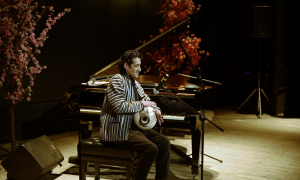
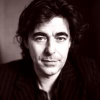
 Luminous harmony, intellectual rigor, and modernist piano technique will be on display when French pianist Benoît Delbecq performs two nights early this month at Jazz Gallery. Although he has played improvised music festivals all over the world, these will be his first New York solo performances.
Delbecq dramatically sets himself apart from other jazz pianists by preparing the piano with objects in the John Cage tradition. "I use mostly curved bits of dried wood and erasers from all kinds of geographical origins. It started when I was a kid with a set of mallets I built myself. Later, after I listened to and performed Cage's "Sonatas and Interludes , it felt like a door opened to research new directions at the piano. His solo recital Nu-Turn (Songlines) is full of amazing prepared and unprepared sounds that marry contemporary harmony with repetitive rhythm.
"I write tunes that include this idea of improvised polymetrics, where combinations of rhythms and melodic fragments are expressed in different layers. Playing this kind of language is like sewing within a precise pattern. It can get somewhat trance-like: in a way, I'm looking for some kind of imaginary folklore.
When it was suggested to Delbecq that there is something African in his compositions, his immediate response was "It is definitely African-inspired, since I avoid a time division hierarchy. I let the fabric develop itself and change pivots of time or articulation...the fabrics of 'In Lilac' [the first track on Nu-Turn] is centered on a 42/8 pattern, but I might divide it along different options of time division - say a triplet feel or a 5/8 feel, etc. which extends the cycles consequently. Sometimes, I suddenly shift from one to another division and this might happen in the middle of a melodic phrase...in the end, it is quite free. Remarkably, there was no over-dubbing and virtually no editing on Nu-Turn.
Delbecq is always eager to talk about his influences. From the classical world (in addition to, obviously, Cage) there is Gyorgy Ligeti. "When I decided to go back to written piano music studies in '88, my main reason was a desire to play Ligeti's marvelous piano etudes, which are influenced by traditional Pygmy music. I then improvised off the ideas of each etude and no doubt you can still hear it in my playing. Ligeti is also one of the rare contemporary music giants to express enthusiasm for jazz or Afro-Cuban music.
And from jazz he cites Thelonious Monk, Mal Waldron, Ornette Coleman, Cecil Taylor and Steve Lacy. "Monk first, because my dad had many records of his and I've always heard Monk's music at home. I remember the day he died: there was a special about him on the French TV news. It was the first time I had seen him play - such an earthquake! Later I studied quite a lot with Mal Waldron in Paris. His playing in the late years was more and more trance-like, just like he had placed all the undesired elements of his playing in a locked box. His feel was so personal. I can never forget the acoustical thrust he radiated from the piano. He was a discreet and very funny man, and a master chess player.
Of course influences are there to be transcended and Delbecq has worked hard to find his own voice. "What I think I may have understood from those giants is maybe 1% of their philosophy of freedom, especially in the way to organize rhythm. To obtain a dialect of my own, I spent quite some time improvising from sentences from both English and French literature. It gave me something to improvise with on forms that don't indicate a time division. So while my melodic statements - especially the starting or ending points - appear to be randomly placed, they're not. They are language. This is what you find in traditional musics from different regions of the planet - especially in Africa.
Nu-Turn is one of three recent and exciting Delbecq releases on Songlines. Both Pursuit (1999) and Phonetics (2003) are virtuosic ensemble records featuring interesting mixes of talented improvisers. Pursuit has the dual horns of Michael Moore and François Houle and another frequent Delbecq collaborator Steve Arguelles on drums and electronics (Arguelles and Delbecq have a duo called PianoBook where the piano is constantly processed.) It also has some of the finest recorded work of the great bassist and longtime Steve Lacy musical associate Jean-Jacques Avenel.
 The most recent disc, Phonetics, is even stronger, with Mark Turner (sax), Mark Helias (bass), Oene Van Geel (viola) and Emile Biayenda (drums). The complicated yet charismatic compositions are played very well, even though the band had only a couple of days to rehearse, perform and then record. "It was a challenge to anticipate the musical directions, since we five have very different stories to tell. I intuited that there were more than merely promising connections between our approaches. I tried to fish those out and hide them at the same time. This set of 9 or 10 tunes took me the longest time to write...probably 18 months or so. I could imagine the blend of tenor sax and viola pretty well and I could bet with no risk on how Mark Helias would anchor the sound and the breath of the band. Emile on drums was a key-point: I have toured with him and Jazz Mic Mac the whole Central African region in '94. As a child, he learned to play drums in Brazzaville, Congo, learning some of Ed Blackwell's or Max Roach's playing from records at the same time as he was becoming a master drummer of his wonderful folklore. Prior to the recording, Emile and I rehearsed quite some time to find a nice rhythmic feel for some key ideas - no doubt it made the whole project more comfortable!
It is still far more difficult for a French musician to play in New York than vice versa and Benoît Delbecq is a forward thinking musician who deserves this city's attention. Let's hope that connoisseurs and the curious-minded alike come out to hear him live and check out a different point of view.
Recommended Listening:
· François Houle/Benoît Delbecq - Nancali (Songlines, 1996-'97)
· Jorrit Dykstra/Benoît Delbecq - European Echoes (BVHaast, 1995-'97)
· Benoît Delbecq - Pursuit (Songlines, 1999)
· Benoît Delbecq/François Houle - Dice Thrown (Songlines, 2001)
· Benoît Delbecq - Nu Turn (Songlines, 2001)
· Benoît Delbecq - Phonetics (Songlines, 2003)
Photo Credit
Sebastian Smith
About Benoit Delbecq
Tags
PREVIOUS / NEXT

Become a Sustaining Member

Since 1995, All About Jazz has championed jazz as an art form and supported the musicians who create it. Over three decades, it has grown into one of the world's leading jazz resources, serving hundreds of thousands of readers, musicians, presenters and industry professionals each month.
Help Build the Future of All About Jazz
Your support helps us continue building All About Jazz for the next generation—expanding our editorial coverage, preserving jazz history, developing new community features and creating better ways to discover the music and the people behind it.
Become a sustaining member for as little as $20 per year and you'll immediately enjoy an ad-free experience along with access to subscriber features and future articles for a full year.
Together, we're not simply sustaining All About Jazz—we're building its future. Thank you for being part of the journey.