Home » Jazz Articles » Album Review » Sylvie Courvoisier: Amalthea
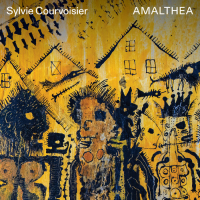
Sylvie Courvoisier: Amalthea
Patricia Brennan is similarly concerned to preserve elements of her Mexican heritage in her music. Suffice it to say that the distance between Courvoisier and Brennan and the MJQ is vast—and instructive.
Amalthea was the nurse of the infant Zeus in Greek mythology, a figure associated with plentiful nourishment. Here, there is a superfluity of ideas and rhythm to feed her musicians.
Courvoisier moved with ease between jazz and her reading of Igor Stravinsky's The Rite of Spring (Pyroclastic 2023). What she revels in, however, is the presence of two harmonic instruments, as she also had with Mary Halvorson on Bone Bells (Pyroclastic 2025)
Like the MJQ, the new quartet delights in a sophisticated title. "La Chimère aux yeux verts" first appeared on Courvoisier's Intakt album Chimaera (2023), a sextet recording with Wadada Leo Smith, Nate Wooley, Christian Fennesz, Drew Gress and Kenny Wollesen. Here, its tentative opening gives way to restless, otherworldly sounds from vibraphone, treble piano register, cymbals and bowed bass. The combination of vibes and piano is aided by Dan Weiss's drums, which provide a subtle pulse without ever dominating.
Courvoisier wrote all eight pieces for these particular musicians, and that specificity is central to the record's success. She has described the group as capable of absorbing "very complicated music" while retaining ample room for individual vocabularies; the album's central achievement is precisely that balance between closely notated architecture and spontaneous life.
Courvoisier and Brennan had already established a close rapport on their duo recording Talamanti (Antlia Records 2026), and here their partnership acquires a broader ensemble context. Courvoisier's piano is characteristically many-voiced: percussive attacks, interior-string preparations, clusters, sudden lyric fragments and passages of driving rhythmic assertion. Brennan answers with an equally wide palette—glassy repeated figures, low resonant clangs, unison lines and, in performance, subtle pitch-bent electronics. Their instruments share a crystalline attack, which makes their unisons especially vivid; they also contrast usefully with Brennan's sustained metallic decay floating against Courvoisier's drier, more angular keyboard articulation.
The sound stage does not encourage the listener to apportion sounds to individual instruments. Rather, it invites one to enjoy the overall sweep of the ensemble's sound picture, with its shifting rhythms and textures. Patricia Brennan comments, "Sometimes our sounds merge so closely that it's hard to tell which instrument is which."
"Queen of Spades" is another piece in which the sounds of piano and vibes blur. Thomas Morgan holds the rhythmic foundation, leaving Courvoisier and Brennan free to create challenging solos.
In "King of Hearts," much depends on Morgan as he maintains the background, aided by Weiss. Courvoisier is scintillating, while Brennan's lines cut jaggedly against the intense rhythm.
"Simone" is apparently dedicated to the Christian mystic and philosopher Simone Weil. It is one of the album's most emotionally poignant pieces. Built from disconnected lyrical fragments, it finds Weiss moving from subtle brushwork to explosive polyrhythmic drive, pushing Courvoisier and Brennan towards a climax before the music evolves into silence.
"At Risk" consists of daring, playful motifs repeated in different ways, in a kind of counterpoint in which everyone assumes a sporadic role. Courvoisier has deliberately chosen younger musicians willing to rise to a challenge she might have hesitated to place before older players. She has cited Sofia Gubaidulina and György Ligeti among her influences, and their presence is audible less as direct imitation than as an attitude to form: tension, colour, asymmetry and dramatic shaping are treated as structural materials.
In "Knots and Dander," Courvoisier and Brennan challenge one another before Morgan and Weiss bring in their own ideas to augment the argument. A fractured melody emerges from Courvoisier's piano, while the emphasis falls on lyrical percussion.
"Circumbent" begins assertively, directed towards Brennan, who answers in kind. The emphasis is on percussion and on a different kind of rhythmic thinking, far removed from the structures favoured by the MJQ. It is a study in sound manipulation and space: Brennan employs electronics and pedals alongside traditional mallet technique to create liquid, textural swells, while Courvoisier responds with sparse, rhythmic stabs.
"Le Pavot Rouge" is anchored by Morgan, who sustains his bass pattern throughout. The front line of vibes and piano only hints at conventional melody. Morgan's elastic playing is central to the middle section, before the group builds towards a driven pattern beneath Brennan's almost discordant crescendo. Underneath it all, Morgan's bass figures return as the intensity subsides.
If there is a potential caveat, it is that listeners seeking conventional song forms, extended swing solos or easily memorable themes may find the music deliberately elusive. Courvoisier's melodic material often appears in fragments, transformed by preparation, unison writing and rhythmic displacement. Yet this is not a weakness so much as the premise of the record: its pleasures are cumulative, arising from the way motifs, timbres and rhythmic cells recur in altered states.
 FOLLOW Jack Kenny
and get notified whenever a new article published.
Jack was turned on to jazz by a mixture of Stan Getz, Lee Konitz and Earl Bostic.
Track Listing
La Chimère aux yeux verts; Queen of Spades; King of Hearts; Simone; At Risk; Knots and Dander; Circumbent; Le Pavot Rouge.
Personnel



Album information
Title: Amalthea | Year Released: 2026 | Record Label: Pyroclastic Records
About Sylvie Courvoisier
Tags
PREVIOUS / NEXT


Sylvie Courvoisier Concerts
Become a Sustaining Member

Since 1995, All About Jazz has championed jazz as an art form and supported the musicians who create it. Over three decades, it has grown into one of the world's leading jazz resources, serving hundreds of thousands of readers, musicians, presenters and industry professionals each month.
Help Build the Future of All About Jazz
Your support helps us continue building All About Jazz for the next generation—expanding our editorial coverage, preserving jazz history, developing new community features and creating better ways to discover the music and the people behind it.
Become a sustaining member for as little as $20 per year and you'll immediately enjoy an ad-free experience along with access to subscriber features and future articles for a full year.
Together, we're not simply sustaining All About Jazz—we're building its future. Thank you for being part of the journey.