Home » Jazz Articles » Live Review » Toronto Downtown Jazz Festival 2005
Toronto Downtown Jazz Festival 2005
 Another year. Another festival. After nineteen years the Toronto Downtown Jazz Festival, having made the transition from the du Maurier Downtown Toronto Jazz Festival to the TD Canada Trust Downtown Festival, continues to be a pale version of what it once was. No longer does it tantalise as it once did; the marquee names may draw an audience and help the till, but the musicians come in once too often to stir a sense of excitement. Roy Hargrove was back, and so were Medeski, Martin & Wood, as well as Kenny Barron, bless him for his regular stops at the Montreal Bistro during the year, and Dick Hyman.
Joshua Redman returned with his Elastic Band, which had Sam Yahel on keyboards, Jeff Ballard on drums, and Jeff Parker on guitar. Redman used a raft of electronic effects to provide the counterpoint and the bed and companion to his improvisations as he played over delayed effects. Often done at length, the exercise began to pall not too far into his ministrations. Yet he did rise above the mundane to change course and pull himself out of the mire. When he did, his intonation was articulate and had enough guile to grab attention. Yahel was out of sorts at the outset, his path on the bank of keyboards sounding overwhelmingly obtuse, but he redeemed himself along the way with some well-defined solos. Ballard was, as always, a tight drummer, lean and spirited without a wasted beat.
 Redman was preceded by the Kenny Garrett Quartet, which ignited the night. Garrett is an exciting player, articulate and intense, with ideas tumbling out of his saxophone. The funky groove of "Wayne's Thing evolved in the hands of bassist Kris Funn and drummer Ronald Bruner, before Garrett juiced up the cavorting melody that danced its way into the soul. The defining moments of his set came when he took the soprano sax to play three folk melodies, two Japanese ones sandwiching a Caribbean tune. He was complemented by the lyrical Carlos McKinney on piano during this shining, shimmering medley.
For something completely different, there was Bugge Wesseltoft, who has played with Jan Garbarek, Arild Anderson, and Terje Rypdal. But the atmosphere was too sterile for him, and so he went out and made music that he calls "nu jazz," for which he founded a label, Jazzland Records. Even under the ever-expanding and elastic umbrella under which musicians like to nestle and give their music some sort of link to jazz, his did not fit that category. Wesseltoft's music is dance, trance, and house, and he is the master of his art. Rising from a slow build up he created tantalising and captivating grooves and beats, the intensity rising from his manipulation of the keyboards. With a band that had assimilated the spirit of its leader, he built a magnetic edifice of sound loops and rhythms that grabbed and never let go.
Directions also fell in the realm of house and trance, which they attempted to marry with jazz. During certain moments Benji Perosin voiced harmonics on his trumpet and Jason Kemeny improvised and enlarged a Latin rhythm, but those were short-lived and never came to any fulfillment. Chantal Thompson's jazz singing was another facet that did not merge into the music; all of this made the evening a disappointment.
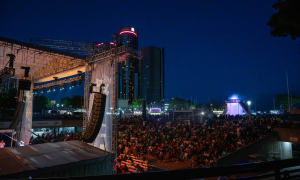
On a hot Sunday afternoon, Kiran Ahluwalia took the BenQ stage, an open-air venue adjacent to the main tent. Ahluwalia sings ghazals (Urdu love poetry) and Punjabi folk songs. No English here, but she explained each song, which helped those not familiar with the languages to understand the message. Ahluwalia knows how to encompass the emotion in a word and to lift it high, so that it throbs and reverberates with meaning. Her voice soars with the joy of expectation of a young lover, or dips into the dejection and sadness of disappointment. She brought verve and vivacity to the folk songs and imbued the ghazal with pathos.
After seeing Luluk Purwanto at the Jazz Yatra in Bombay in 1986, it would have been a mistake not to catch her performance at this festival. Purwanto appeared with the Helsdingen Trio, featuring René van Helsdingen on piano, Essiet Okon Essiet on bass, and Marcello Pellitteri on drums. The band traversed several idioms that included folk motifs and bop. Purwanto used the violin to essay some vibrant strokes, infusing the songs with striking colour, and then tucked the bow aside to pluck a melody. She also scatted and used her voice in wordless song to lend a greater dimension to the music. As the songs changed tempo within their cycle, Helsdingen punctuated the movement with thick chords, scintillating runs, and some ruminative excursions. Essiet is an expansive bassist, moving into a melody and then getting into a percussive groove by tapping the body of his instrument or running a double collective of chords.
And on the final day came the Italian Instabile Orchestra. The last time the group was in town, it was confined to the recesses of a bar. This time the musicians had a large and appreciative audience as they played an afternoon show at the main venue. The orchestra, the brainchild of Pino Minafra, features musicians from all across Italy—quite the cream of the crop, including Carlo Actis Dato, Paolo Damiani, Giancarlo Schiaffini, Eugenio Colombo, Tiziano Tononi, and Albert Mandrini. The one non-Italian, who has been living in the country for twenty years, is Martin Mayes, which he said made him an honorary Italian, at least enough so to be in the band.
The orchestra is a cooperative venture and lives up to its name. Several of the band members write and arrange tunes and come up front to conduct. The music is always lively and full of punch and panache. Even as the musicians go into free territory, they never lose focus, always bringing in a wealth of invention. Point, counterpoint, melody, dissonance, an earthy solo, a rambunctious ensemble... all find a comfortable niche.
The group's repertoire largely consists of original material, but as Mayes said on the day, there are times when evergreens rear their heads. There were two this time around: "Come Sunday and "Lament. The spiritual head of the former invoked Ellington, but then Schiaffini's imagination took over. The orchestra dissected the tune, purveying it into several compelling strands before bringing it all back together in a smooth weave, even after the pianist bent into the body of his instrument to pluck the strings and thwack the wood. This was unequivocally an exhilarating and marvellous performance.
Next year will mark the festival's 20th anniversary. What can we look forward to? Will there be bold strokes of imagination, or will it continue to be mostly daubed in pallid shades?
Visit the Toronto Downtown Jazz Festival on the web.
Photo Credit
Kris King
 FOLLOW Jerry D'Souza
and get notified whenever a new article published.
FOLLOW Jerry D'Souza
and get notified whenever a new article published.
From Bombay, India to Toronto and into the third dimension.
Tags
PREVIOUS / NEXT

Become a Sustaining Member

Since 1995, All About Jazz has championed jazz as an art form and supported the musicians who create it. Over three decades, it has grown into one of the world's leading jazz resources, serving hundreds of thousands of readers, musicians, presenters and industry professionals each month.
Help Build the Future of All About Jazz
Your support helps us continue building All About Jazz for the next generation—expanding our editorial coverage, preserving jazz history, developing new community features and creating better ways to discover the music and the people behind it.
Become a sustaining member for as little as $20 per year and you'll immediately enjoy an ad-free experience along with access to subscriber features and future articles for a full year.
Together, we're not simply sustaining All About Jazz—we're building its future. Thank you for being part of the journey.