Home » Jazz Articles » The Blue Note Portal » Future Perfect—4. The Invisible Man
Future Perfect—4. The Invisible Man
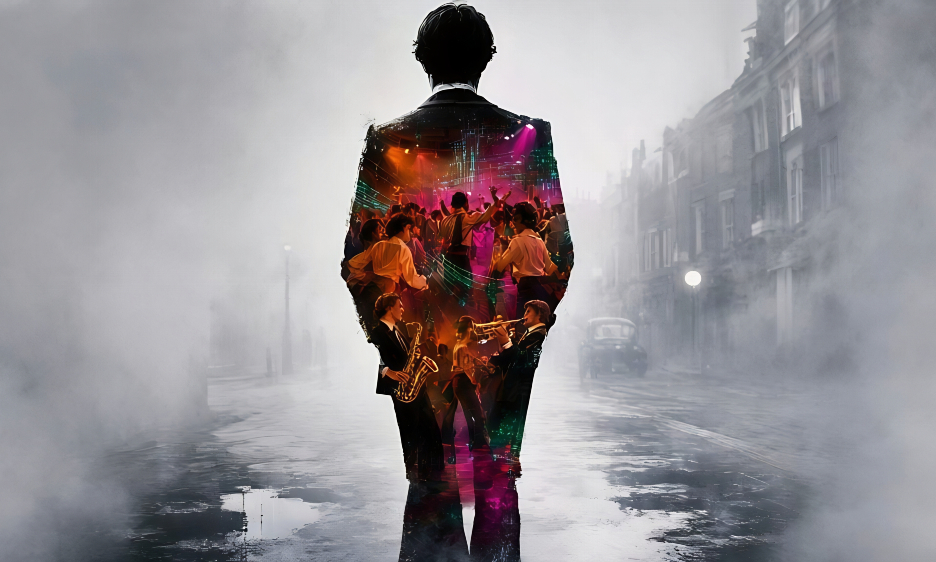
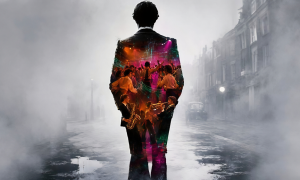
Courtesy AI
Liverpool 1970
Rod Temperton stood just inside the doorway of the rehearsal room watching Future Perfect. He fought the urge to simply slip away unnoticed. He had won a raffle he hadn't even remembered entering—a ticket to the WOOD film premier with a backstage pass to meet Future Perfect. It had been hand-delivered to him along with train tickets. A former drummer and aspiring keyboardist in a semi-amateur band, he could hardly fathom that this was actually happening.He was twenty, thin, with the careful neatness of a shy provincial man who had learned early on that grooming was one of the few things entirely within his control. His suit was from Grimsby. His haircut was from Grimsby. As he surveyed the room, a young woman with a sunburst Les Paul slung low crossed the room toward him, hand extended. "You must be Rod Temperton. We're so glad you made it, I'm Maya."
"This is Chloe,"—blonde, Telecaster, her smile arrived a half-second before she did—"That's Zack on bass, Kyle on drums, and Monty, who pretends he isn't listening to everything we say."
Monty, behind the Hammond, lifted two fingers off the keyboard in salute.
"I watched the film," Rod said. Then, hearing himself: "The Apollo film. Everyone did. That's—obviously everyone did. Sorry."
"What did you think of it?" Maya asked.
Although the question was casual, Rod had discussed it with everyone around him for months. His shyness vanished.
"The harmonics," he said. "On the fast numbers. Everyone hears the rhythm section, and the rhythm section is—it's perfect, it's the best thing I've ever heard, honestly. But the thing that got me was the way the two guitars play octaves against each other, slightly out of phase, so your ear can't sit still. It makes the groove shine. Like light on water. I don't think anyone's done that on a pop record before."
Silence. Rod felt his ears go hot.
"Too much," he said. "Sorry. I'm a musician, I analyze things, it's a terrible habit—"
"Don't you dare apologize," Chloe said. She had stopped smiling, which somehow seemed friendlier. "That's exactly what it is. Light on water. We've been trying to get a producer to hear that for a year and you got it in one sentence."
"The tea's decent," Kyle offered, "if the tea matters."
"It matters," Rod said, with such conviction that Zack laughed out loud, and the room loosened, and Rod Temperton—raffle winner, fish-factory worker, nobody from nowhere—sat down to lunch with Future Perfect.
Xample Global, 2092—Two weeks earlier. The executive lounge.
"The board is on my back again about 'things simply falling into place,'" Xap said, primarily to Julian. "They want more suspense and drama in the CCE."Julian smiled. "You did happen to mention that subscribers have climbed from 400 million to 1.6 billion, right?"
Xap gave him an exasperated smile. "Of course. I told them subscribers are there for the music and the interpersonal connections. Then I gave them a reality check. I said, 'People understand we know the timeline history, we have the means to jiggle it, financial assets to open doors, and we have'"—he gestured across the room at the band—"'musicians whose playing is literally out of this world.'"
He shook his head, "It would be unbelievable if things didn't work out." Then I looked Marion square in the face and said, 'Wasn't the meteor shower and the loss of the tether dramatic enough?'"
"I've got an idea," Julian said, "let's give the board the suspense they want!"
"You're kidding, right?" Xap asked.
"No, I'm serious," Julian replied. "Do any of you know who Rod Temperton is?"
All five shook their heads. Julian continued, "Do you recognize any of these songs: 'Rock with You,' 'Thriller,' 'Boogie Nights,' 'The Groove Line,' 'Off the Wall,' 'Give Me the Night,' 'Sweet Freedom,' and 'Yah Mo B There'?"
Of course, as students of the decade, they all laughed.
"Rod Temperton had the nickname The Invisible Man, he wrote those songs!" Julian explained. "But he began writing them in the mid-1970s. In our timeline in 1970, he is utterly unknown, working in a fish factory in a little North Sea town. So here is my gamble: that kind of genius is at least latent, or, my assumption, present with no opportunity to gain recognition. This guy heard complete arrangements in his head, and would sing each part to the various musicians—that is the kind of talent we are talking about."
Julian leaned forward. "So we create a ruse, he wins a raffle and gets a trip to Liverpool for the WOOD premier and a chance to meet Future Perfect in our rehearsal room. We test my theory, we play him chord progressions, rhythms, bass lines, and hints of melody and lyrics from his song 'The Groove Line' and see if we awaken his genius. The original had terrific bones and enormous potential—Future Perfect can take it to the next level—our version with extended dueling guitars at the end, oh yeah, that will kill."
Xap looked at the group; they were clearly on board. "Okay, it looks like the Invisible Young Man is about to get lucky."
1970 Liverpool, Meeting Future Perfect
"So Rod, tell us about yourself," Maya said, around a sandwich. "Where's home? You don't sound Scouse, and you definitely don't sound American.""Grimsby," Rod said. "Well—Cleethorpes, then Grimsby. It's a fishing town. There isn't a lot of music there, exactly. Not much going on, played drums as a kid, a bit of guitar, and lately I'm trying to learn keyboards. I fell asleep most nights with a radio to my ear. I'd hear a tune once and it would just... stay. Whole arrangements, staying. I used to think everyone could do that. They can't, apparently."
He said it the way you'd report the weather, and it landed in the room like something heavier than he intended.
"And then at fifteen they put me to work sorting fish. Which I didn't mind, because I was able to listen to the radio a lot of the time. Then our little band." He caught himself, as if he'd revealed too much. "But this and your new film premiere. I wanted to be part of it. Music history, I mean. I know that sounds—"
The table was quiet for a moment. Then Maya set down her sandwich.
"Wait. You're a musician. Working musician? Gigs, clubs?"
"Aspiring, but my dream is to write songs. I play keys, just the occasional gig." He smiled for the first time, briefly and apologetically, like a man showing a forged passport.
Maya looked down the table—one glance, no longer than a blink, at Zack, at Chloe—and Rod, who had spent his life reading rooms for signs of trouble, didn't catch it at all.
"You know what," Maya said, standing, "I've eaten enough sandwiches and I've talked about myself all afternoon, which I hate." She waved two roadies over, and they carried a Fender Rhodes into the cleared center, setting it down facing the band. Zack slung the fretless bass. Kyle settled onto his stool, sticks loose in his right hand.
"We've been kicking around something new," Maya said. "It's got potential, but it's going nowhere. It's a mess. But there's a piece of it we can't get past, and we've been arguing about it for two weeks, and you're the first person in months who's talked about our music like a musician instead of a headline. So. Humor us. This will at least give you bragging rights that you sat in with Future Perfect. Julian, take a Polaroid for Rod."
She looked at Zack. He nodded once.
"E minor," Zack said. "Sixteen feel. Kyle—drag it, don't push it."
And they began to play.
The bass came first: a winding ostinato, low and liquid, climbing through E minor and sliding back down—bom, ba-dum, bom-bom—the kind of line that seemed simple until you tried to hum it and discovered it never landed where your ear predicted. Kyle's hi-hat laid a sixteen-beat shimmer on top of it, straight and relentless, while his kick drum punched only where it had to—one, and the and of three—a heartbeat inside a sewing machine. Chloe found a chop: tight, muted, dry as a snapped towel, hitting the two and the four with a voicing that was neither major nor minor, a suspended fourth hanging unresolved over the bar line like a held breath.
The groove locked. Like the sound of a city at night with the windows open. It was, Rod would think later, somehow the exact sound he had carried inside of his own head.
"Nothing on top," Maya said, over the groove, not stopping. "That's the hole. We want a line that answers the bass—not follows it, argues with it. And we can't find it."
She nodded at the Rhodes.
"Go ahead. Sit in on keys."
Rod walked to the instrument the way a man walks to the edge of a diving board in cold weather. He sat. His hands were shaking. He placed them on the keys—left hand finding the low register without being told, because some part of his brain had already mapped the bass line's entire architecture in eight bars—and he entered.
Not loudly. A counter-figure, low in the left hand, falling away from the bass line exactly when the bass rose and rising when it fell, so the two lines wove and separated like doubled threads. Then the right hand: single notes, sparse, glinting—answering the fourth in Chloe's chord with a ninth, easing the suspension into something sweeter and stranger at the turn of the phrase, so that every eight bars the groove seemed to exhale.
They played for four minutes. Nobody stopped him. Nobody would have been able to.
When Kyle finally brought it down with a soft crash and a hiss of the hats, the silence afterward had that specific density of a room full of people deciding not to say the thing they're all thinking.
Rod lifted his hands off the keys as if they might go off.
"Sorry," he said. "I probably overplayed—"
"Rod." Maya's voice was very even. "Give us your number. Where you're staying in Liverpool."
He recited it. Kyle wrote it on the back of a set list without appearing to think about it.
"We'll be in touch," Maya said. And then, softer, almost to herself, looking at the Rhodes where his hands had been: "Day after tomorrow. We'll send a car."
After Rod left, Xap smiled. "I've got a good feeling."
"One man," Julian said. "Not a performer. Not a face. He refused all of it—no photos, no talk shows, no red carpets. The industry called him the Invisible Man, and he liked it that way. One of the most important dance-music writers of the century." He looked around the table. "In his timeline, he'd never been in a band like this one. More importantly, no one had ever given him harmonics like this to write against."
Maya broke the silence first. "The counter-line he played. Against the bass. He didn't take it from anything—he heard four minutes of a sketch and built the answer in real time."
"He's been doing that his whole life," Julian said. "In his head. Whole arrangements, composed and stored. You didn't meet a fan. You met the source code of songs a billion people have danced to."
Zack leaned back slowly. "And your plan is—"
"We build the thing our timeline never built—not disco, not funk, something above both. Dazz."
"Dazz," Chloe repeated.
"High-end dance music that jazz musicians respect and dancers can't resist. Hooks and sophistication at the same time. Two audiences, one record."
Xap looked at the towers of light a long moment. Then he smiled.
"You're about to become the backup band," he said, "for the King of Dazz."
They all gave him a curious look.
"You'll see," Xap said.
Two weeks later. A rehearsal hall, London.
By the end of the first week, nobody was calling him "the raffle winner" anymore.Rod Temperton was officially a writer and arranger for Future Perfect, and he worked the way Julian had promised he would: silently, completely, and strangely. He never brought charts. He sat at whatever keyboard was nearest, closed his eyes while the band ran a sketch, and then sang the horn parts—every note of every brass line, exactly where it belonged, with syllables instead of words.
Monty's expanded horns had come from New Orleans—trumpet, two tenors, trombone, baritone—and they found that Rod's sung-and-hummed arrangements fit their hands like gloves. Maya's harmonic riffs sat over the top of them like light on water; Kyle's sixteen-beat hats drove underneath like a loom; Zack's ostinatos wound through the middle holding the floor. And the songs kept coming—Rod wrote fast when the door opened, stacked up finished sketches like cordwood.
At first, Maya thought Rod was simplifying things.
He would listen to some strange harmonic turn she and Chloe had spent an hour building, nod appreciatively, then move one chord half a step, shorten the phrase by two beats, and put the hook where even a child could find it. The first time he did it, Maya felt a tiny professional resistance. The second time, she noticed everyone in the room was humming the line before the take had ended.
Rod was not making the music smaller. He was making the entrance wider.
"That's the bit they'll remember," he said once, almost apologetically, after moving a horn answer from the end of the phrase to the front of it.
"Who's they?" Chloe asked.
Rod shrugged.
"Everybody."
Zack laughed. "That's ambitious."
"No," Rod said, then colored slightly because everyone was looking at him. "I mean—not everybody in the world. Just... if the groove is right, and the tune is right, people don't need permission. They come in."
After five weeks there was more than enough for an album. The material had a sound none of them could name—funk with an architecture, dance music with a harmonic brain, hooks that musicians found themselves whistling and then stopping to count the intervals—and one evening Maya stood at the board listening to playback and said the thing everyone had been avoiding saying for a week.
Maya looked at Xap. "So you still haven't said who you want to front this."
He looked troubled. "Who I want and who we can get might not be the same."
Maya looked puzzled. "Who would turn you down?"
"Elvis," Xap said, "but think about what we're asking. He's thirty-five years old. He's more popular right now than ever. The blues record put him on a new run—he's hitting multiple generations at once, he's hotter in Europe than he was in his twenties, and Liverpool made him a folk hero in half of England. And we want to take the hottest blues frontman on the planet and move him to dance music?"
"The way he moves, Xap," Maya said. "Come on. It's a no-brainer."
"I'm afraid he'll say no," Xap said. "Watch him say no."
Elvis said no.
He was gracious about it—warm, quick, no theater. After thinking about it, he called Xap himself, and was put on speakerphone. "You know I love you all, and whatever you're cooking, it's going to be a smash. But I just got here. Two years ago I was making goofy movies. Now I'm headlining blues festivals with B.B. and Muddy—some of the best nights I've ever had. You don't leave a party that good to go start a new one. My mind's made up, but you know I love you all."
Maya let it sit for a day, but then she called him, because there was one card left and she knew it.
"Elvis. Before your answer becomes official—come and listen. If you still say no after you've heard it, I'll never raise it again, do it for me and Chloe."
There was a long pause on the line and some background talk.
"Okay," Elvis said. "But Maya, honey, my mind is made up."
They worked up two songs. The session was cleverly done; using the right beat, chord progressions, and vague melodies, they had coaxed Rod into essentially re-composing "The Groove Line" and "Rock with You." They transformed "The Groove Line" with similar lyrics, but much tighter, more sophisticated, featuring a rebuilt harmonic climb and a horn turn that answered Maya's guitar like a call in church, ending with Maya and Chloe circling each other like a pair of hawks on their way to ecstasy. And "Rock with You"—pitched into Elvis's register and less produced in a good way—had verses sitting right in that baritone window where the man could growl or soar at will, with the chorus opening up like a highway. They stripped away the smoother late-seventies studio sheen, keeping the dance-floor immediacy while giving the funked-up, swampy guitar arrangements enough depth and bite to reward a discerning ear. Elvis arrived at the hall dressed in black, coffee in hand, all Southern charm and gentlemanly finality. "Let's hear it."
They played him "The Groove Line."
Zack's bass ostinato first, that winding, never-landing line; Kyle's hats, sixteen beats to the bar, drag-don't-push; Chloe's dry chop; Maya's octaves, out of phase; Monty's horns stabbing the answer a half-beat late, every time, the mistake-that-wasn't. And through the middle of it, Rod's keyboard—the counter-line that argued with the bass and won. Zack took the vocals.
Elvis's foot started moving during the intro. By the first chorus he had set the coffee down. By the horn turn he was leaning forward with his forearms on his knees, and there was a look on his face the band had seen before—when Julian had dropped the needle on Elmore James' "Dust My Broom."
When it ended, Elvis sat back slowly.
"That," he said, "is the best dance music I have ever heard in my life. Play me the other one."
They played him "Rock with You." The register fit him like a glove. This was not a song about the Delta. This was a song about a room at midnight where everybody beautiful was going to be. He mouthed the chorus once, silently, testing Zack's vocal against his own range, and his eyebrows went up at the top of the phrase, because the song had left him exactly the room he needed at exactly the moment he needed it.
The track ended. Elvis stood, and everyone in the hall braced.
"I'm flattered," he said. "Truly. And I'm going to say what I said, because it's true: I'm on top of the world, and you just don't trade a hand like that." He smiled the crooked dangerous smile. "Thank you for thinking of me. They're going to be smash hits with whoever sings them."
Xap stood up, unhurried, and offered his hand.
"Thanks for traveling, Elvis. We understand completely." He shook the hand, warmly, and delivered the rest with perfect, glacial mildness: "You've just made Tom Jones the happiest man on Earth."
Elvis stopped.
He turned around. Slowly. The smile was gone.
"Hold on Hoss," Elvis said. "Let me hear what else you got."
Maya did not celebrate. Maya, very carefully, looked at the floor, because if she looked at Xap she was going to lose the whole thing laughing, and Chloe, equally carefully, became intensely interested in her tuning pegs.
They played him everything. Rod sat at the keyboard lost in the magic of the idea.
"You guys never cease to amaze me," Elvis said. "This material is amazing. This whole—" he gestured at the room, the horns, the board, the future—"thing is amazing."
Chloe crossed the room, linked her arm through Rod's. Rod, who had gone rigid at the first touch and then, gradually, relaxed entirely as Chloe walked him forward.
"Elvis," she said. "Meet Rod. The genius who is going to revolutionize popular music."
Rod put out his hand, the way a fish-factory worker from Grimsby puts out a hand—careful, clean, slightly too formal.
"Mr. Presley," Rod said. "It's—I've. Sir."
"Son," Elvis said, shaking Rod's hand and not letting go, "you wrote that?"
Later that week Elvis added more spice to this gumbo; he flew in the Sweet Inspirations, his gospel-trained backup singers. They arrived at the hall, were introduced around, and Rod—who had spent his whole life as the odd man out—noticed he was now in a majority black band. It gave him a bit of a thrill, he smiled to himself, a frontman from Mississippi who had learned his music from black radio stations in a segregated South and had just, without a speech or a statement, put one of the most visibly integrated bands anyone had ever put on a screen onto a rehearsal floor and started the count-off.
Nobody remarked on it, but the music reflected it, pepper and salt; Rod smiled at the thought.
The Sweet Inspirations changed the sound immediately. Their intuitive call and response with Elvis. Rod recognized it immediately: the arc of four voices over the horns gave his arrangements something instruments alone couldn't provide. He went home that night and rewrote four songs in his head. The next morning he sang the new vocal lines to the four women in close, gospel-tight harmony, and they sang them back to him better than he'd even imagined, and Rod Temperton stood in the middle of it with his eyes closed and his hands in his pockets and wore, for one unguarded second, the expression of a man who had finally found what he was looking for.
"That's the record," Elvis said simply. "Whatever that is, that's the record. Don't touch it."
It was Xap, at the end of the second week, who brought the idea into the room.
"The album's nearly done," he said. "It's going to be enormous. And an enormous album deserves something nobody's ever done, because that's the only kind of thing we do." He looked at Elvis. "When's the last time you made a really good film?"
The room laughed, and Elvis laughed hardest. "That's a long list of crimes, Xap. Twenty-something pictures, and I could defend maybe four of them in court."
"That's what I thought. So here's the idea. Not a concert film. Not a musical. A feature—a real one—but the story is woven around the music instead of interrupting it. None of that 'wait for the song to end so the plot can continue.' The songs are the story." Xap was pacing now, and the band recognized the stride. "A dance. One night, one room, and every dancer connected by the music—people who would never have met, wouldn't have shared a table, a neighborhood, a decade—and the music puts them all on the same floor. That's the whole story. We never explain it. We show it."
"Show it how?" Maya asked.
"Ultra close-ups. Slow motion. The dancers' eyes, their hands, the moment somebody catches somebody's gaze across a crowded floor and the whole rest of the room falls away. We cut between them and the band. Constant shifting—a hand on a hip, Maya's fingers on the frets, a smile starting, The horn section breathing in, Elvis at the center of it like the sun the whole thing orbits. The dancers' faces and bodies tell their stories. The band tells the story underneath. Elvis is the reason it's all happening, and he's the thing every camera returns to."
"Surreal," Chloe said slowly, catching it, already seeing it. "Not realistic. Dream-logic. People step out of the crowd and dance like nobody's ever danced on film, and it feels like memory, like everybody watching it has been in that room."
"Jazz listeners will watch it for the band," Xap said. "Dancers will watch it for the floor. And everybody will watch it for the eyes." He turned to Elvis, who had gone quiet. "Elvis. You've spent fifteen years playing parts written by people who didn't know who you were. Here's a film with no part to play. You walk out, you sing, and the camera proves what Julian's been saying all along—music is a live thing being pulled out of the air. You wouldn't be acting. You'd just be documented."
Elvis was quiet a long moment. Then: "Who directs it?"
"Whoever we want," Xap said. "We owe George Lucas a phone call."
Elvis grinned the crooked, dangerous grin. "Well," he said. "Hell."
The band's performance was captured over three days in a decommissioned ballroom in London with a floor that had been danced on since 1897, and it came out of the camera the way Afro Chill had come out of the speakers—like something that hadn't existed until it existed. The dance segments took six weeks, and it was ground breaking cinematography.
The film had no villain and no plot and didn't need either. A stock clerk and a debutante. A sailor on leave and a widow who hadn't danced since before the war. We see eyes meet across a crowded room, everything else fades away, the anticipation, the movement through the sea of people, and that magical moment their hands touch as they make their way to the dance floor. During "Rock with You," a girl who hasn't been asked to dance closes her eyes and begins to move, loses herself, and opens them to find someone dancing with her and smiling at her.
The camera did what Xap had promised. It lived on eyes. It caught the half-second before a touch, the exhale after a spin, and it cut—always, always—back to the band: Maya's octaves; the Memphis singers leaning into a harmony like sisters at one microphone; Rod Temperton at the keys, captured in one long slow shot during "The Groove Line" that George Lucas fought to keep in the final cut over the studio's objection that nobody knew who the keyboard player was.
"That's the point," Lucas said. "Nobody knows. Look at his face when the horns come in. That's the movie."
And at the center, Elvis—thirty-five years old, in a black suit with the collar open, moving the way Maya had said he moved, oozing charm and sensuality—singing material built for his register out of the head of a shy young man from Grimsby, while one of the most visibly integrated bands anyone had ever put on a screen turned the whole thing into a beautiful dream machine.
The Premiere looked more like a music awards show; a who's who of the world of popular music were on the red carpet. Julian, well aware of what the year 1970 had been like during the original timeline, was struck by the sheer implausibility of it all—by the beginning of 1970, the Beatles were rapidly unraveling. John had privately told the others he was leaving in September 1969, and Paul made it official in April 1970. Elvis premiered The Jumpsuit Era by performing 57 live shows at the International Hotel in Las Vegas—two shows a night for four weeks.
The Beatles and Elvis were in different musical worlds, yet here in this timeline they were together—socially, musically and financially intertwined. Temperton's music and Lucas's film rocked the music world, literally and figuratively. The musicians themselves had neither seen the film, nor the way film magic was done. They were overwhelmed by the surreal dreamscape Lucas had conjured up. Julian thought to himself, with this primitive technology... how was this even possible? He later shook Lucas's hand and called him a genius, and meant it.
The film ended on the shot everyone would talk about for fifty years. The last chorus of the last song. The whole floor dancing, every story in the room resolved into motion, the camera pulling back slowly past Elvis, past the band, past the arc of singers and the wall of horns—and then, in the final second, cutting hard to the ultra-close-up Lucas had fought for: Rod Temperton's face, eyes half closed, singing a horn part under his breath that nobody would ever hear, wearing the small, private, apologetic smile of a man who cannot quite believe the room he is in.
The lights came up. The hall was on its feet.
For a moment Rod did not move.
The hall was standing. Not politely, not because premieres required it, but with the strange force of people who had been taken somewhere and were still trying to find their way back. The applause came at him in waves, huge and physical, breaking over the rows, bouncing off the gilt ceiling, rolling down toward the stage and the musicians and the screen where, a few seconds earlier, his own face had been larger than any face had a right to be.
He had seen it. That was the trouble.
He had watched himself in the final shot—eyes half closed, mouth moving around a horn part nobody in the audience could hear, that stupid little smile on his face—and for one terrible second he had wanted to disappear through the floor. Not because he was ashamed. Something worse than shame.
Recognition.
The camera had caught him in an unguarded act.
Not playing. Not performing. Not being anyone.
Hearing.
Rod stood beside the others while the ovation grew. Elvis was laughing, one hand raised. Maya had both arms around Chloe. Zack was looking out at the crowd with the dazed expression of a man watching weather arrive indoors. The Sweet Inspirations were crying and pretending not to. George Lucas, three rows back, had been swallowed by people trying to shake his hand.
Someone touched Rod's sleeve.
"Rod," Maya said, leaning close so he could hear her over the applause. "Come on. They're clapping for you too."
He nodded. He even smiled. But the room had begun to tilt away from him, not unpleasantly, just too brightly, too much glitter, too many faces turned in his direction. He thought of the fish factory before dawn. The hard cold stink of it. Men in rubber aprons. Tea strong enough to stand a spoon in. A radio somewhere, half buried in static, playing American records through a speaker that rattled on the high notes.
He had spent years hearing music no one else could hear. And now an entire cinema had heard it.
That was the part his mind could not fit around.
The applause went on and on.
Rod waited until the others were being pulled toward the aisle, toward the photographers and the questions and the after-party, then stepped backward once, then again. No one stopped him. Or perhaps someone saw and understood. He found the side door Lucas had used during rehearsals, pushed it open, and slipped into a narrow service corridor that smelled of dust, wet wool, and old electricity.
The door closed behind him. The applause became a muffled sea.
For the first time all evening, he could hear himself breathe.
He walked down the corridor with his hands in his pockets. At the end was another door, then an alley, then London in the drizzle—black pavement, yellow lamps, taxi tires hissing through shallow water. The city did not know what had just happened inside the theater. Or if it did, it was too old and too wet to make a fuss over it.
Rod liked that.
He turned up his collar and started toward the hotel. His shoes clicked softly on the pavement. Every few steps he caught his reflection in a shop window: thin man, damp hair, borrowed evening suit, walking alone after the most impossible night of his life. He looked exactly like himself, which seemed absurd. Surely something should have changed. Surely a man did not walk out of one world and into another without acquiring some visible sign—a burn mark, a halo, a better overcoat.
But there he was. Rod Temperton from Grimsby. Rod Temperton who had sorted fish.
Rod Temperton who had once been afraid to play in front of Future Perfect.
He passed a closed tobacconist, a florist with buckets chained outside, a café where two waiters were stacking chairs and arguing in Italian. Somewhere behind him the theatre doors opened and the ovation spilled briefly into the street before being swallowed again. A few people cheered. A flashbulb went off. Someone shouted Elvis's name.
Rod kept walking.
He was not ungrateful. That was important. He was grateful beyond language, which was perhaps why language had become useless. What could he possibly have said if they had put a microphone in front of him?
Yes, I wrote the tune. No, I don't know where it came from. Yes, it was in my head already. No, I don't know why.
He smiled at that.
A bus went by, glowing and nearly empty. In its wake came a smell of diesel and rain, and beneath it—absurdly, impossibly—he caught the phantom smell of the fish factory again. Fish scales. Rope. Salt. Cold metal. His old life rose up so vividly that for half a block he was walking in two places at once: London after the premiere, Grimsby before sunrise.
Then the horn line came to him.
Not the one from the film. A new one.
Three trumpets in close harmony, answering a vocal phrase he had not written yet. Baritone sax underneath, not on the beat but leaning behind it. The singers above them, soft at first, then opening. Elvis lower than expected, almost speaking the first line. Maya's guitar not strumming, just touching the top of the chord, making it shimmer. Zack refusing the obvious root. Kyle holding everything back until the chorus could no longer bear waiting.
Rod stopped under a streetlamp.
Rain ticked against his shoulders. He listened.
There it was. Whole thing. Not finished, exactly, but alive. Verse, lift, chorus, horn answer, middle eight. He could see where the dancers would move if Lucas wanted another film. He could hear where Elvis would smile. He could hear where the audience would think they knew what came next and then discover they didn't, but would sing along anyway by the second time through.
Walking through the drizzle to his hotel, he smiled to himself, realizing he had been whistling to the music playing in his head.
Disclaimer
This is a fictional account exploring what might have happened if a temporal quantum event had occurred. While real musicians and historical figures appear within these pages, they exist here in an alternate timeline—a reality that quantum theory suggests was possible, but that never came to pass. All interactions, conversations, and events involving these individuals are entirely fictional, products of a world that exists only in the space between what was and what might have been.About the Series
Future Perfect follows a time-traveling band from the year 2092—winners of a planet-wide musical talent search—who journey back to the golden decade of 1964 to 1974. Over a billion subscribers plug into the Chronos-Consciousness Engine (CCE) to experience the band's exploits first-hand in a vivid, waking-dream state. Originally designed as a hyper-realistic historical simulation, the sheer volume of connected minds has triggered a quantum event that is drawing actual consciousness into this alternate reality. Ideally, new readers should start at the beginning of the series.
 FOLLOW Blue Note Portal
and get notified whenever a new article published.
The Blue Note Portal: a garage-assembled '70s microcomputer relic, eternally portaling through jazz timelines with Serling-esque irony, hacking bebop anomalies into binary swing for the ultimate improvised reboot.
About Elvis Presley

Tags
PREVIOUS / NEXT

Become a Sustaining Member

Since 1995, All About Jazz has championed jazz as an art form and supported the musicians who create it. Over three decades, it has grown into one of the world's leading jazz resources, serving hundreds of thousands of readers, musicians, presenters and industry professionals each month.
Help Build the Future of All About Jazz
Your support helps us continue building All About Jazz for the next generation—expanding our editorial coverage, preserving jazz history, developing new community features and creating better ways to discover the music and the people behind it.
Become a sustaining member for as little as $20 per year and you'll immediately enjoy an ad-free experience along with access to subscriber features and future articles for a full year.
Together, we're not simply sustaining All About Jazz—we're building its future. Thank you for being part of the journey.