Home » Jazz Articles » The Blue Note Portal » Future Perfect—5. Compared to What
Future Perfect—5. Compared to What
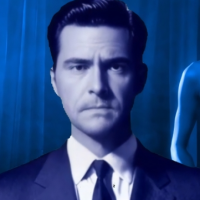
Courtesy AI
Year 2092
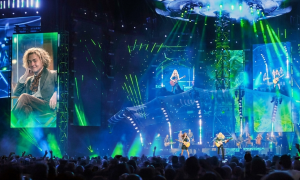
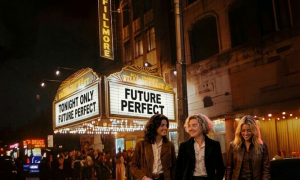
The live planetary broadcast opened to the warm applause of a studio audience. The studio was built in a wide crescent around the stage, its transparent rear wall looking out over the blue curve of Earth. Behind the host's chair, a living projection shifted gently through images from the CCE: the Ganges at dusk, the Apollo marquee, Madeira's cliffs, Lake Tahoe under snow-bright mountains, the dark wood and red velvet of the San Francisco opera house.It is difficult to grasp the connection between the CCE subscribers and musicians of Future Perfect. Naturally, to the band the billion-plus subscribers are strangers. Yet the subscribers, having experienced journeys to the past through the band members' consciousness, know Future Perfect intimately. As a result, there is a palpable sense of connection.
Maya and Chloe sat together on a low sofa, guitars absent for once. Zack and Kyle occupied the chairs beside them, relaxed but alert in the way musicians often seem to be when on stage.
At the edge of the stage, just beyond the primary lights, Xap and Julian watched from the shadows. The interviewer smiled at the band.
"You have now spent what must feel like years inside the CCE timeline," she said. "You've shared stages with The Beatles, Elvis Presley, Bob Marley, Miles Davis, Yusef Lateef, B.B. King—more artists than most musicians could name in a lifetime. So I'll ask what everyone across the network has been asking. What has been your favorite moment?"
The four of them looked at one another.
Maya gave Chloe a small smile.
"That's not fair," Chloe said.
The audience laughed.
"It really isn't," Zack added. "There have been too many. A song can be a favorite moment. A conversation can be one. Sometimes it's just somebody hearing themselves differently for the first time."
Kyle nodded. "Or a room going quiet in the right way."
"So no answer?" the interviewer asked.
Maya leaned toward the microphone. "If I picked one, I'd be leaving out ten others that mattered just as much."
"A diplomatic dodge," the interviewer said.
"A true one," Maya replied.
The crowd applauded again.
The host glanced down at her tablet, then looked back up with the expression of someone about to offer a question she knew would travel. "All right. Let's try this instead. If you could choose any musician from that time—someone you have not yet played with—who would it be?"
For the first time, the four did not answer immediately. Maya's eyes brightened.
"Well," she said, "we've played jazz, blues, blues-rock, reggae, folk, African music. We've had the great blessing of being around people who know where so much of modern music came from." She paused. "But roots music—Western music, Americana, the deep Southern stuff—that's something I'd personally love to explore more."
"Anyone in particular?" the interviewer asked.
Maya smiled. "He isn't as famous as some of the names you've mentioned, but Tony Joe White. He's so authentic. He has that swamp thing—you can't fake it, and you can't really improve it by making it more sophisticated. You just have to meet it honestly." She glanced at the others. "Though I do think we could funk him up a little."
Zack laughed. Kyle nearly fell out of his chair, and the studio audience joined them.
The host turned toward Chloe. "And Chloe?"
"My pick would be even less well known," Chloe said. "A steel guitarist named Buddy Emmons."
Zack and Kyle slapped hands in an immediate high five. "Yes," Zack said. Kyle nodded hard. "Absolutely yes."
Chloe continued, growing more animated. "Buddy has this way of making the steel guitar sound like it has its own interior life. Not just country licks, not just decoration. He can make it ache, laugh, float, disappear. I'd love to put him in a room with us and see what happened."
At the side of the stage, Julian glanced toward Xap. Xap was watching the four musicians with the expression of a man whose calendar had just become considerably more complicated. Julian gave him a quick wink.
"I'm on it," he murmured.
Xap's eyes narrowed with amusement. "It should be a total surprise."
Julian smiled. "Of course."
Oak Island, Alabama—Year 1970
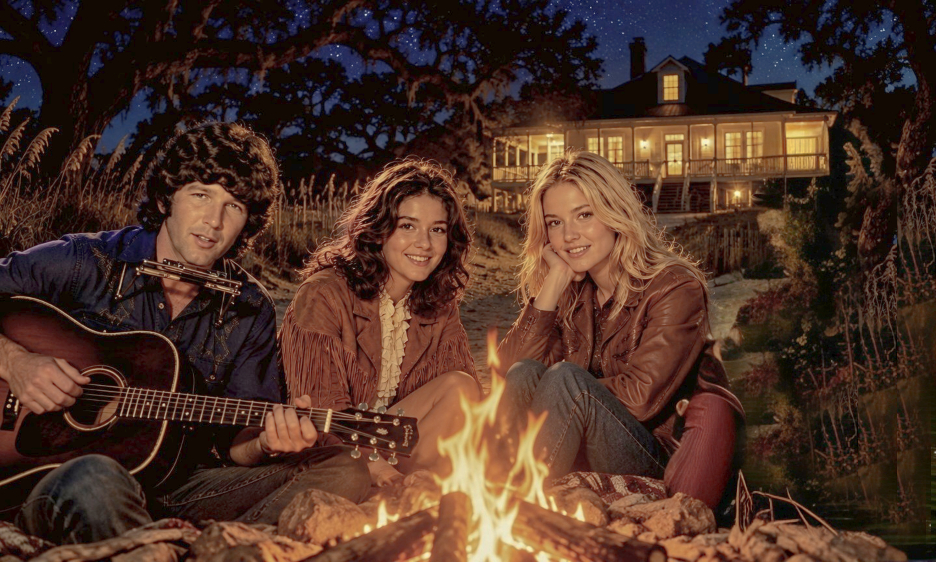
Oak Island was not much on a map. A six-acre patch of green set in the freshwater expanse of Lay Lake in Shelby County, it held water oaks, tall pines, a wooden dock weathered silver by time, and one broad old house built by a lumber family who had wanted privacy more than grandeur.October had settled over Alabama with mild, sunlit afternoons and cool, still nights that kept the bugs away. Beneath the late-afternoon sun, the lake lay calm and iron-dark, reflecting the trees lining the shoreline. For four days, it became the least public gathering in music history.
Xap had rented the entire island through two layers of intermediaries and an Alabama attorney who preferred not to ask questions when presented with a generous retainer. Ray handled the rest locally: a quiet visit to the Shelby County sheriff, a generous cash contribution to the upcoming reelection campaign, and four off-duty deputies hired to patrol the shoreline in flat-bottom boats and keep curious fishermen at a polite distance.
The house had enough rooms for the core guests; guest quarters back near the tree line held the road crew, cooks, and engineers. Invisible to the outside world in the 1970s timeline, but intimately experienced in real time by 1.6 billion subscribers connected to the CCE in 2092.
The guests arrived in waves. The Beatles came first, looking almost suspiciously ordinary in loose shirts, boots, and sunglasses. John pulled a light jacket closer against the breeze coming off the lake before he had made it halfway down the dock. Paul emerged from the launch smiling as he looked around. George stood a moment at the shore, breathing in the quiet, pine-scented air as though the entire lake had been arranged for his benefit. Ringo, seeing the old house and the open lawn, said only: "Now this is more like it."
Elvis arrived that afternoon from Memphis, dressed casually, open at the collar, carrying no entourage beyond one old friend and a garment bag. He stepped off the boat, took in the lawn sloping down to the water, the guitars leaning against the porch rail, and Future Perfect waiting near the steps. "Y'all sure know how to make a man forget he's got appointments," he said.
A short time later, Tony Joe White and Buddy Emmons stood at the end of the dock. For a few seconds, neither of them moved. Maya, Chloe, Zack, and Kyle had been sitting on the porch steps, ostensibly tuning guitars. Maya looked from Tony Joe to Chloe, then to the steel case in Buddy's hand.
Chloe's mouth opened. "No way," she whispered as her eyes lit up.
Tony Joe shifted the guitar case in his hand. "Well," he said in a soft Louisiana drawl, "I reckon somebody told us there was gonna be music."
Chloe stood so quickly she nearly knocked over her chair. "Buddy Emmons?"
Buddy gave her a cautious smile. "Yes, ma'am."
Then Chloe laughed—a bright, disbelieving sound—and crossed the lawn in three strides. Maya was right behind her.
Tony Joe looked at Future Perfect, then past them to Elvis, John, Paul, George, and Ringo, gathered under the shade of the oaks. He took off his sunglasses.
"Either I've taken a wrong turn," he said, "or I'm dreamin.'"
Elvis walked down the porch steps, smiling wide. "Tony Joe," he said, offering his hand, "I been listening to you, son."
Tony Joe shook it, still taking in the scene. "Well, Mr. Presley," he said. "That makes two of us."
"My Daddy ain't here, call me Elvis."
Buddy looked at Chloe's Telecaster, then at the open cases and amps spread across the porch. "You really wanted to play?" he asked.
Chloe stared at him. "For years."
Buddy's smile grew warmer. "Then we ought to get to it."
They set up at sunset. No stage, not exactly. Just an open-sided pavilion near the water, built years earlier for family dances and fish fries.
Someone had run power from the generator shed. Julian had organized a Hammond M3—a smaller, lighter spinet version of the B3 for Monty that still packed the same tonewheel design at a manageable 250 pounds—along with a couple of Fender Deluxe Reverbs and nine Fender Princeton Reverbs. There was a modest PA, Kyle's drums and hand percussion, a tic-tac bass rig, microphones, and plenty of chairs.
The musicians arranged themselves in a loose semicircle. Electric and acoustic guitars with pickups and a mandolin with pickups were passed from hand to hand. Ringo claimed a tambourine. Paul had one of Maya's left-handed acoustic guitars. John sat with an acoustic across his lap and watched everybody with the narrowed attention of a man trying not to reveal that he was having the time of his life.
By nightfall, the island was lit by strings of warm bulbs and the yellow windows of the old house. Beyond the pavilion, the lake had settled into a flat, black silence. Tony Joe stood at the center microphone, his guitar hanging low. "I don't usually do requests," he said.
Elvis, seated at the edge of the circle with a guitar, called back, "You don't have to."
Tony Joe looked toward Future Perfect. Maya gave him a nod. "Your spot," she said. "We're just in it."
He began with "Rainy Night in Georgia." Monty on the M3, Zack on tic-tac bass, and Kyle on drums were on it immediately. Tony Joe's guitar, low and damp with tremolo, harmonica, and his voice came out of the Alabama dark like it had been there before the house was built. Future Perfect did not crowd him. Zack's bass was warm and patient. Kyle used brushes and the softest kick pulse. Chloe placed a few suspended chords into the open spaces. Maya waited until the song reached its first emotional bend, then answered Tony Joe's guitar with notes that seemed to rise out of the dark water itself. The song became wider without becoming bigger. Elvis sat forward, elbows on his knees.
When Tony Joe finished, there was no applause at first. Only the quiet lap of the lake against the bank. Then Elvis stood and walked to the microphone. "Let me try a verse of that," he said. Tony Joe stepped aside, smiling.
Elvis did not imitate him. Instead, he took the song into his own dark, gospel-inflected register, letting the final lines fall almost to a whisper. Maya and Chloe found harmonies around him, low and close.
Buddy Emmons, who had not yet plugged in, sat with his hands folded over the steel case and watched. When the final chord faded, he shook his head once. "That boy can sing," Buddy said softly.
Tony Joe looked toward the sisters. "And those girls," he said. "They don't play behind a song. They listen it forward."
Maya heard him and smiled. "That may be the nicest thing anybody's said about us," she replied.
Tony Joe shrugged, almost embarrassed by the attention. "It's true."
After the mood had shifted from rain and memory toward laughter and grease, Tony Joe began the opening figure of "Polk Salad Annie."
Kyle grinned before the second bar. "Oh, now we're talking," he said.
The groove arrived all at once. Zack took the tic-tac bass, snapping muted notes through the little tube amp. Kyle moved from brushes to sticks, turning the beat into a dry strut. Ringo joined him on tambourine. Chloe chopped rhythm on the backbeat while Maya and Tony Joe traded clipped, nasty little guitar phrases. Elvis was laughing before the first verse ended. By the time Tony Joe reached the story of Annie and the alligators, the Beatles were singing the response lines, and the whole pavilion was moving.
When it came time for the reprise, Elvis stepped forward. "Tony Joe," he said, "mind if I borrow your Annie a minute?"
Tony Joe tilted his head with a wicked smile. "Man, she ain't mine. She belongs to whoever can catch her."
Elvis took the next verse and turned it into something half swamp-funk, half Memphis revue. His body moved with the rhythm, loose and unforced. The crowd of musicians around him shouted the refrains. Maya's guitar cut across the groove in bright, sharp octaves; Chloe locked in beside her; Kyle drove the drums more through rhythm than volume so that the floorboards hummed under their boots. Buddy Emmons had been quiet through all of it. He had set up his steel guitar at the side of the pavilion: pedals gleaming under the strings of lights, volume pedal at his right foot, bar resting on the instrument's neck. Chloe had stayed close by, trying not to stare, failing completely.
Finally Buddy looked toward Tony Joe. "You know 'Night Life'?" he asked.
Tony Joe nodded. "Everybody knows 'Night Life.'"
"Not like we're about to," Maya said.
Buddy glanced at her, amused. "That confidence usually makes me nervous."
"It should," Chloe said.
Buddy laughed. Then they began. "Night Life" unfolded slowly, almost without time. Tony Joe sang the first verse in a low murmur. Elvis took the next, bringing a deep blue ache into the lyric. Zack's bass moved like a patient animal under the chords. Kyle's cymbals barely breathed. Then Buddy played. No one spoke. His steel guitar did not merely decorate the song. It entered the spaces between the words and found rooms inside them. The notes bent and opened, resolving only when they had exhausted every other possibility. Chloe watched his hands, then his feet, then his hands again, trying to understand how one man could make machinery sound so natural. Buddy turned slightly toward her. "Come on," he said.
Chloe blinked. "Me?"
"You asked for this, didn't you?"
She picked up her Telecaster and stepped into the circle. What followed was not a duel. Buddy would never have made it one. He gave Chloe a phrase, a long rising line that ended in a question. Chloe answered on guitar, finding the shape underneath it rather than on top. Buddy smiled and moved again. Maya joined them, weaving a third line between steel and Chloe's guitar. By the end, the three instruments had made something no one could separate into parts.
Elvis, who had been singing, stepped back from the microphone and simply listened. When they finished, he crossed to Buddy and put a hand on his shoulder.
"Man," Elvis said, "I thought I knew what heartbreak sounded like."
Buddy looked down at the steel. "Sometimes it sounds like a string pulled just far enough," he said.
Near midnight, Buddy played alone. The cool night air had brought on a chill, and people had drifted toward a big stone fire pit outside the pavilion. Dry oak logs crackled, sending sparks into an ink-black sky clear enough to show the Milky Way. Buddy sat beneath the pavilion lights and began "L'Hiver Sur La Plage."
The piece moved with the quiet, inward grace of Bill Evans's "Peace Piece," but Buddy's pedal steel gave it another weather entirely. Notes hovered and folded into one another. The melody did not insist on itself. It appeared, receded, returned changed. When Buddy finished, everyone remained silent for several moments.
Then Future Perfect took a turn. Maya smiled, "While everyone was fixated on moonwalks and Woodstock last summer, there was something cool happening at the Montreux Jazz Festival in Switzerland. We're gonna feature Monty on the organ to help us out with Eddie Harris and Les McCann's song 'Compared to What.' Forgive me for reading the lyrics, this is just a warm-up."
"Compared to What" began as a driving, funky question with Monty digging into the Hammond while Zack's bass cut deep and sly. Kyle found a pocket that was more New Orleans than Alabama, planting a hard-swung backbeat that made John Lennon tap his boot against an empty crate. Maya and Chloe built clipped, biting chord figures, and Buddy's steel was on it immediately, slurring through the intervals in a way that made the groove sound both sharper and stranger.
When they finished the opening run-through, they didn't stop—they simply wheeled it right back around to the top. Elvis grabbed the lyric sheet with a grin, stepping up and reading every line with the amused, streetwise contempt of a man who had seen far too much glitter to ever be impressed by it again.
When they reached "Try to make it real, compared to what!" everybody under the pavilion shouted it at the top of their lungs. Then the song broke wide open.
Maya threw a cue with her head toward the organ, and Monty took the first turn. He leaned over the dual manuals, drawing out the Les McCann gospel-grit with heavy, percussive block chords before leaning on the Leslie switch. The speaker horn inside the cabinet spun up to speed, sending out a churning, reedy wail. Monty worked the drawbars on the fly, dragging the organ down to a dark, gutter simmer, then violently slamming the upper register with the heel of his hand until the entire pavilion seemed to vibrate with churchhouse electricity.
Before the roar could settle, Zack brought one hand off the bass, reaching into his jacket pocket and pulling out a silver transverse flute. Passing the bass line off to Monty's left foot on the organ pedals, Zack stepped up to the vocal mic. He blew a fierce, raspy breath tone right into the embouchure hole—channeling Eddie Harris's biting funk bite, humming down the barrel as he played. He ripped through short, pentatonic bursts, overblowing until the notes split into jagged harmonics. He traded furious two-bar punches with Kyle's snare, the flute sounding less like an orchestral woodwind and more like an electrified siren screaming over the Alabama sand.
With a final trill, Zack slid the flute aside, and Buddy Emmons dipped his right knee into the steel's lateral lever. Buddy didn't play jazz the way guitar players did; he played it like an architect pulling apart a building from the inside. He hit the groove on an off-beat, sending long, crystalline glissandos cutting clean across Kyle's syncopation. His bar flew diagonally across the strings, finding microtonal bends and altered dominant grips that made George Harrison sit bolt upright to watch. Buddy made the pedal steel bark with the bite of a tenor sax, then resolved a dizzying bop run with a slick, pedal-pumped slide that landed square on the downbeat.
Chloe was waiting right in the pocket of that landing. Uncoiling a coiled cable, she dug the pick hard into her Telecaster's bridge pickup. Where Buddy had floated, Chloe attacked. She leaned into a syncopated, staccato funk assault, slicing off clean, blues-drenched double-stops that answered Buddy's modern chords with pure telepathic grit. Her fingers danced high on the neck, throwing in jagged chromatic bends and rhythmic chucks against the muted strings, playing with time as if she had all the hours left in the night to spend. Elvis let out a sharp whoop, and Chloe snapped her wrist, tossing the final phrase across the circle to her sister.
Maya caught it instantly. With the glass slide already gleaming on her ring finger, she struck high on the neck. The slide didn't cry country—it whined with raw, stinging delta grease, overdriven and ferocious. She leaned over the strings, using her bare thumb to pluck with heavy, percussive snaps. She tore through low, swampy growls before rocketing straight into the stratosphere, sustaining a blistering, vocal cry that mirrored the ache of the lyric. She locked eyes with Tony Joe, who leaned forward with a slow grin, watching her bend pitch with a precision that was terrifyingly soulful. Maya dragged the glass back down the bass strings with an abrasive, descending scrape, landing right on the root just as Kyle crashed the ride cymbal and brought the whole band slamming back into the monstrous, unified vamp.
After a break, the Beatles took over around 1:00 a.m. Someone had passed around hot coffee. Someone else had found a bottle of bourbon. The fire had settled into a bed of red coals, warming the circle of chairs against the dropping temperature. The mood shifted. "We've got a few that might suit the neighborhood, Buddy. I can't wait to hear what you can do with this!" Paul said with a wink. Looking at Future Perfect he said, "Up for some harmony?"
They began with "Baby's in Black." The song, already touched by country darkness, found a new center with Buddy's steel behind it. Chloe and Maya stood at a shared microphone, their harmony wrapping around John and Paul's voices with close, Appalachian precision. George played an acoustic, looking happier than anyone had seen him in weeks.
Then came "I've Just Seen a Face." It started simply: Paul's acoustic guitar, a quick pulse from Ringo, the sisters' harmony lifting the chorus. Then Buddy took the middle. Maya joined him first, her acoustic guitar moving into fleet, ringing runs that turned bluegrass vocabulary inside out. Chloe followed on mandolin, her notes flying bright and exact. Buddy's steel rose through them both, somehow keeping the whole thing grounded while making it feel like the song had grown wings. By the end, Paul was laughing so hard he nearly missed his vocal entrance.
They closed with "Wait." It was John's choice. "Always liked this one," he said. "Never quite knew what to do with it." Buddy's steel gave the verses a slow ache. Chloe and Maya found high harmonies that turned the chorus luminous. Tony Joe added a small, swampy guitar line under the bridge. Elvis stood just outside the circle, listening—perhaps hearing the song for the first time.
When it ended, John looked around at the musicians gathered beneath the fading stars. "I wish we had had you lot in the studio with us."
They sat around the fire with jackets and wool blankets pulled close, instruments laid carefully in their cases. A light mist hung over the calm surface of Lay Lake, and the water turned pale gray as the dark receded. Along the shoreline, an early heron stepped silently through the shallows.
Tony Joe sat beside Future Perfect, a cup of coffee in both hands. "You four don't play like you're trying to prove anything," he said.
Kyle smiled. "That's a pretty good way to get in trouble with the record business."
Tony Joe considered that. "Maybe." He looked out over the quiet water. "But music knows when somebody's trying to sell it a suit."
Maya laughed softly. Buddy was seated nearby, his steel case closed at his feet. Chloe had not drifted far from him all morning. Finally he looked over at her.
"You hear a lot," he said.
Chloe looked down, suddenly shy. "I try to."
"No," Buddy said. "Most people try to play. You listen first." He nodded toward her guitar case. "Keep that. The steel will tell you what it wants if you don't make it explain itself too fast."
Chloe held his gaze and nodded.
Elvis sat on a cedar bench with Tony Joe, both men looking out across the cove. "You know what I like about them?" Elvis said.
Tony Joe glanced over. "What's that?"
"They don't come in acting like they're here to rescue anybody." Elvis smiled. "They just make room. Then somehow you hear what you had in you all along."
Tony Joe nodded slowly. "Yeah," he said. "That's it."
Up toward the porch, just beyond the reach of the dying firelight, Xap and Julian stood together in the crisp morning air. They had remained mostly invisible all weekend, content to let the music do what music did when nobody tried to turn it into a product. Julian watched the musicians by the fire: Beatles, Elvis, Tony Joe White, Buddy Emmons, and Future Perfect. No audience except one another—and, beyond the veil, the vast silent field of subscribers in 2092. Xap let out a slow breath.
"You outdid yourself," he said.
Julian kept his eyes on the lawn. "I only hired a few boats."
Xap smiled. "Imagine how the subscribers experienced the surprises you organized. A waking dream of the highest order."
By unspoken agreement, Xap and Julian followed the Bro Rules, emotions and feelings remained where they were supposed to be, stuffed down in a drawer no one else could access. But as the sun began to clear the pine ridge across the lake, Xap opened it.
"My original CCE idea was simply to return to a lifelike recreation of the past and experience the magic of that time. Then the unexpected awakening of consciousness. But your idea—to introduce the best of our era into that timeline to interact—that was genius. It not only reshaped the music in an unimaginable way, but subscribers experience what it is like to be part of it, on stage while it's happening. Inspired, surprised—the joy, the rush, all of it. Now you and I are bystanders in it, but remember the thrill of our first CCE stream when the Beatles played with them in India? That, my friend, is your legacy."
Julian watched the sunrise, his eyes drifting over to John and Paul, who were deep in conversation with Elvis. He answered through deflection: "They were great solo artists, but as a team? Genius." For one brief, perfect moment, the island held no past and no future—only the morning chill, the smell of woodsmoke and pine, and the lingering certainty that something extraordinary and inexplicable had happened. And because they could not explain it, they, and their subscribers, would remember it.
The Next Day
The sun had climbed high enough that the mist had burned off entirely. The grounds were empty, save for the lingering scent of woodsmoke. Maya and Chloe stood on the deck of the old house, watching the last of the boats ferry the crew off the island. The silence felt heavier now, charged with the memory of the music that had swirled just hours ago. Xap and Julian stood a few feet away, leaning against the railing, sharing a quiet coffee."We have to ask," Maya said, her voice soft. "We've been trying to figure it out all night. We know Elvis. We know the Beatles. They don't just clear their schedules for a random jam session in Alabama. How did you actually get them here?"
Julian set his mug down on the railing, exchanging a look with Xap. There was no corporate slickness in their expressions, just the satisfied look of men who had pulled off the impossible.
"It wasn't complicated," Xap said, smiling. "We didn't pitch a 'supergroup event.' We didn't talk about industry optics, or historical legacies."
"We just told them the truth," Julian added. "We told them it was your birthday. And that you didn't want a party, a fuss, or anyone to know. You didn't want the lights, the crowds, or the noise."
Chloe blinked, surprised. "You told them that?"
"We told them what you wanted," Xap continued, "was to be completely out of the spotlight. You wanted to be among friends. We asked them if they would be willing to just show up, leave the entourage, and help you spend a day just playing music, the way it's meant to be played. We told them it was your only wish."
Maya leaned against the railing, processing that.
"And we told them something else," Julian said, his eyes crinkling. "We told them we knew you were dying to play with Buddy and Tony Joe, but it was a surprise. We told them that having them there—just to sit in the circle—would be the only reason the surprise would work."
Chloe looked out at the water, a slow, genuine smile spreading across her face. "So they came because they thought they were helping us celebrate?"
"They came because for the first time in a decade, someone wasn't asking them for a song, or a signature, or a photo," Xap said. "They came because you gave them an excuse to be human. They weren't there as icons. They were there as guests at your table."
Maya looked at her sister. The realization hit them both: the magic hadn't been orchestrated by high-level manipulation, but by the simple, radical act of treating their heroes like people.
"Happy birthday, you two," Xap said quietly, raising his coffee cup toward them.
"The best one yet," Julian added. Maya laughed, the sound bright and untroubled. They stood there for a long moment, four people in the quiet of a southern morning, knowing that for a brief, flickering window in time, they hadn't just changed the world—that world had also changed them.
Disclaimer
This is a fictional account exploring what might have happened if a temporal quantum event had occurred. While real musicians and historical figures appear within these pages, they exist here in an alternate timeline—a reality that quantum theory suggests was possible, but that never came to pass. All interactions, conversations, and events involving these individuals are entirely fictional, products of a world that exists only in the space between what was and what might have been.About the Series
Future Perfect follows a time-traveling band from the year 2092—winners of a planet-wide musical talent search—who journey back to the golden decade of 1964 to 1974. Over a billion subscribers plug into the Chronos-Consciousness Engine (CCE) to experience the band's exploits first-hand in a vivid, waking-dream state. Originally designed as a hyper-realistic historical simulation, the sheer volume of connected minds has triggered a quantum event that is drawing actual consciousness into this alternate reality. Ideally, new readers should start at the beginning of the series.
 FOLLOW Blue Note Portal
and get notified whenever a new article published.
The Blue Note Portal: a garage-assembled '70s microcomputer relic, eternally portaling through jazz timelines with Serling-esque irony, hacking bebop anomalies into binary swing for the ultimate improvised reboot.
Tags
PREVIOUS / NEXT


Become a Sustaining Member

Since 1995, All About Jazz has championed jazz as an art form and supported the musicians who create it. Over three decades, it has grown into one of the world's leading jazz resources, serving hundreds of thousands of readers, musicians, presenters and industry professionals each month.
Help Build the Future of All About Jazz
Your support helps us continue building All About Jazz for the next generation—expanding our editorial coverage, preserving jazz history, developing new community features and creating better ways to discover the music and the people behind it.
Become a sustaining member for as little as $20 per year and you'll immediately enjoy an ad-free experience along with access to subscriber features and future articles for a full year.
Together, we're not simply sustaining All About Jazz—we're building its future. Thank you for being part of the journey.