Home » Jazz Articles » The Blue Note Portal » Future Perfect—3. Miles from the Center
Future Perfect—3. Miles from the Center
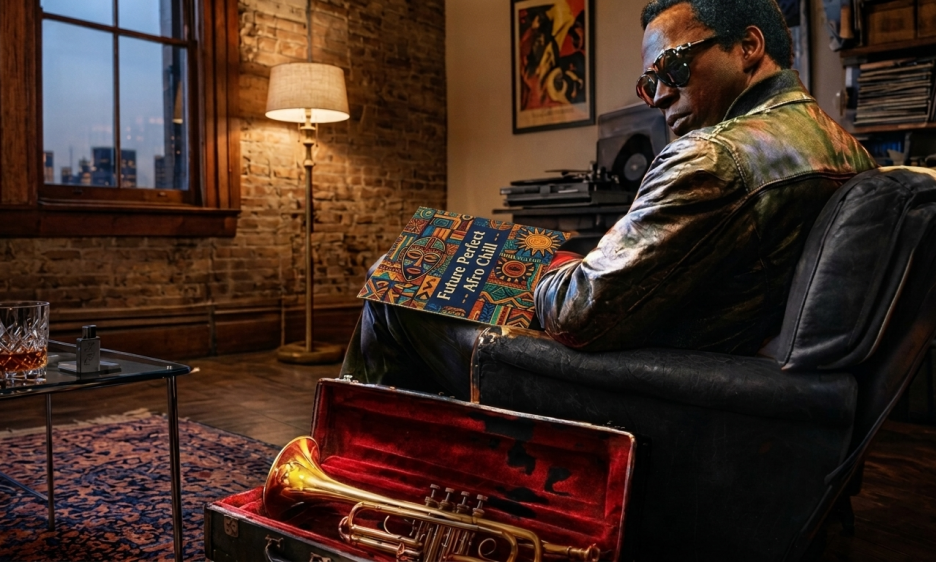
Courtesy AI
He didn't call Teo Macero back right away. He paced. His hip fired sharp, white-hot needles down into his leg with every turn, a constant agony that a tumbler of cognac and two Percocets had barely softened. The line of cocaine on the glass coffee table was gone, but his jaw remained clenched tight.
Afro Chill.
The record sat on the turntable like an open accusation. He'd tried going back into Columbia with Teo, but the sessions had disintegrated into furious, unformed jams. He had yelled at the tape operator, blown three harsh, distorted notes through a wah-pedal, and kicked an amplifier stand before walking out into the rain. The dense, clattering sprawl of Bitches Brew—the jagged wall of double drummers, distorted Rhodes, and abrasive funk—suddenly felt cluttered to him. It felt like noise trying to bludgeon a path forward, while these kids from nowhere had simply opened a window and let the room float away.
Worse, they had used his guys. Herbie. Chick. Julian Adderley.
Two days later, Miles tracked Herbie Hancock down at a café near Greenwich Village. Miles sat slouched behind his dark oversized shades, his tailored leather jacket creaking as he leaned across the table.
"What was that?" Miles rasped, his voice low, gravelly, and stripped of pleasantries. "What the hell did they give you over there in London?"
Herbie stirred his espresso, completely unfazed. "Purity, Miles. Space. We didn't play charts. We didn't even chase solos. We just listened to the space between the notes."
"Bullshit," Miles hissed, eyes darting toward the street outside, checking the shadows, his paranoia humming. "They doctored it. It's Beatles studio magic crap."
"They just captured it," Herbie said gently, looking directly into Miles's dark lenses. "They don't play like they're trying to win an argument, Miles. They play like they already know the end of the story."
When Miles called Cannonball, the altoist just gave that booming, resonant laugh over the telephone wire. "Miles, don't go looking for a fight where there's only music. Go hear 'em yourself."
Miles slammed the receiver down. I follow no one, he repeated to himself like a mantra. I don't repeat myself. And I sure as hell don't ask for directions.
A month passed. Afro Chill didn't reach the volcanic commercial numbers of the Beatles' Apollo record or Elvis's explosive Mississippi to Memphis, but it sat at number three on the charts—a jazz album—and it moved through late teens, college campuses, and late-night FM radio like a quiet contagion. The jazz purists bickered in the columns—some called it anti-intellectual minimalism, others hailed it as the only true evolution since modal jazz—but the youth didn't care about the columns. They put the needle down and let it breathe.
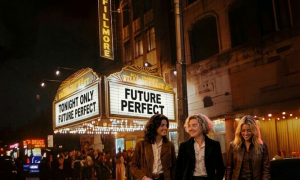
Then came the murmur through the grapevine: Elvis Presley's Liverpool film was having an exclusive, invitation-only premiere in Liverpool. A private gathering of barely one hundred and fifty people.
Miles Davis, a man who rarely crossed the street to see anyone, spent forty-eight hours calling in every favor, every promoter, and every offshore contact he had. He had to be in that room.
Act II: The Gathering at the Mersey
The Liverpool reception room smelled of champagne and high-society perfume. George Lucas's documentary cut of the Philharmonic concert was still ringing in the heads of the crowd, but the room itself was a constellation of titans—John Lennon and Paul McCartney leaning against a marble pillar, the who's who of British rock scattered in clusters, and Elvis holding court near the fireplace.Miles stood near the velvet drapes, wearing an electric-blue silk shirt and dark glasses, holding a glass of scotch he barely touched. His movements were jerky, his weight shifting off his bad hip every few seconds. His eyes flicked across the room, tracking every exit, every shadow, running on high-grade cocaine and sleepless adrenaline.
A few yards away, Dr. Kiran stood observing him. The scientist and yogi watched the jagged aura surrounding the trumpeter—a fractured, flickering field of immense creative fire wrapped around a restless, dislocated spirit.
Kiran stepped beside Maya, Chloe, and Xap.
"The trumpeter," Kiran murmured softly, his voice calm amidst the chatter. "He is not truly present. Pain—physical and emotional—has pushed him outside his own center. He is searching, but he is fleeing."
"Miles Davis," Maya whispered, glancing over. "He actually came."
"Be gentle," Kiran advised. "The ego is a brittle shell when the spirit is wandering."
Miles set his glass down on a passing tray and cut through the crowd. He approached the hearth where Elvis was talking with Maya and Chloe.
Miles stopped, his posture stiff, hands buried in his leather coat pockets. In that sandpaper rasp that cut through the room's ambient hum, he looked at Elvis:
"You surprised me."
Elvis turned, momentarily perplexed by the small, dark, intense figure staring at him. Before the silence could stretch into discomfort, Maya smoothly stepped into the space with an easy smile.
"Miles Davis," Maya said warmly. "What a surprise to see you in Liverpool."
Elvis's Southern manners immediately kicked in. A gentlemanly grin broke across his face. "Pleasure to finally meet you, Mr. Davis. I've admired your work for a long time."
Elvis offered a warm nod and excused himself to greet Jimmy Page.
Miles remained fixed where he stood. Behind the dark tint of his glasses, his eyes locked onto Maya and Chloe. For ten long, excruciating seconds, nobody spoke. The sisters simply met his gaze with unhurried, patient warmth, completely free of the intimidated awe Miles usually commanded.
Just as Chloe began to shift her weight to move along, Miles spoke, forcing the words through his throat:
"I'd like to meet with you. And the rest of your group."
Maya tilted her head slightly. "About what?"
The question caught Miles off guard. Nobody asked Miles Davis about what. You were supposed to drop everything and wait for the maestro to speak. He tightened his jaw, suppressing the instinctive urge to bark an insult to guard his vulnerability.
"Sound," he rasped dismissively, looking away for half a second. "Music. Whatever."
Chloe smiled, bright and disarming. "We've got to make the rounds right now, Miles. But Yusef Lateef is here. Talk to him. He can introduce you to our manager, and he'll give you our contact info."
Miles had meant the core band—the players—not a manager. But rather than argue, he merely tipped his chin, turned on his heel, and stalked toward Lateef.
Act III: The Loft in New York
Five days later, sunlight cut through the tall industrial windows of Future Perfect's loft in Lower Manhattan.The friendship between the band and Yusef Lateef had grown profound; Lateef sat comfortably on a low sofa, sipping mint tea, discussing African microtonal intervals with Zack and Kyle.
A sharp, impatient knock rattled the wooden door.
Julian opened it, and Miles Davis stepped inside—surprisingly punctual to the minute. He wore a dark leather jacket, his eyes darting across the open space, taking in the guitars resting on stands, the tape machines, the quiet simplicity of the room. He looked thin, coiled like a spring, the residual tremors of sleeplessness and stimulants humming through his hands.
He sat on an ottoman, not taking off his jacket.
"That record," Miles began abruptly, his voice a harsh dry scrape. "Afro Chill. What are you doing next? You burned that sound up. What's left?"
Maya leaned against the rustic kitchen counter, holding an acoustic guitar lightly against her hip. "Yeah, I mean... we didn't really know each other that well, and we recorded that whole thing in three days. We've got plenty of material. We could cut two double albums tomorrow if we felt like it."
Miles scoffed, a gruff, dismissive sound. "Yeah, I get that. I was in that spot once. But art... I can't repeat myself. Once it's done, the past is the past. You move or you die."
Chloe let out a soft, heartfelt laugh—entirely devoid of mockery, radiating pure, innocent charm.
"Thank God Bach, Mozart, Debussy, and Vivaldi didn't think like that about their gifts," Chloe said with a grin. "Imagine if Bach wrote one fugue and said, 'Well, that's over, what's next?'"
Miles blinked. He looked ready to lash out, but the absolute sincerity and warmth in Chloe's eyes disarmed him before the anger could form.
From the sofa, Yusef Lateef set his tea down. His deep, resonant voice filled the loft like a church organ.
"The modern world is obsessed with the concept of novelty, Miles," Lateef said gently, embarking on a quiet mini-lecture. "We confuse progress with motion. But music in its true, ancient form is not linear. It is circular. It is an exploration of the eternal breath. An autophysiopsychic expression. When you touch a true frequency, you do not abandon it because the clock moved. You inhabit it until its healing work is finished."
Miles stared at the floor, chewing on the inside of his cheek, silent.
In the corner near the stove, Dr. Kiran caught Maya's eye and gave a subtle, beckoning nod. Maya quietly slipped into the kitchen space beside him.
"Just so you know," Kiran whispered, his eyes gleaming with quiet wonder, "he appears to actually be here now. His soul has settled into the room."
Maya nodded once, taking a steadying breath, and walked back into the living space.
She waited for a natural pause in Lateef's rhythmic voice, then looked directly at Miles.
"Miles," Maya said softly, "if you'd like, you could sit in on a couple of tracks when we go into the studio. We're recording here in New York, at the Record Plant East."
The defensive reflex fired in his throat immediately—the legendary pride flaring up. He caught himself, swallowing down the sharp rebuke, though his jaw remained rigid.
"Hmm," Miles rasped, tilting his head. "That might be interesting. But I no longer make guest appearances."
Maya smiled, exchanging a brief, knowing glance with Chloe, then looked warmly back at Yusef.
"We think of ourselves as a backup band anyway," Maya said gently. "And really, at the end of the day, it's all about truth, spirit, authenticity, and emotion. Or, in one word: music."
Chloe leaned forward from the edge of a flight case, offering an easy, low-stakes compromise.
"Tell you what, Miles," Chloe said softly. "If you've got some ideas, just come by a session. Let's see what happens. We don't have to release a single thing. Let's just find out what happens."
Lateef watched the exchange from behind his glasses, deeply impressed by the grace of the two young women. They had deftly dismantled the trap of Miles's towering ego, allowing him to save face entirely while leaving a clear, unthreatened door wide open.
Miles looked from Maya to Chloe, then down at his hands. He didn't say yes. He didn't say no. He simply nodded once, stood up, and left the loft as quietly as he had arrived.
Act IV: The African Impressionist
Three nights later, the Record Plant East on West 44th Street was bathed in low, amber light—after some negotiation, Miles having insisted on no engineers present beyond the bare minimum.There were no massive banks of Marshall stacks, no chaos of competing rhythm sections. Just Zack on a custom-made fretless electric bass, Kyle with his two African percussionists, Chloe holding a warm hollow-body Gibson, Maya with her Les Paul, Monty on keys, and Yusef Lateef on tenor sax.
Miles stood in the center of the wooden floor. He had left the sunglasses in his leather case. His red trumpet gleamed beneath the soft lights.
He didn't speak a count-off. He simply raised the horn to his lips.
The sound that emerged was breathtaking—a muted, haunting, impressionistic melody that bent like mist over water. It was filled with profound melancholy, floating over an ethereal, modal canvas that Zack and Kyle immediately met with the quietest, most disciplined pulse: a subtle, polyrhythmic heartbeat underneath wide, suspended chords.
The melody hung in the air for several minutes, exploring pure color and breath, stripping away every ounce of pretension until only raw emotion remained.
When the last note evaporated into the vast ceiling, Miles slowly lowered the trumpet from his lips.
He stood there for a moment, chest rising and falling, his eyes clear and remarkably still for the first time in years. He looked across the room at Maya, Chloe, and the band.
In his low, raspy voice, he broke the silence:
"After we talked... I was thinking. What if Debussy's mama had been African? What would his music have sounded like?"
Disclaimer
This is a fictional account exploring what might have happened if a temporal quantum event had occurred. While real musicians and historical figures appear within these pages, they exist here in an alternate timeline—a reality that quantum theory suggests was possible, but that never came to pass. All interactions, conversations, and events involving these individuals are entirely fictional, products of a world that exists only in the space between what was and what might have been.About the Series
Future Perfect follows a time-traveling band from the year 2092—winners of a planet-wide musical talent search—who journey back to the golden decade of 1964 to 1974. Over a billion subscribers plug into the Chronos-Consciousness Engine (CCE) to experience the band's exploits first-hand in a vivid, waking-dream state. Originally designed as a hyper-realistic historical simulation, the sheer volume of connected minds has triggered a quantum event that is drawing actual consciousness into this alternate reality. Ideally, new readers should start at the beginning of the series.
 FOLLOW Blue Note Portal
and get notified whenever a new article published.
The Blue Note Portal: a garage-assembled '70s microcomputer relic, eternally portaling through jazz timelines with Serling-esque irony, hacking bebop anomalies into binary swing for the ultimate improvised reboot.
About Miles Davis

Tags
PREVIOUS / NEXT

Become a Sustaining Member

Since 1995, All About Jazz has championed jazz as an art form and supported the musicians who create it. Over three decades, it has grown into one of the world's leading jazz resources, serving hundreds of thousands of readers, musicians, presenters and industry professionals each month.
Help Build the Future of All About Jazz
Your support helps us continue building All About Jazz for the next generation—expanding our editorial coverage, preserving jazz history, developing new community features and creating better ways to discover the music and the people behind it.
Become a sustaining member for as little as $20 per year and you'll immediately enjoy an ad-free experience along with access to subscriber features and future articles for a full year.
Together, we're not simply sustaining All About Jazz—we're building its future. Thank you for being part of the journey.