Home » Jazz Articles » Book Review » The Da Capo Best Music Writing 2005
The Da Capo Best Music Writing 2005
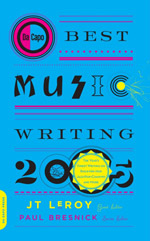 Da Capo Best Music Writing 2005
 JT Leroy, Guest Editor; Paul Bresnick, Series Editor
Trade Paperback; 202 pages
ISBN: 139780306814464
Da Capo Press
2006
'Tis hard to say if greater want of skill
Appear in writing or in judging ill,
But of the two less dangerous is the offense
To tire our patience than mislead our sense
Some few in that but numbers err in this,
Ten censure wrong for one who writes amiss
A fool might once himself alone expose,
Now one in verse makes many more in prose.
— Alexander Pope, Essay on Criticism
In its fifth year the Da Capo Best Music Writing 2005 chimes in with its slimmest volume yet. At just over 200 pages, it's dwarfed by the 2004 edition (360 pages). Was less good music writing written? To be sure, the volume could have included several other pieces, as evidenced by the two pages of citations under "Other Notable Essays of 2004. But the collection does have its charms in the form of shorter, easier-reading essays. The guest editor is the enigmatic author/lyricist JT LeRoy. LeRoy spins a gleefully irreverent introduction by previous standards. By weaving together Geoffrey Chaucer, Motorhead, and personal stories, LeRoy introduces the most interesting collections of authors yet assembled for the series.
The collection opens with Ingrid Sischy speaking with socio-sexual pop goddess Camille Paglia for Interview about rock style and closes with Tom Roche's Stomp and Stammer piece "There is a Light That Never Goes Out about broadcaster John Peel. In between are a few surprises.
Past volumes of Da Capo Best Music Writing have been dominated by essays on hip-hop. Not this time. In fact, the newest addition addresses older musics and forms, though hip-hop does make an appearance. There are two articles devoted to the Clash's 1979 masterpiece London Calling. Michael Corcoran, writing in the Austin-American Statesman, addresses "1979 Calling as a siren marking the X made by the intersection of punk and rap. Corcoran sums up the morning of rap and the evening of punk. He notes the similarities and differences between the two genres and how effectively one dovetails into the other.
He sums up the relationship between the two by saying, "As 1979 became the '80s, there was nothing more for punk rock to do than listen to rap..." and concluding his tome with this observation in the face of the dramatically different culture today: "...But to listen to music that's popular today, from Kanye West and Ludacris to the Strokes and Franz Ferdinand, and 1979 could almost pass for last month."
Sasha Frere-Jones' New Yorker article "1979: The Year Punk Died, and Was Reborn, again addresses the Clash, this time crossed with the Ramones and accepting the responsibility for punk in the 1980s:
In 1979, The Clash were experiencing some pressure. Whether they wanted it or not, punk rock had become their responsibility. In New York, the Ramones had come up with the musical idea of reducing rock to three chords, doubling the volume, and accelerating songs until they sounded like Morse code. In London, the Sex Pistols had turned disgust into an ideology and made punk a historical moment, inspiring teenagers across England to start bands. But by March of 1979, the Ramones had become more interested in being themselves than changing the world, the Sex Pistols had disbanded, and The Clash, feeling burned out, had fired the manager who helped put the band together in 1976. Yet they still owed CBS a record.
That record, or course, was London Calling. These quotes are among the best offered by this edition of Da Capo Best Music Writing.
Beyond the Clash fixation are a few nuggets. Luke Sante recalls Buddy Bolden's invention of "Funky Butt with a mini-history of the word "funky. Greil Marcus speaks to the "Lost Boy in Buddy Holly, and Robert Christgau explores Minstrelsy and Jim Crow. Almost ending the collection is Ray Charles ghost biographer David Ritz writing on "The Last Days of Brother Ray for Rolling Stone, offering an unflinching and bracing account of the end of that Great One.
Let's just call this an off year for Da Capo Best Music Writing, but appreciate what it did contain.
 FOLLOW C. Michael Bailey
and get notified whenever Michael has a new article published.
FOLLOW C. Michael Bailey
and get notified whenever Michael has a new article published.
I'm Sanctified and Southern Fried / Mama tried and daddy cried / I tell the truth 'cept when I've lied / And like my huevos on the side.
Tags
PREVIOUS / NEXT

Become a Sustaining Member

Since 1995, All About Jazz has championed jazz as an art form and supported the musicians who create it. Over three decades, it has grown into one of the world's leading jazz resources, serving hundreds of thousands of readers, musicians, presenters and industry professionals each month.
Help Build the Future of All About Jazz
Your support helps us continue building All About Jazz for the next generation—expanding our editorial coverage, preserving jazz history, developing new community features and creating better ways to discover the music and the people behind it.
Become a sustaining member for as little as $20 per year and you'll immediately enjoy an ad-free experience along with access to subscriber features and future articles for a full year.
Together, we're not simply sustaining All About Jazz—we're building its future. Thank you for being part of the journey.