Home » Jazz Articles » Live Review » Summer Bummer 2026
Summer Bummer 2026
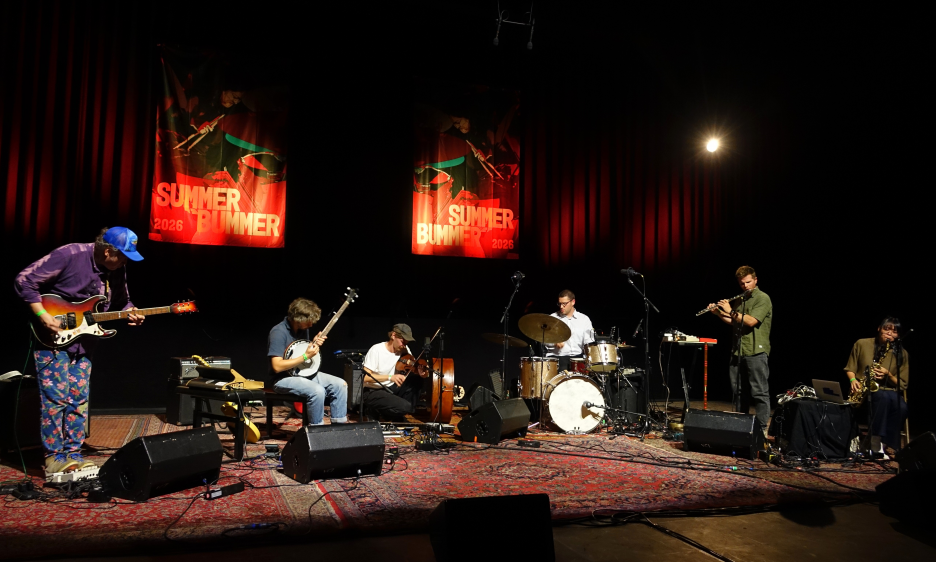
Courtesy John Sharpe
With its great sound, top notch programming, attentive audience and comfortable seating, lovers of adventurous goings on will be eagerly awaiting the line up for next year’s event.
Trix, Antwerp
Belgium
August 28-29, 2026
Intro
The 11th edition of the Summer Bummer festival more than lived up to the promise of the mouth-watering bill, presenting a wide variety of experimental music without fealty to any particular genre. While Summer Bummer inevitably tips its hat to the local Belgian improvised music scene, it is notable for bringing in projects not routinely heard elsewhere, including one world premiere. Trix—more often a rock venue—once again played the host. The unassuming box-like complex sits on one of Antwerp's outer ring roads, well away from the bustle of the city center, but still accessible for anyone staying within it.The 14 acts alternated between a main stage in a seated auditorium, and a smaller stage in a room usually without seating, adjacent to the venue's café bar. Further space, both inside and out, allowed people to relax, browse record stalls and eat the delicious food on offer. As usual with such occasions, visitors from across the continent swelled the ranks of local aficionados, and the main auditorium was virtually full both nights.
While the international nature of free improvisation has long been recognized, it was noteworthy that almost every act united members from multiple countries, and sometimes continents. However rather than a festival pot pourri throwing together exotic ingredients, almost all were extant groupings, in which the diversity of approaches was one of the main attractants, proving once again that attitude outweighs location every time. Every set harbored interest, but two piano / drum duets particularly stood out.
Marta Warelis / Mariá Portugal
Piano/drum duets can become a percussion summit, but Polish pianist Marta Warelis and Brazilian drummer Mariá Portugal straight away subverted the parameters in an outing that was edge-of-seat stuff throughout. Portugal's plaintive opening calls on a small mouth organ prompted a rejoinder of sparse resonant chords to establish a spacious open mood. Portugal then sang a repeated refrain, one that provided a thread of continuity, even as she wove in cymbals and drums, and the context changed.Singing was forgotten when Warelis upped the intensity. If it can sometimes seem that the pianist loves to immerse herself in the group sound, here she was fiercely present. Both ran amok: Portugal whirling fluidly around her kit with dramatic flourishes, Warelis hammering clusters, reiterated motifs, and back-of-hand glissandos in the treble, in a detonation worthy of comparison to Cecil Taylor's numerous excursions in the form. But they channeled delicacy too, noticeable in almost melodic figures atop a rumbling tattoo, and a rare empathy evidenced when Portugal again added a tuneful layer, which Warelis fleetingly mirrored before again pushing further out, in a flailing solo explosion.
Rather than echoing the tumult when she re-entered Portugal gripped a colorful tangle of shakers between her teeth and wielded small mallets in her hands for an assault on assorted woodblocks. In the subsequent shuffle of tonalities, Warelis deployed scrabbling forays up and down the keys, but notably didn't delve under the bonnet. Even when they stopped playing, Warelis was so in the zone that she sat for what felt like an age before she acknowledged that the piece was complete. The audience too sat in rapt silence, not daring to pre-empt an ending.
The encore could not have been more different. Warelis applied tape to the strings and worked inside the piano, while Portugal bowed cymbals and sang honeyed phrases. Squeaks and squeals rose and fell as one, an intimate interplay that made plain that the duet's earlier clamour was only one aspect of their musical dialogue.
Alexander von Schlippenbach / Paal Nilssen-Love
A generation or two older, storied German pianist Alexander von Schlippenbach and Norwegian drummer Paal Nilssen-Love might have been less tempestuous, but were no less enthralling. Although long acquainted, the German pianist and Norwegian drummer first played together in a quartet assembled for the Peter Brötzmann Celebration at London's Café Oto in February 2024. Further concerts followed, including their first duo in January this year, and nothing in this encounter suggested that familiarity had settled into routine.Nilssen-Love sounded gongs to start the set. Schlippenbach answered with measured splashes. Quickly the give and take took on a rhythmic dimension, with agile jazz-infused runs and brushed patterns. Schlippenbach kept his eyes glued on the drummer throughout, in a set that was receptive and conversational. But in addition he applied a certain rigor derived from a composer's ear of such focus that he is able to introduce structural principles from New Music into his freewheeling jaunts. Seemingly inexhaustible, Schlippenbach pursued his muse through atonal austerity, the American songbook and Monk-like intervals, but never opted for prolonged quotation. Nor did Nilssen-Love encourage it. In one of several unaccompanied interludes, Schlippenbach set up a walking line in the bass, only for the drummer to disrupt it with intensely mutating hi-hat patterns, demarcating time without a fixed meter.
Nilssen-Love ranged widely from skins to tambourine to malletted cymbals, allying precise momentum to timbral ingenuity. Responses never seemed rote. A tappy Latin-inflected exit from one episode of controlled commotion enticed Schlippenbach into a tango-like sequence, then later when locomotive drive morphed into ballad, Nilssen-Love's shrilly blown whistle undercut any sentimentality. The set finished with the two musicians still testing how far a musical conversation could stretch as a short encore navigated a tryst between drawn out finger rubs across metal and slinky glides along the keyboard. Cue more tumultuous applause.
Rodrigo Amado/ Joëlle Léandre/ Gerald Cleaver
The debut performance by the trio of Portuguese saxophonist Rodrigo Amado, French bassist Joëlle Léandre and American drummer Gerald Cleaver delivered another highlight. Cleaver has recorded separately with both the reedman and the bassist, but this was Léandre's first rendezvous with Amado. Although lined up as a classic saxophone trio, with such formidable improvisers involved, they tested the limits of the format to breaking point. From the outset, their three way leap into the free jazz continuum proved sufficiently fluid that each musician could redirect the music at will.With her authoritative tone, peerless arco technique, ecstatic phrasing, and rich palette, Léandre transformed proceedings, furnishing depth and nuance to even the briefest exchanges. Cleaver too was an inspired choice as he brought a volatile unconventional slant to both rhythm and texture—whether manifest through dull thumps on blanketed drum heads or persistently scraped cymbals—that again shifted the paradigm.
Amado was if anything more restrained than usual, reaching his peaks without lingering there, preferring instead to probe and parry. Sometimes airily lyrical, elsewhere gruff and insistent, he found an especially strong partner in Léandre. Both generate structure as they go. Her sawing figures meshed powerfully with his nagging motifs as bursts of rhythm propelled the music forward, while she braided high bowed cries with Amado's falsetto yelps. A paragon of responsiveness and technique, at one point she answered a Cleaver rat-a-tat with repeated taps on her fingerboard while simultaneously sustaining a filigree of high tones.
The saxophonist has a history of working with strong drummers—Chris Corsano, Gabriel Ferrandini and Gerry Hemingway all come to mind—and Cleaver too belongs on that list. His chattery pulse and eruptive accents, avoiding the typical bombast, resulted in a striking duet with Amado at the beginning of the second piece. Léandre frequently lends a theatrical component to the discourse, and she and Cleaver traded vocal interjections on the third piece over a percussive rattle, eventually supplemented by Amado's incantatory vibrato dirge. Their music thrived on such collisions.
Daughter Daughter
For Daughter Daughter the convergence of charts and spontaneity proved superbly productive. During an unbroken set, Argentinean tenor saxophonist Camila Nebbia, Norwegian alto saxophonist Amalie Dahl, German cellist Elisabeth Coudoux and Korean percussionist Sun-Mi Hong treated themes—from jostling staccatos to annunciatory fire music to loosely anthemic passages—as launchpads for unfettered exploration that could veer sweet or squalling without sounding forced. Both saxophonists impressed: Nebbia a forceful presence and compelling texturalist, Dahl an expressive interpreter and impassioned soloist. Together they formed an especially potent combination. Coudoux often functioned like a third horn, though occasional pizzicato and low-register fills supplied a skeletal foundation, while Hong combined power with an acute sense of dynamics and coloration, in a terrific performance.Das B
The Berlin-based confluence of Lebanese trumpeter Mazen Kerbaj, German pianist Magda Mayas and the Australians bassist Mike Majkowski and drummer Tony Buck, appeared under the moniker Das B. Billed as deconstructing A Love Supreme, that might be the last thing that came to mind for anyone witnessing their set of marvellously selfless group improvisation. The quartet's music more than stood on its own terms. Admittedly there was more of a jazz feel at times—in the rubato opening section, and in the resemblance of Majkowski's bass throb to Jimmy Garrison, which was the nearest anyone came to the classic Coltrane quartet—than in standard Euro improv. Buck and Majkowski repurposed the jazz vocabulary for their own ends, while Kerbaj and Mayas gloried in extended technique. The trumpeter inserted a length of plastic tubing between his mouthpiece and the body of his instrument, while Mayas' piano bristled with wires. The sounds they produced defied the norms, clanking, slobbering, buzzing, often evoking digital processing, yet the quartet never sounded dependent on novelty. Instead, it sustained a taut collective tension, and by the close with Mayas' solemn chording and Kerbaj's prayerful vocalisation through his trumpet, attained a near transcendental release.Mariá Portugal Erosão Septet
Given the liberated credentials of Mariá Portugal's Erosão septet, its commitment to compositions by the leader and other Brazilian songwriters might have seemed counterintuitive. Instead, the contrast between song form and freedom became the set's defining trait. The band set up as two almost symmetrical line ups flanking Portugal in the center. On one side was tubaist Carl Ludwig Hubsch, trombonist Moritz Wesp and saxophonist Lotte Anker, mirrored on the other by bassist Reza Askari, alto saxophonist Angelika Niescier and trombonist Matthias Müller. However the group's fusion of unbridled expression and popular song meant there were always opportunities for the band to stretch out. Anker and Niescier were two of the most accomplished soloists, but Wesp enjoyed a splendid outpouring of plosives, multiphonics and whinnies. An a capella trio of Niescier and the two trombones riffed exuberantly on something that recalled "El Pueblo Unido," while later tuba and bass cavorted inventively before settling into a groove. At one point in the long closing medley, Portugal finally let everyone off the leash for a riotous blow, before returning to the animating songs.Elsewhere
Song form also featured in the set by French guitarist Julien Desprez' Integral. Electronicist Claire Gapenne intoned the sometimes dulcet melodies, often in tandem with the leader, but they emerged between or even simultaneously with, slabs of ferocious industrial noise. Desprez exploited an array of buttons and pedals at his feet with a restless athleticism, going from deafening pneumatic drill to abraded wire sonorities. On drums and electronics Lukas König, and reed-biting saxophonist Christine Abdelnour, further expanded the mayhem. It was a fascinating gambit but one which lost its initial impact as it was repeated without significant variation through the set. Desprez' second appearance, as part of MOPCUT, alongside König again and vocalist Audrey Chen similarly divided the audience. While there were no songs, the noise element remained, with Chen's electronically modified wails and screams an additional component. Although there were sudden lulls, sudden escalations were more frequent. But even during the most brutal moments, König's talent was unmistakable. He created a stunning amalgam of percussive FX and live action drumming, with his manipulations of an amplified cymbal particularly riveting.There was no circuitry whatsoever in reedman John McCowen's set, only a closely miked contrabass clarinet in a darkened room. The influence of his collaborations with fellow reedman Roscoe Mitchell was readily apparent as he asserted exquisite command of breath and embouchure. His trajectory traced a rough bell curve in terms of density and volume, but with sufficient digressions to retain interest. He progressed from a distant hum and fragile susurrations to juddering reverberations in a near subterranean register, juxtaposed with a simple tune played in delicate harmonics. His prodigious technique meant that he barely had to move a finger to achieve even maximal change. His set almost constituted a sort of meditation, one rewarded by captivated audience concentration.
Kabas, New Best Friend, Laurenţiu Coţac / Diana Miron
Sporting multiple instruments, Belgian quartet Kabas (Nils Vermeulen, Louis Evrard, Thijs Troch, Jan Daelman) invited American guitarist Jonathan Horne and Canadian saxophonist Karen Ng to join them in a set of evolving scenarios that inaugurated the two days. As scratchy atmospherics, spiced by minimalism and drone gradually gave way to more serrated territory, Troch supplied a lilting undertow on guitar that tied the parts together. Even so, a later transition to a stark glitchy hush felt uneasy until Troch once again reinstated that structural lilt. Nobody imposed themselves, even as Ng's alto snuffles, mumbles and bleats gained traction. However in the second half of the set, Evrard kicked into an unrelenting techno beat that somewhat flattened those subtler interactions. Horne and Ng also formed half of New Best Friend, along with American expat bassist Aaron Lumley and Spanish drummer Nasim L-P Navarro. Once again it wasn't until the initial foot-to-the-floor sonic vortex, with droning bass and bowed guitar, subsided that the music came into focus. From a contemporary classical background, the Romanian duo of bassist Laurenţiu Coţac and violinist Diana Miron also investigated an abstract textural language which pitted shrieks and gasps against deep bowing, then detuned violin against electronic FX, and ultimately conjured a booming orchestral breadth, punctuated by metallic crashes and operatic vocal embellishments.Composite Mashworks
All through the two days, the central atrium hosted saxophonist Cath Roberts and trombonist Tullis Rennie in a participative art and sound piece under the banner Composite Mashworks. Using their instruments, electronics, toys, field recordings, paper, card and marker pens, their DIY ethos crafted an ever-shifting sonic tapestry, in a space festooned with colored emblems, hanging like prayer flags. Their immersion in the process was such that it didn't seem to matter how many people were in attendance, as the low key pile ups of gloopy beeps, voice samples, indeterminate scrawls, and even the occasional instrumental duet created a relaxed ambience putting forward a quieter counterpoint to the festival's more confrontational encounters.Outro
The whole festival boasted a friendly vibe. With its great sound, top notch programming, attentive audience and comfortable seating, lovers of adventurous goings on will be eagerly awaiting the line up for next year's event.
 FOLLOW John Sharpe
and get notified whenever a new article published.
FOLLOW John Sharpe
and get notified whenever a new article published.
John first fell under the spell of free jazz in the 1970s when he wistfully regarded the loft jazz scene from across the Atlantic
About Rodrigo Amado

Tags
PREVIOUS / NEXT


Become a Sustaining Member

Since 1995, All About Jazz has championed jazz as an art form and supported the musicians who create it. Over three decades, it has grown into one of the world's leading jazz resources, serving hundreds of thousands of readers, musicians, presenters and industry professionals each month.
Help Build the Future of All About Jazz
Your support helps us continue building All About Jazz for the next generation—expanding our editorial coverage, preserving jazz history, developing new community features and creating better ways to discover the music and the people behind it.
Become a sustaining member for as little as $20 per year and you'll immediately enjoy an ad-free experience along with access to subscriber features and future articles for a full year.
Together, we're not simply sustaining All About Jazz—we're building its future. Thank you for being part of the journey.