Home » Jazz Articles » Album Review » Tommy Muellner: Solitary Moon
Tommy Muellner: Solitary Moon
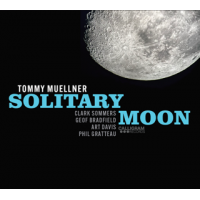
Chicago pianist Tommy Muellner is no poseur. In fact, his choice of repertoire and the performances on Solitary Moon are, in every sense, hip. A mainstay of the Chicago jazz scene, Muellner, along with trumpeter Art Davis and drummer Phil Gratteau, has logged thousands of gigs and likely committed more music to memory than most musicians ever encounter.
Saxophonist and label head Geof Bradfield invited Muellner to expand the traditional piano-trio format into a quintet, adding himself on saxophones and bassist Clark Sommers. Muellner responds with a program that moves comfortably among standards, personal favorites and original compositions, demonstrating that familiarity need not mean predictability.
Jimmy Van Heusen's "Like Someone in Love" has been interpreted by everyone from Frank Sinatra to Cecil Taylor and Eric Dolphy. Muellner approaches it with an elegant swing and an affectionate touch, engaging in a relaxed conversation with Sommers and Gratteau's delicate brushwork. The same warmth permeates Van Heusen's "Polka Dots and Moonbeams," which recalls the lyrical sensibility of Bill Evans, another pianist who returned to the composition throughout his career. Muellner does not imitate Evans; rather, he finds a similarly intimate way into the song.
His original compositions fit naturally alongside the standards. The two sambas, "Cuz Tune" and "Sandy Samba (Ahma's Garden)," reveal his fondness for rhythm and melody. Bradfield's soprano saxophone lends "Cuz Tune" a graceful, singing quality, while on "Sandy Samba," his flute joins Davis' flugelhorn for an airy, sunlit texture. "Monk See, Monk Do" pays affectionate tribute to Thelonious Monk without resorting to caricature, while Muellner's interpretation of Steve Kuhn's "Oceans in the Sky" allows Bradfield's soprano to float above Gratteau's propulsive drumming.
The album's final sequence gradually strips away the ensemble. Two duos lead into a solo performance, creating the atmosphere of a jazz club approaching closing time. Muellner and Bradfield's reading of "Diane" is followed by "Danny Boy," whose familiar melody takes on the intimacy of a late-night farewell. Then Muellner returns alone for "Why Did I Choose You." His playing is so restrained and beautiful that the best response is simply to listen quietly.
Solitary Moon makes a persuasive case for the enduring power of repertoire. Muellner understands that playing a familiar song isn't about reproducing the past; it is about discovering something new inside music we thought we already knew. In his hands, standards become less like museum pieces than old friends.
 FOLLOW Mark Corroto
and get notified whenever a new article published.
FOLLOW Mark Corroto
and get notified whenever a new article published.
Mark misses his dogs Louie & Freddy, but endeavors daily to find and listen to new and interesting sounds.
Track Listing
While We're Young; Like Someone In Love; Sandt's Samba (Ahma's Garden); The Wind; I Remember You; Soldier In The Rain; Cuz Tune; Oceans In The Sky; Monk See, Monk Do; Make Someone Happy; Polka Dots and Moonbeams; Solitary Moon (aka Moon Song); Somewhere; Diane / Danny Boy; Why Did I Choose You.
Personnel

Tommy Muellner
piano
Clark Sommers
bass
Geof Bradfield
saxophone, tenorArt DavisTrumpet
trumpet
Phil Gratteau
drumsAdditional Instrumentation
Geof Bradfield: flutes, soprano saxophone; Art Davis: flugelhorn.
Album information
Title: Solitary Moon | Year Released: 2026 | Record Label: Calligram Records
About Tommy Muellner
Tags
PREVIOUS / NEXT
Become a Sustaining Member

Since 1995, All About Jazz has championed jazz as an art form and supported the musicians who create it. Over three decades, it has grown into one of the world's leading jazz resources, serving hundreds of thousands of readers, musicians, presenters and industry professionals each month.
Help Build the Future of All About Jazz
Your support helps us continue building All About Jazz for the next generation—expanding our editorial coverage, preserving jazz history, developing new community features and creating better ways to discover the music and the people behind it.
Become a sustaining member for as little as $20 per year and you'll immediately enjoy an ad-free experience along with access to subscriber features and future articles for a full year.
Together, we're not simply sustaining All About Jazz—we're building its future. Thank you for being part of the journey.