Home » Jazz Articles » Live Review » Otherlands Trio at BOP STOP
Otherlands Trio at BOP STOP
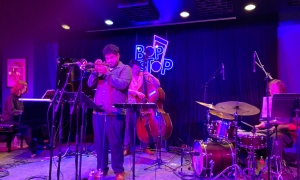
Courtesy Gary Finney
BOP STOP at the Music Settlement
Cleveland, OH
June 18, 2026
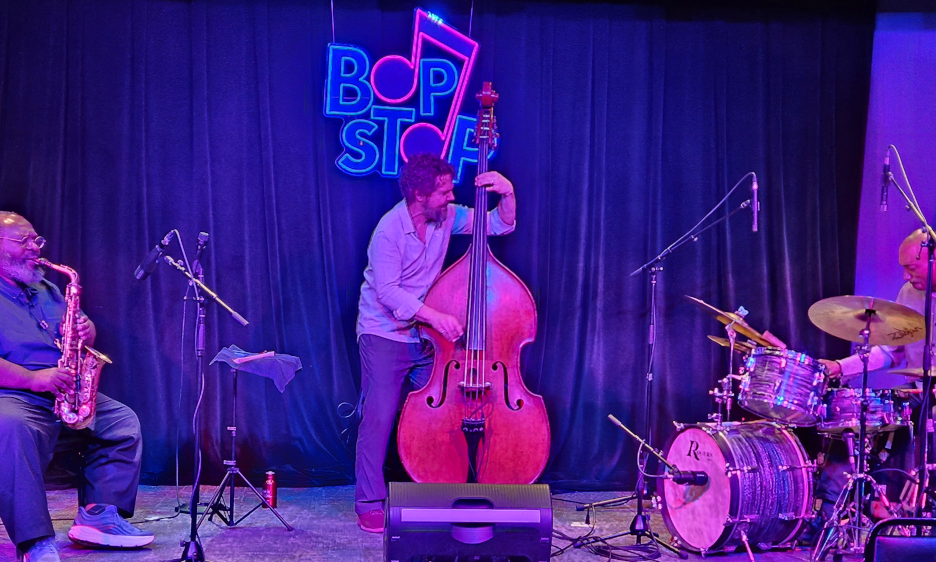
Cleveland's New Ghosts presenting organization was named in honor of Albert Ayler, perhaps the city's most notable jazz player. That said, any notion that the astonishing, two-hour concert by Otherlands Trio—bassist Stephan Crump, Darius Jones on alto saxophone, and drummer Eric McPherson—was intended as a tribute concert is pure speculation. But at times, one had to wonder.
Start with Jones, whose sound filled the room in the way that Ayler's was said to have done. Melodic fragments, often diatonic, drifted in and out as if they were fugitive memories of ancient hymn tunes or folksongs. At other times, Jones blew sustained split tones or little whoops and telegraphic exclamations, his lines strikingly extemporaneous and vocal in their quality.
McPherson is a punctilious drummer. A slender man who sits upright at the kit, he used a variety of sticks and brushes to summon murmuring cymbal washes, eerie harmonics, portentous taps, and ghostly thumps on toms. At times he upshifted into a groove, taking great enjoyment in nudging the band forward. Peering over his kit as thoughtfully as a scholar contemplating an ancient manuscript, McPherson's every gesture was intentional and compact, his quick reflexes in service to a nimble mind and big ears.
At the center of the stage and the music, Crump was both a whirlwind of energy and the eye of the storm. Whether bowing lacy harmonics or digging into a ferocious, Charlie Haden-like groove—often in six—his technical command was sovereign. The trio is a cooperative, but Crump often played the role of the basketball point guard, establishing the pace and subtly steering the flow of action. When he stepped out front to solo, he did so with ferocious commitment.
Like a classic Ayler performance, the shape of the music evolved moment to moment. If there were compositions or even points of reference, they were well concealed. Early in the first set, Crump answered a phrase by Jones (there was a lot of call and response) with groaning bowed double stops that strongly evoked the iconic cello of Abdul Wadud, another Clevelander, on Julius Hemphill's monumental "The Hard Blues."
Yet none of this was mimesis; 56 years after his mysterious death, Ayler's and Wadud's languages have long since been absorbed into the tradition. So, maybe blame the tribute vibes on confirmation bias. Cleveland holds its heroes close.
There were differences. For the greater part of the evening, Otherlands played at a relatively moderate volume level—at times even at a whisper—as when McPherson began the first set with delicate wipes of brushes on his snare that evoked breathing. Jones was much more likely to murmur than to scream, although his almost tactile sound can make an impact at any volume level. Some of Crump's bowed harmonics barely rose above the hum of the air conditioning system. This was no free-jazz freakout.
And that was perhaps the most remarkable thing about this frequently amazing concert: the level of formal, technical and conceptual sophistication at work in music that was apparently freely and spontaneously composed. It was the sound of freedom and the revolutionary spirit, the truth marching in.
About Stephan Crump

Tags
PREVIOUS / NEXT

Become a Sustaining Member

Since 1995, All About Jazz has championed jazz as an art form and supported the musicians who create it. Over three decades, it has grown into one of the world's leading jazz resources, serving hundreds of thousands of readers, musicians, presenters and industry professionals each month.
Help Build the Future of All About Jazz
Your support helps us continue building All About Jazz for the next generation—expanding our editorial coverage, preserving jazz history, developing new community features and creating better ways to discover the music and the people behind it.
Become a sustaining member for as little as $20 per year and you'll immediately enjoy an ad-free experience along with access to subscriber features and future articles for a full year.
Together, we're not simply sustaining All About Jazz—we're building its future. Thank you for being part of the journey.
Near

Cleveland Concerts