Home » Jazz Articles » Jazz Fiction » Now's the Time: Part 3-5
Now's the Time: Part 3-5
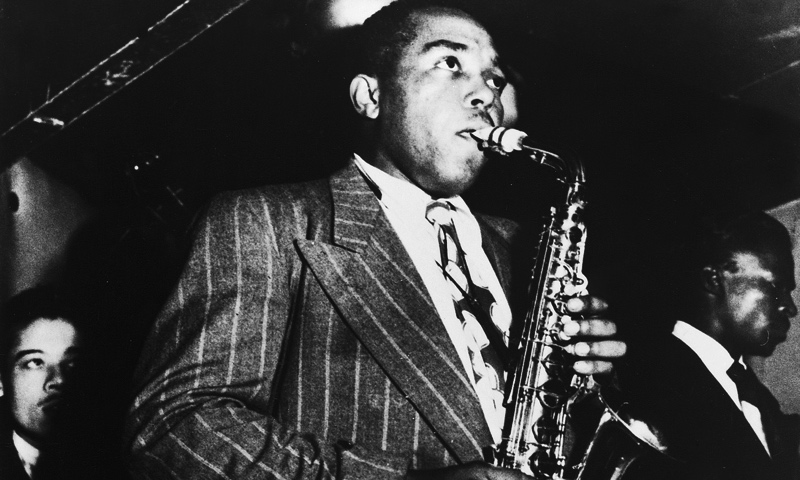

The life and times of a minor jazz legend are recounted through his narrated memories. In this fictional treatment of jazz music in the mid-to-late 20th century, issues of race, creativity, addiction and, ultimately, redemption, are explored. With a title taken from the immortal Charlie Parker tune, "Now's The Time" is an extended meditation on the artistic life.
Part 1 | Part 2 | Part 3 | Part 4 | Part 5
He is back.
Everyone is standing and he blinks as the lights come on. Intermission. He heads for the lobby.
He stands off in the corner, watching people discussing what they'd already seen, and what still lay ahead. They were dressed nicely, but seemed at ease and comfortable in their fancy clothes. In a flash he recalls how much he used to love dressing up, getting in that suit before a gig, or even a recording session. You couldn't play good unless you looked good, everyone knew that. And he had looked good. He knew it, then.
You are only what you know yourself to be. You are also what they say, or would like to think you are. It was absurd, and often revealed more about the individual than the artist, but their patronage entitled them to this liberty. Such is the fate of the individual who resides in the public eye, and depends upon others' support and interest. Of course, the ones who most resented the way they were received by, or portrayed to, the larger world outside their entourages, were invariably the same ones whose actions, or attitudes, did little to contest the various libels and slanders they felt so persecuted by.
He closes his eyes and imagines the dialogue:
Did you really play with Miles Davis?
Yes.
Is it true you spent time in prison for heroin possession?
Maybe.
Is it true you have a daughter that you've never seen?
Yes.
Is it true your first wife left you for your best friend...the one that was a drummer in your famous band?
Yes.
Is it true you were present the night he overdosed, a few years later?
No.
Is it true you two did shoot up together though?
Oh yeah.
Is it true your second wife burned all your jazz records, and almost burned the house down?
No. That was me.
I'm leaving you.
When his old lady hissed these words at him, it seemed as though one of those badly acted movies he had recently been in the habit of watching until all hours of the night was coming to life right before his eyes, right in his living room.
He barely had the energy, or the interest, to lift the slab of New York Strip off his eye in order to look across the room at her. "Where you goin'?" he asked her. She didn't answer, but she didn't need to. He knew. She was going to her man. Her new man. The back door man. The man who also happened to be the drummer of his band, and his best friend.
This man, with whom he had exchanged blows the night before, was the reason he was holding a smelly, raw piece of beef over his eye. And he was the reason his wife was leaving him. After the gig, he had engaged in his first (and last) fistfight with a fellow band member. It was an unwritten rule, universally acknowledged: it was bad business, it was childish, and of course, it could kill the music. Granted, serious fisticuffs between professional musicians in the same band were exceedingly rare, and usually were the result of either drunken mayhem taking an unfortunate turn, or the repercussion of an egregious offense. This brawl, while both participants were unquestionably inebriated, was a result of the latter (and graver) circumstance.
He had suspected she was spending time (probably a lot of time) with another man, but this did not particularly trouble him. He was having a hard enough time with things, such as keeping his band together, staying on top of his habit, and the other ladies in his life. But he never, ever, entertained the thought that she was with anyone he knew, much less one of his boys.
It had been a scene, a spectacle. After the fists and feet had flown—he had gotten the better of the man who he'd so suddenly and unexpectedly come to hate—he squatted over his rival, showing him his knife. He wanted to show it to him, just so he'd know it was there. He had no intention of using it. He only carried the knife for his own protection; he'd never even contemplated using it to inflict violence. He just wanted to scare him, that's all. Put a little of that fear of God in him. Show him what happened, what could happen, to men who fucked around with other men's ladies. Next thing he knew he woke up in the backseat of his own car, dry blood caked on his face.
* What's going on? What the hell happened?
* Man, we told you to put the knife down; we kept telling you to put it down...
* Yeah I heard you hollering...
* Well why didn't you listen to us, man?
* I don't know, I just wanted to show him the knife, that's all...
* Well you were on top of him waving that thing in his face, we thought you were fixin' to kill him...
* I wasn't gonna do nothin...'
* You wouldn't even look at us man...we had to come up and grab you. We really thought you were fixin' to kill him...
* I don't remember that...
* You don't? Well, we dragged you off of him, trying to talk some sense into you. Then he comes over, with a bottle in his hand, the bottle you was drinkin' from, and cracked it over your head...
* He did? Then what happened?
* Then we cracked his head...That dumb motherfucker, we save him from gettin' stuck, and then he tries to kill you...
* So where's he at?
* I don't know. I don't really care either. Probably in the hospital, that'd be my best guess...
So they'd brought him home, after taking him to the knitting factory to get his skull stitched up. They gave him the steak to hold over his eye and a bag of ice to hold over his head. It hurt so badly he wasn't even trying to drink the pain away. He just wanted to sleep, and forget. When the boys were telling him what happened he hadn't remembered most of it. And that scared him.
But then she came in, grabbed the suitcase she must have already had packed and ready, and strolled out his door. He didn't have the energy, or the interest in getting up, or even saying anything to her. That's it, he thought. No more drugs, no more women, no more pain. At least it's over.
But it wasn't over.
Continue to Part 4.
About Charlie Parker

Tags
PREVIOUS / NEXT


Become a Sustaining Member

Since 1995, All About Jazz has championed jazz as an art form and supported the musicians who create it. Over three decades, it has grown into one of the world's leading jazz resources, serving hundreds of thousands of readers, musicians, presenters and industry professionals each month.
Help Build the Future of All About Jazz
Your support helps us continue building All About Jazz for the next generation—expanding our editorial coverage, preserving jazz history, developing new community features and creating better ways to discover the music and the people behind it.
Become a sustaining member for as little as $20 per year and you'll immediately enjoy an ad-free experience along with access to subscriber features and future articles for a full year.
Together, we're not simply sustaining All About Jazz—we're building its future. Thank you for being part of the journey.