Home » Jazz Articles » Late Night Thoughts on Jazz » Lester Young & Ageism
Lester Young & Ageism
Jazz is an art form that rewards experience. The enthusiasm of youth is often enough to cover some defects or a lack of originality, but any artist that stays with it over a career that spans decades generally deepens his or her ability to communicate the joys, sorrows, relief, and disappointment that any human being chalks up over the course of a lifetime. So it was with Lester Young.
It has long been thought and too often repeated that following his dismissal from the U.S. Army after 16 months' detention for smoking marijuana, Lester Young was a burned-out player who never approached the brilliance of his pre-army playing. While it is true that Young's depressive mental state was erratic after 1946 and that his playing was very closely tied to his mood, Lester Young continued to be capable of producing incredibly beautiful and brilliant music practically up until his dying day. Young, like all jazz players who ply their art over a lifetime, culled many earlier ornamentations from his style until he approached the essence of what his playing was all about. The result may lack the bounce and long phrases of his earlier playing, but offers its own pleasures just as surely as does a fine vintage cabernet.
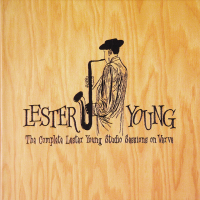 All of the work that Young did for Norman Granz's Verve label from 1946 to 1958 has been collected on the 8-CD set The Complete Lester Young Studio Sessions on Verve. Here you will hear Young working with a variety of musicians with varying degrees of comfort and vitality. His playing with Nat "King" Cole on piano and Buddy Rich manning the drums, as well as the 1951 group of John Lewis, Gene Ramey, and Jo Jones is bright and nearly as great as his pre-war output. In 1952 he worked with the Oscar Peterson trio, releasing the recording Lester Young with the Oscar Peterson Trio, and again he rises to the occasion, clearly inspired by his colleagues. Listening to a track like "Undercover Girl Blues" or "Ad Lib Blues," you sure don't get the impression that Young has lost his ability to play.
 Even those who are willing to concede that Young was still playing well through the early '50s generally feel that by 1955 his output demonstrates a steady decline straight through to his death in 1959. This completely ignores the fact that in 1956 Young was probably playing better on a day-to-day basis than he had in any given year since 1952, and quite possibly before.
The five volumes of Lester Young In Washington, D.C., 1956 provide evidence of this fact. Bill Potts, whose trio backs Young sympathetically, made these recordings at Olivia's Patio Lounge in D.C. The LP versions weren't released until 1980, and they provide a second look at Pres in the last few years of his life. Lester is clearly relaxed on these recordings, which are now available on compact disc as well. True, there is nothing revolutionary or new here, but neither does Young play poorly or by rote, as his detractors sometimes charge. Check out his work on "Lullaby of Birdland" or "These Foolish Things" and you'll hear a musician completely in control of his musical thoughts and voice. So, it clearly wasn't true that Lester was no longer capable of playing with flashes of his former brilliance, but at times, especially when less than comfortable with the circumstances or other musicians, he would put himself on "auto-pilot" and just walk through a session.
This reluctance to acknowledge the late-career work of a legendary jazzman is based on a characteristic that is central to American culture, but should certainly not apply to jazz music. I speak of ageism. Jazz has generally venerated the experience of the older player, though it certainly also thrives on the thrill of the new young gunslinger. The best jazz musicians have always shown respect for those who came before even when their style seemed at odds with the older musicians. Thus, Charlie Parker spoke of his debt to Young, Dizzy of the inspiration he found in Roy Eldridge; even the mercurial Miles Davis paid tribute to the spirit of Louis Armstrong. Today's young jazz musicians are generally no less respectful of their predecessors-check out Chris Potter's heartfelt tributes to the great saxophone players of jazz history on his new Gratitude CD. No, it is the public and the critics who often seem so willing to pit the new against the old, as though the new, in the form of bebop, cool jazz, or "new thing," sprang whole from the head of its creator, like Athena from the head of Zeus. Usually any "new" development is a long, painful birth process with a long gestation period during which the future innovator hones his chops playing the music of his elders.
One example of this process is the development of bebop. Those unaware of the music's history often speak as though Parker & Gillespie developed the new style in a vacuum, not realizing that the transformation took place slowly. Particularly important was the period when both musicians played in Earl Hines' band. What made it seem that the music developed from out of nowhere was the recording ban imposed by the American Federation of Musicians. Had the Hines band featuring Parker & Gillespie been recorded, it would have revealed the nascent development of bebop as well as showing how the new style developed from the music that had gone before. But human nature thrives on the "new" and the "revolutionary" despite the fact that we, as a species, don't really seem to care for actual change all that much.
Ultimately, I guess that another solid recording by a musician who's been working at his art for 20 years isn't as interesting or exciting as a hot "new" sound by a young musician who can be marketed as coming out of nowhere, even though he/she knows that nothing could be further from the truth. So it was with Lester Young. Many turned away from his playing as his sound turned thicker, more thoughtful and even melancholy. As he aged and drank more, his tone also became breathier, somewhat like Ben Webster's, making him seem like even more of a throwback. Eventually a lifetime of smoking and drinking took its toll and Young began to have difficulty breathing, which ended his ability to play long phrases that skipped over the bar lines with little effort. All of these are signs of aging, and most jazz fans and critics didn't like that. Better instead to focus on the new sounds of the time and dismiss Young as a shell of his former self barely deserving of a listen.
 FOLLOW Marshall Bowden
and get notified whenever a new article published.
FOLLOW Marshall Bowden
and get notified whenever a new article published.
Marshall Bowden is a Chicago-based writer and web designer.
About Lester Young

Tags
PREVIOUS / NEXT


Become a Sustaining Member

Since 1995, All About Jazz has championed jazz as an art form and supported the musicians who create it. Over three decades, it has grown into one of the world's leading jazz resources, serving hundreds of thousands of readers, musicians, presenters and industry professionals each month.
Help Build the Future of All About Jazz
Your support helps us continue building All About Jazz for the next generation—expanding our editorial coverage, preserving jazz history, developing new community features and creating better ways to discover the music and the people behind it.
Become a sustaining member for as little as $20 per year and you'll immediately enjoy an ad-free experience along with access to subscriber features and future articles for a full year.
Together, we're not simply sustaining All About Jazz—we're building its future. Thank you for being part of the journey.