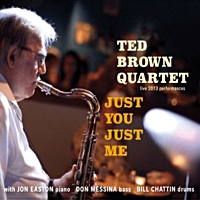
Home » Jazz Articles » Album Review » Ted Brown Quartet: Just You Just Me
Ted Brown Quartet: Just You Just Me
Tristano's concept of improvisation—marked by avoidance of standard licks and clichés—prioritizes spontaneous creation over formulaic repetition. His solo work is distinguished by extended, linear phrases, rhythmic freedom, and intricate block chords. By rejecting the irregular accents of the bebop tradition in favor of a more flowing rhythm, Tristano laid the groundwork for cool jazz, yet his influence transcends any single stylistic label.
Brown is celebrated as a tenor saxophonist firmly rooted in the Tristano school. His playing is defined by melodic inventiveness, relaxed swing, and a devotion to improvising over familiar standards, always delivered with self-assured artistry. Brown's sound is often described as pallid and clear, favoring linear improvisation and demonstrating a deep affinity as for Tristano's method of "note-to-note in the moment spontaneity," as liner notes state. This organic, intuitive melodic flow, paired with an "airy" yet soulful tone, lends warmth and restraint even amid harmonic complexities.
Brown's preference for working with well-known jazz standards, or original lines crafted over familiar progressions, helps foster musical connection and spontaneity. His improvisations, true to Tristano's ethos, feature purity and freshness; rather than trotting out stock patterns, Brown builds long, linear phrases characterized by rhythmic freedom.
Brown's artistry pivots on melodic invention, contrapuntal interplay and an introspective lyricism. He occupies a distinct niche in postwar jazz, upholding the sophistication and clarity of the Tristano school while channelling the warmth of the Young tradition.
Key albums showcasing Brown's artistry include Complete Free Wheeling Sessions (Lonehill Jazz, 2014—with Art Pepper, Warne Marsh), Jazz of Two Cities (Imperial, 1956) and Dig It (SteepleChase, 1999—with Lee Konitz). These recordings highlight his blending of classic swing influences with the advanced linear innovations of the Tristano School, making him an important though often underrated figure in modern jazz.
On "Everything Happens To Me," lingers over the tune's melancholia, allowing familiar emotions to resonate with listeners. His variations unfold organically, exhibiting a tone reminiscent at times of Marsh, but ultimately closer to late Young. Jon Easton's lyrical piano solo matches the mood perfectly, followed by Don Messina's sensitive bass embroidery. In Brown's concluding chorus, new variations soar, leading the piece gracefully to its end.
"Just You Just Me" is driven by Messina's jaunty rhythm. Brown breaks away with inspiration, emphasizing melodic development over mere virtuosity. The piano's low-register explorations complement Brown's melodic certainty, echoing Tristano's percussive sensibility. Their ensuing duet has a gentle confidence and a tangible musical rapport.
Easton describes Brown's tone as a "pure hollow gourd sound." The second chorus of "Gone With The Wind" bursts with invention, while Bill Chattin's drumming remains creative yet unobtrusive. Easton's clarity and commitment to a consistent musical line mirror Brown's own approach, and their piano-tenor duet at the piece's close is both delightful and skillful.
Messina's liner notes are perceptive: he calls Brown's playing "kind-hearted," and observes how the music gently wins listeners over without force. Easton further notes that Brown's melodies are conceived on-the-spot—real, honest improvisations in the jazz tradition—reminding us how often jazz is diluted by gimmicks or preconception, rather than born from genuine moment-to-moment creativity.
Brown, born in the 1920s, still playing in the 2010s, is a witness to the cool vitality of his cool school mentors.
 FOLLOW Jack Kenny
and get notified whenever a new article published.
FOLLOW Jack Kenny
and get notified whenever a new article published.
Jack was turned on to jazz by a mixture of Stan Getz, Lee Konitz and Earl Bostic.
Track Listing
After You’ve Gone; Gone With The Wind; I Can’t Believe That You’re In Love With Me; Just You Just Me; It’s You Or No One; Everything Happens To Me; I’m Getting Sentimental Over You.
Personnel


Album information
Title: Just You Just Me | Year Released: 2025 | Record Label: New Artists Records
About Ted Brown
Tags
PREVIOUS / NEXT


Become a Sustaining Member

Since 1995, All About Jazz has championed jazz as an art form and supported the musicians who create it. Over three decades, it has grown into one of the world's leading jazz resources, serving hundreds of thousands of readers, musicians, presenters and industry professionals each month.
Help Build the Future of All About Jazz
Your support helps us continue building All About Jazz for the next generation—expanding our editorial coverage, preserving jazz history, developing new community features and creating better ways to discover the music and the people behind it.
Become a sustaining member for as little as $20 per year and you'll immediately enjoy an ad-free experience along with access to subscriber features and future articles for a full year.
Together, we're not simply sustaining All About Jazz—we're building its future. Thank you for being part of the journey.