Home » Jazz Articles » Live Review » Jazzkaar Festival 2026
Jazzkaar Festival 2026
Donny McCaslin
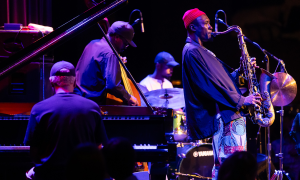
Donny McCaslin 's Jazzkaar performance was, above all, a reminder that the saxophonist who contributed so decisively to David Bowie's Blackstar has never been content to operate within the boundaries jazz conventionally draws around itself. He treats the stage as a laboratory, and the results are consistently volatile in the most productive sense.The set moved between progressive jazz, industrial electronica, and raw rock energy, often within a single piece. McCaslin's saxophone retained a warm, lyrical core even when pushed through heavy distortion—a quality that bridges soulful melody and abrasive noise without either mode fully compromising the other. The band's structural approach was notably modern: in place of conventional swing, the music leaned into intricate, groove-heavy pockets closer in spirit to indie rock, underpinned by the kind of drum-forward production more often associated with studio records than live jazz performances.
The dynamic range was the set's most striking technical achievement. From the minimalist, ambient passages of his Lullaby for the Lost project to the cinematic, near-doom textures of the set's more ferocious moments, the ensemble moved between extremes without losing coherence. The electronics—stuttering gameshow-sample references, industrial reverb, orbital-inflected processing—were not ornamental additions but fully integrated elements of the ensemble's language.
McCaslin's stage command is worth noting: he doesn't lead the band from a fixed position but moves through it, directing with physical gesture, signaling shifts through posture and eye contact, building improvised passages toward large, cathartic arrivals. The encore, a version of Bowie's Lazarus, functioned as the evening's emotional anchor—urgent, deeply personal, and a decade on from its original context, no less affecting. By the close, the case had been made: jazz is, for McCaslin, simply too confining a category for what he does. The language he and his ensemble speak borrows from Nine Inch Nails, Neil Young, and the avant-garde alike, and the result is, in the best sense, entirely its own.
Day 8: May 2
Anne Veski & Lexsoul Dancemachine
The final night at Von Krahl was the ideal way to close a festival. The venue was at capacity well before the first note, and the energy in the room—impatient, anticipatory—suggested that the audience had already decided to enjoy itself before Lexsoul Dancemachine had walked on stage.They rewarded that disposition fully. Lexsoul Dancemachine is not simply a tight, accomplished band, though they are certainly that; they are practitioners of a kind of total performance in which showmanship and musical authority are treated as inseparable. Robert Linna's physical exuberance—at one point deploying his leg at the keyboard—and the guitarist's relentless forward momentum kept the energy at a sustained pitch that lesser bands can only approach for a few minutes at a time. The rhythm section was immaculate throughout.
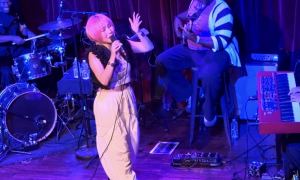
The final quarter of the set brought a guest who, judging by the room's reaction, requires no introduction in Estonia: Anne Veski, a luminous figure of the country's pop heritage, stepped onto the stage in a glittering jacket and slid into the group's funky groove with the ease of long familiarity. For a visitor without the relevant cultural context, the audience's response was the most eloquent possible introduction—the kind of collective recognition that attends a genuine icon.
Even without the language, the music made its case. When the band launched into Heja tuju laul, the room turned. Roses were thrown. The set concluded with a reprise that converted the entire venue into something approaching a single organism of collective joy—a fitting end to a festival that had, across eight days, consistently demonstrated the best of what jazz and its neighboring traditions are capable of.
 FOLLOW Nenad Georgievski
and get notified whenever a new article published.
FOLLOW Nenad Georgievski
and get notified whenever a new article published.
For as long I can remember music has been a focal point in my life.
About Bill Frisell

Tags
PREVIOUS / NEXT

Bill Frisell Concerts
Become a Sustaining Member

Since 1995, All About Jazz has championed jazz as an art form and supported the musicians who create it. Over three decades, it has grown into one of the world's leading jazz resources, serving hundreds of thousands of readers, musicians, presenters and industry professionals each month.
Help Build the Future of All About Jazz
Your support helps us continue building All About Jazz for the next generation—expanding our editorial coverage, preserving jazz history, developing new community features and creating better ways to discover the music and the people behind it.
Become a sustaining member for as little as $20 per year and you'll immediately enjoy an ad-free experience along with access to subscriber features and future articles for a full year.
Together, we're not simply sustaining All About Jazz—we're building its future. Thank you for being part of the journey.