Home » Jazz Articles » Film Review » Jazz Icons: Bill Evans Live '64 - '75
Jazz Icons: Bill Evans Live '64 - '75
 Bill Evans
 Jazz Icons Series 3: Bill Evans Live '64 - '75
Jazz Icons
2008
A dweeb with a bad haircut or junkie messiah? The most significant jazz pianist since Bud Powell or an over-rated ivory noodler? Bill Evans is a delicious musical enigma whose influence on the piano was as far reaching as Charlie Parker's on the alto saxophone. Evans' Jazz Icons release is singular among the seven Series 3 releases in that it spans over a decade in the middle of Evan's tragically short career.
The DVD consists of 18 selections performed during five televised concerts between 1964 and 1975. The 1960s performances are vintage black white, crisp and clean as have been the previous releases in this series. Delightfully, color video emerges in the 1970s just in time to document Evans' couture transition from geek accountant pianist to almost hipster-poet-sage.
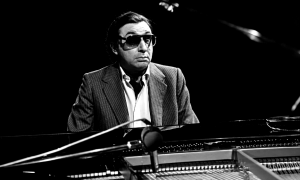
The visual part of musical performance is a powerful, iconic spectre. The familiar 'S' shape of the late Miles Davis in hip-full-flight is well known to all jazz fans. Likewise is the hunched concentration of the early Bill Evans, conjuring pathos from the piano, head close to the keys as if in supplication, vocalising and nodding. The profound change in Evans' appearance appears between the Sweden 1970 and Denmark 1975 performances. Evans' demeanor changes as well as his wardrobe. The iconic hunch is gone and the pianist nods his head in time with the music.
Striking is the evolution of Evans the pianist over the 11 years documented here. The early Evans is in keeping with the famous 1961 Village Vanguard sessions: ethereal, impressionistic, introverted. There is almost a shyness to the music, a shyness that wears off as Evans enters the '70s. The early performances are all well after Evans' association with Scott LaFaro and Paul Motian. The pianist's dedication to the trio format has strengthened through the course of his empathic integration with his sidemen. No matter who Evans played with, he was able to induce telepathic cohesiveness.
Evans possessed a relatively large band book. However, he did favor certain types of songs (ballads) and certain titles ("Someday My Prince Will Come" and "My Foolish Heart&"). Evans detractors have asserted that he was a one-trick pony with ballads, playing the same tired melodies the same way over and over again. The performances on this Jazz Icons release readily refute such a charge, revealing Evans as a growing and evolving artist, making his death in 1980 at 50 that much more untimely.
Tracks: Sweden 1964: My Foolish Heart; Israel. France 1965: Detour Ahead; My Melancholy Baby (with Lee Konitz). Denmark 1970: Emily, Alfie, Someday My Prince Will Come. Sweden 1970: If You Could See Me Now, 'Round Midnight; Someday My Prince Will Come; Sleepin' Bee; You're Gonna Hear From Me; Re: Person I Knew. Denmark 1975: Sareen Jurer; Blue Serge; Up With the Lark; But Beautiful; Twelve tone Tune Two.
Personnel: Sweden 1964: Bill Evans: piano [all shows] Chuck Israels: bass; Larry Bunker: drums. France 1965: Lee Konitz: alto saxophone; Neils-Henning Orsted Pedersen: bass; Alan Dawson: drums. Denmark 1970: Eddie Gomez: bass; Marty Morrell: drums. Sweden 1970: Eddie Gomez: bass; Marty Morrell: drums. Denmark 1975: Eddie Gomez: bass; Eliot Zigmund: drums.
Production Notes: B & W/Color. Running time: 99 minutes. Sweden 1964: Trumpeten SVT, September 29, 1964. France 1965: Jazz pour Tous, RTFB, 1965. Denmark 1970: Copenhagen Jazz Festival DR TV, 1970. Sweden 1970: Nightmoods, STV, February 20, 1970. Denmark 1975: Bill Evans in Louisiana, DR TV 1975. Twenty-four page booklet, Forward by Maxine Evans. Liner notes by Robert Doerschuk. Interview with Chuck Israels. Rare photographs and memorabilia collage.
 FOLLOW C. Michael Bailey
and get notified whenever Michael has a new article published.
FOLLOW C. Michael Bailey
and get notified whenever Michael has a new article published.
I'm Sanctified and Southern Fried / Mama tried and daddy cried / I tell the truth 'cept when I've lied / And like my huevos on the side.
About Bill Evans

Tags
PREVIOUS / NEXT

Become a Sustaining Member

Since 1995, All About Jazz has championed jazz as an art form and supported the musicians who create it. Over three decades, it has grown into one of the world's leading jazz resources, serving hundreds of thousands of readers, musicians, presenters and industry professionals each month.
Help Build the Future of All About Jazz
Your support helps us continue building All About Jazz for the next generation—expanding our editorial coverage, preserving jazz history, developing new community features and creating better ways to discover the music and the people behind it.
Become a sustaining member for as little as $20 per year and you'll immediately enjoy an ad-free experience along with access to subscriber features and future articles for a full year.
Together, we're not simply sustaining All About Jazz—we're building its future. Thank you for being part of the journey.