Home » Jazz Articles » Album Review » Joel Ross: Gospel Music
Joel Ross: Gospel Music
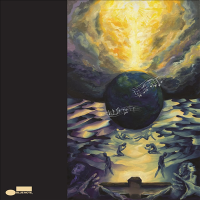
However, Joel Ross operates with different antecedents. His approach to gospel music tracks the biblical narrative linearly: the Creation, the Fall, and Salvation—themes explicitly referenced in the biblical texts that Ross includes in his liner notes. He intends for this music to inspire meditation on faith in Christ, calling on listeners and practitioners alike to embody divine love.
In this iteration of the Good Vibes sextet, the hierarchy is deliberately flat. Ross operates on a principle of "collective improvisation." This ethos distinguishes the group from a standard jazz band, where the hierarchy usually places the soloist above the accompaniment. Here, the vibraphone and two saxophones often move together like vocalists in a choir, trading melodies rather than merely taking turns.
Central to this sound is Ross's technical evolution. He has cultivated a playing style focused on clarity, heavily influenced by the classic vibraphonist Milt Jackson. Notably, Ross decided to stick to using two mallets (like Jackson) rather than the four mallets favored by most contemporary virtuosos. "The more notes you have, the more you're dictating the harmony, and I don't want to do that," Ross explains.
As the primary composer, Ross is rarely the loudest voice. He approaches the vibraphone less like a percussion instrument and more like a piano or a singer, prioritizing sustain and melody over flashy runs.
This music relies heavily on the unique chemistry of its players: Josh Johnson (alto saxophone). Johnson serves as the main melodic contrast to Ross. This marks a significant sonic shift for the Good Vibes band; for years, the alto chair was held by Immanuel Wilkins. While Johnson shares Ross's Chicago roots, his career path took him west to Los Angeles rather than east to New York. As a key figure in the modern Chicago/LA scene, his sound is textural, patient, and warm, fitting the religious tone of the album perfectly.
Maria Grand (tenor saxophone): If Ross and Johnson represent the soprano and alto voices, Grand provides the depth. Her playing is deeply melodic and often focuses on the lower register of the instrument, grounding the airy, resonant sound of the vibraphone.
Jeremy Corren on piano supplies the harmonic anchor of the group. Corren has been Ross's pianist since the beginning. He avoids typical jazz "comping." Instead, he plays "counter-lines," weaving secondary melodies around Ross. His playing on this project leans heavily into church hymnal traditions, utilizing block chords and gospel motifs.
Kanoa Mendenhall (bass): Mendenhall is known for a massive, deep sound and a "less is more" philosophy. In a band full of complex rhythms, she often plays long, sustaining notes that hold the music together. She rarely solos in the traditional sense; her bass lines act as the glue that prevents the band from floating away.
Jeremy Dutton: Dutton is Ross's oldest musical partner; the two grew up playing together in Houston. Along with Ross, Corren, and Mendenhall, this core unit has played together since they were students, sharing a connection often described as "telepathic"—able to change tempo or key instantly without visual cues. Unlike a traditional time-keeper, Dutton plays "melody drums," mimicking the rhythm of the melody on his kit. His role is to replicate the energy of a Black church drummer, using swelling dynamics to push the emotional peak of a song rather than simply maintaining a beat.
A knowledge of the gospels is not necessary. The album notes are helpful with chapter and verse to offer a way through. "Wisdom Is Eternal (For Barry Harris)" is a delightful piece with a lyrical melody. There is much else to admire, "The Sacred Place," with Jeremy Corren's quiet piano, for instance. More conventional gospel music emerges with "A Little Love Goes A Long Way." Laura Bibbs sings on "Praise To You, Lord Jesus Christ." Ekep Nkwelle meditates on "Calvary."
This is a fundamental reimagining of gospel music. It is difficult to separate the music from the message. Should you even try?
Ultimately, the project is supported by the philosophy of Blue Note Records President, Don Was. "We believe in signing people that we trust and then enabling them to manifest their dreams," says Was. "Your best shot at getting something magnificent comes when you don't water it down. Just trust the artist, man."
 FOLLOW Jack Kenny
and get notified whenever a new article published.
FOLLOW Jack Kenny
and get notified whenever a new article published.
Jack was turned on to jazz by a mixture of Stan Getz, Lee Konitz and Earl Bostic.
Track Listing
Wisdom Is Eternal (For Barry Harris); Trinity (Father, Son and Holy Spirit); Protoevangelium (The First Gospel); Hostile; The Shadowlands; Nevertheless; Word for Word; Repentance; The Sacred Place; A Little Love Goes a Long Way; Praise to You, Lord Jesus Christ; Calvary; The Giver; To The Throne (The Mercy Seat); Be Patient; The New Man; Now & Forevermore.
Personnel

Joel Ross
vibraphone
Josh Johnson
saxophone, alto
Maria Grand
saxophone, tenor
Jeremy Corren
piano
Kanoa Mendenhall
bass, acoustic
Jeremy Dutton
drumsLaura Bibbs
trumpet
Ekep Nkwelle
vocalsAlbum information
Title: Gospel Music | Year Released: 2026 | Record Label: Blue Note Records
About Joel Ross
Tags
PREVIOUS / NEXT


Joel Ross Concerts

Become a Sustaining Member

Since 1995, All About Jazz has championed jazz as an art form and supported the musicians who create it. Over three decades, it has grown into one of the world's leading jazz resources, serving hundreds of thousands of readers, musicians, presenters and industry professionals each month.
Help Build the Future of All About Jazz
Your support helps us continue building All About Jazz for the next generation—expanding our editorial coverage, preserving jazz history, developing new community features and creating better ways to discover the music and the people behind it.
Become a sustaining member for as little as $20 per year and you'll immediately enjoy an ad-free experience along with access to subscriber features and future articles for a full year.
Together, we're not simply sustaining All About Jazz—we're building its future. Thank you for being part of the journey.