Home » Jazz Articles » Interview » Bryan Stovell: The Secrets Of Viral Jazz
Bryan Stovell: The Secrets Of Viral Jazz

Courtesy Genevieve Huchulak
And so, I called up her mom, Adella, and said, 'Adella, this is Bryan from school. We have got to talk about your daughter [Diana Krall].' And Adella said, 'What has she done wrong?' (No, no, no, because they did not realize how good she was).
—Bryan Stovell
Some of Stovell's former Nanaimo Musicians Association band members and students include the international elite of Canada's jazz world, like past Nanaimo residents and multi-JUNO winners Ingrid Jensen and Christine Jensen, esteemed saxophonist/pianist Phil Dwyer, OC (Order of Canada), and award-winning educator Carmella Luvisotto. The platinum-selling, Grammy award-winning pianist and vocalist, Diana Krall, OC, is a global jazz star loved by both jazz and pop fans alike. Others like clarinetist Connor Stewart saxophonists Brodie West, and Karen Graves have also impacted the international music scene.
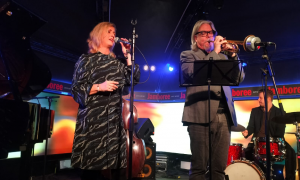
Led by Stovell, the popular Nanaimo Musicians Association band (NMA) often serenades a keen Simon Holt jazz audience, with popular big band and jazz standards, as brought to the Nanaimo community by the expertise of local jazz music producer Luigi Porretta of Quadwrangle Music.
The jazz aficionados at the events are treated to the Nanaimo NMA Band's favorites such as Louis Armstrong's "Struttin' with Some Barbeque," 's, Fats Waller's "The Jitterbug Waltz," to Jimmy Heath, Cole Porter, Nelson Riddle, Charles Mingus, and Frank Foster.
The band's talented vocalist Tash Adams wows audiences with jazz standards like Cole Porter's, "Let's Do It," and the 1929 song, "Mean to Me," with music by Fred E. Ahlert and lyrics by Roy Turk, made popular by Billie Holiday and scatter extraordinaire Ella Fitzgerald.
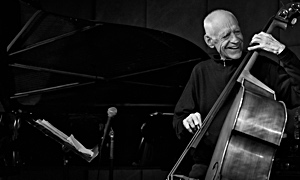
The band boasts a rich tradition dating back to 1967. Bandleader Bryan Stovell has been a distinguished educator/bassist in Nanaimo for 65 years. Since 1997, he has served as Chair of MusicFest Canada's Jazz and Concert Band Divisions, as President, and as a board member. Stovell is a MusicFest Canada Hall of Fame member and recipient of the Marshall McLuhan Distinguished Teacher Award for both British Columbia and Canada.
Stovell retired from a busy career as a school music educator in Nanaimo, BC. Since his initial retirement in 1997, he taught Jazz Theory, Improvisation, and Instrumental Pedagogy at the Vancouver Island University Music Department in Nanaimo until his second retirement in 2015. He continues to direct the Nanaimo Musicians Association Big Band and adjudicates at regional jazz festivals throughout Canada.
All About Jazz managed to catch NMA bandleader Stovell at a moment where he could get away from a dedicated, busy music and bandleading schedule for an interview.
All About Jazz: Bryan tell us how you first started with music and how your path led you to become such a stellar band leader.
Bryan Stovell: Well, I started as a singer, and when I was a boy soprano, another friend and I put together a bit of a program, and we went on a short tour when we were 12 years old before our voices broke. And that gave me a taste of playing for audiences. Then I went to the movie house at Qualicum Beach, my hometown, and saw The Story (1956), and I decided he was an immigrant like me. So, I thought," Why don't I get a clarinet and have a go?" And so, I hitchhiked in Nanaimo, got a clarinet for 40 bucks, and had one lesson down at Fletcher's music store from Ed Gibney, who was a name around here at the time. And I went home and just played it by ear, and got together with another guy in Qualicum, and we started playing dances at the high spots like the Coombs Community Hall and the Errington Hall. And so that is how I got started.
AAJ: When did you start bandleading?
BS: Well, in 1967, I came down to Nanaimo for grade 13, and I met some people down here, like Bruce Farquharson, and some others in the music field. And there was a big band here, and I would go to the Legion on a Saturday night to hear Al Campbell. And Al and the guys had played at the old Pygmy Ballroom, which is legendary. And so, when the ballroom closed, Al kept a nucleus of guys from The Pygmy together. And then when I came back from university, he and I got together and made the NMA. (Nanaimo Musicians Association.)
I started teaching in 1960 because in those days, all you needed was one year of university and you could get a certificate quickly, because they were short of teachers as the population was increasing. I graduated early because I came from England, and I was two grades ahead of everybody. So, I was teaching at Harewood school in 1960 when I was 20 years old.
AAJ: That was quite a young start.
BS: Yeah. So that is how I got the early start. I followed that through, and then I went back to UBC in the music program to try and finish towards a degree, because your salary got higher with each year of teaching. That opened up a whole new world. I met John Capon and Ian McDougall, and Don Clark, and I am sure you know some of those names; they were the established musicians at the time. They were short of bass players, so I took up the bass. I was playing way above my head with some really talented players, and I just continued on from there.
AAJ: Despite being based in Nanaimo, you have mentored many of the stars of the jazz world in Canada. Can you talk about some of those people and what they were like in their formative years, and how you thought best to guide them? Diana Krall, Christine Jensen, Phil Dwyer, and some of the others that were coming up on the scene?
BS: Yes, well, the Diana (Krall) story, I went to school in Nanaimo with her parents. Her Dad was a musician, and so I knew who they were, but I didn't know Diana. But one day I was watching TV, and there was the Woodlands School Band directed by a friend of mine, Dave Strong, and I thought I would look in at it.
And it was a pretty good junior high school band. And then the piano solo started, and four bars in, it was, "Who is that?" And it was Diana, and she just had that jazz feel. You could tell right away that she was miles above anybody around here when she was 15. So, wow. I found out who she was, and oh, my goodness, it was Jim Krall's daughter. My, my, so that was quite surprising.
And so, I called up her mom, Adella, and said, "Adella, this is Bryan from school. We have got to talk about your daughter." And Adella said, "What has she done wrong?" (No, no, no, because they did not realize how good she was). I said, "Look, we have got to look after her a bit." So, you know, we just went on from there. Well, of course, I wanted to get Diana heard by more than the locals. MusicFest Canada is a national festival that had regional festivals at which you could qualify to go to the national finals. Our regional then was in Victoria.
We got the invitation, and we went to the national finals. And just as I had hoped, Phil Nimmons and Tommy Banks adjudicated her, and they became firm friends of mine. And, you know, in other words, Diana Krall opened up the whole world.
Because I could have had a nice life just playing at the mall and playing concerts at school, that would have been fine, yes? But this... this just opened me up to the greater world out there. Nothing to do with my own playing or anything. It was all because of the great students who came through.
And they came through me, because in those days, Nanaimo District Secondary School was the last step in education from K to 12. Junior high schools fed into NDSS, so all the junior high band programs fed into me. I had seniority. So, if I had not made good bands out of them, I should have been fired because they came prepared. You know, we used to have music from K to 12. Alastair HIghet was our District Music Coordinator who established the Kodaly program, and they were learning to read music from kindergarten on.
AAJ: And music was extensive in the schools back then.
BS: All the way through, so yes, it is difficult to duplicate that now.
AAJ: So, what Diana did...it seems like she just bridged the world you were already in and opened up some doors to meeting new people. Is that what you meant?
BS: Oh, yes. And then, of course, Ingrid Jensen told me that she wanted a piece of that, because she was a couple of grades behind that all going on. And so, she worked towards it. And Christine (Jensen) did, too. And one day, I got a call from the Washington Post. "Oh, Bryan, this is the Washington Post. What are you all doing up there? Is it the water?"
We have all joked about that ever since, "It must be the water," and Tommy Banks, once he became Senator, said on TV, "Jazz didn't come up the Mississippi, it came across the Strait of Georgia from Nanaimo."
AAJ: Oh, I love it, yeah.
BS: So, it was just the right time, the right place, and it has been really good. Well, yes, you know, I started young, so I was able to retire at age 57, and at that time, Steve Jones called me up. He was the head of music at Vancouver Island University, and he said, "You've got to come and teach for us now." So, I did another 17 or so years there and finally retired at age 75.
AAJ: And what a career!
BS: But I should mention that I didn't direct the NMA all the way through. In '75, I went off to Berklee for more training in Boston. Norm Porter took over for me, and he did that for 10 years, and then Steve Jones took over.
AAJ: But now you are back at it.
BS: Well, yes, Steve, you know, thought he had done his bit by 2017, no, before that, I've been doing it now 15 years again.
AAJ: You were the initiator of the band. And I want to ask you about yourself as a musician, a bassist. Have you recorded on a few albums?
BS: I am not so much known as a player. I do not think there are any recordings of me out there, except for playing the bass in dance bands from the early years. I played with a lot of the big names. Well, they were big for Vancouver. I played above my head a lot of times because they were short of bass players, and I had, I guess, a decent sense of time, which was what they were looking for.
It was playing down low and keeping the thing going, because a lot of it was dance music. So, I played with Paul Perry, PJ's father, a lot, and I met PJ Perry when he was pretty young. And, you know, Dal Richards at the Panorama Roof, which was six nights a week.
AAJ: You were playing with a lot of the best people at the time, and then you moved into the teaching aspect. And the mentoring?
BS: I realized that "the times were a-changin,'" as the song says. And you know, in 1967, I could see that around town, the jazz venues were closing to some extent, and there was not so much work for jazz, because rock and roll was encroaching, yes, on all of our territories. And so, I could see that by that time, I had a couple of kids, and I figured, well, I would go back to teaching. And I came over here to Nanaimo, and I have done pretty well being here ever since, except to take a leave of absence to go to Berklee.
AAJ: When did you move to Nanaimo?
BS: 1967. I bought a house on Metral Drive for $16,000.
AAJ: You put the music together, and you lead the bands, and you mentor the kids, and you are a really great support to so many in Nanaimo and Canada's community. So, you worked with Ingrid Jensen. So, what about Phil Dwyer? You know you were working with Phil for a little while.
BS: Yeah, Phil and Diana were the same year. When we went off to the Music Fest Finals, the first one was in Calgary, and Phil rode with us, because I don't think they had a full band at the time. Qualicum was much smaller at that time. He had a trio with Pat Collins, who is a bassist in Toronto, and Richard Cave, Bill Cave's son, who decided not to continue on with music. But their trio was really good, and it was some time around the time Diana was at Music Fest, and Phil rode with us and I, that he did play in the NMA initially, for a while, yes, so, and we've stayed friends. He went to New York, yes. He went everywhere. He was everywhere. Well, he is also such a great Canadian star in jazz.
AAJ: This is interesting about you. You have mentored some of the biggest stars in Canadian jazz.
BS: I can't say that I mentored Phil. He rode with us.
AAJ: You've been there as support, a great support, and you've been there during the formative years of stars like Christine Jensen, Phil Dwyer, Diana Krall, all the heavies that came off Vancouver Island, and there you were. And so, it's quite fascinating that the people who have been in your sphere have excelled so wonderfully. And I am not saying that they didn't have talent, but you had a bit of magic in how you were able to inspire them to continue and to help propel them forward.
BS: Well, I have thought about that, and I have tried to understand what it is, because I do not consciously do any of that stuff. But I do remember way back in elementary school, when I came from England, when I was seven, and we had survived the Blitz. And we were bombed. And when I came over here, it was to a little school up in North Qualicum Dashwood, and I was one of the first of the immigrants, because they hadn't seen immigrants. The Hungarians did not come until, you know, a few years later. So here was this funny little guy with horn-rimmed glasses. Who talked funny, you know. And I got bullied a lot, but I learned how to talk my way out of bullying. So, I think that's where it all started. I learned how to "schmooze," people, as we say, yes. Some people say, "Hey, you could have started a cult." So, you know, like the Music Man, right, yes? You know that show...
AAJ: Yet it seems like some of the actual music activities that you were drilling through with some of the playing, some of what you were teaching these young musicians, was transforming them and helping them to excel. And that is special. And I don't understand why there are so many either, or why you've always been involved there, but you have just been at the core of that. And it seems strange that Nanaimo has this jazz talent pool, do you agree?
BS: I attribute that to the Nanaimo Concert Band; it started in 1872. The musicians came from England, and Wales and so on, who played in the Colliery bands, the coal mines. And instead of sponsoring a hockey team or something, in those days, they would sponsor bands. A lot of those musicians came here because of the coal mines. And they needed somewhere to play. They formed a band. And that is why it goes back to 1841. And the Nanaimo Concert Band is still going, I know. And then came along in the '30s, the Pygmy Ballroom. And a lot of the Colliery bands' people played in that band. They switched to playing for dancing. And, they even had the Louis Armstrong big band there. I have the pictures.
AAJ: You know, CHLY 101.7 FM radio hosts Tom Roden (What's Next) and the late Gord Theedom (Music from the Past) were showing me some of those. And you were the one who gave them to Gord. There have been these great photos floating around.
BS: That was a tradition in the '30s. And when Al (Campbell) came out of there with a few of the musicians, that tradition came with him, and plus all the charts. So, we have the original charts. "In the Mood," and all that stuff, as we do not play dances much nowadays, of course.
Al Campbell unfortunately died earlier this year, and his daughter, Nancy, is getting some of the memorabilia from the Pygmy Ballroom into the Nanaimo archives.
AAJ: Well, it's just so wonderful to have a chance to talk to you. Many people have always wondered about you, as there is an aura of mystery around you, and, you know, all this excellence that has come out of your world, and everybody wants to know how you did it.
So, we've talked about all these other people, but as you were coming up as a young musician, who were the musicians that were inspiring you? How did all this come to be? Where were you drawing your inspiration from?
BS: Oh, well, I got a lot of it from playing with the names in Vancouver. You know, I played with Mart Kenney, who had a band that was known nationally. I used to search the radio dial and find anything, you know, Jazzy or Big Bandy. And so, I'd find that, and that was one inspiration. And then, of course, there were the recordings. And when I first started the NMA (Nanaimo Musicians Association) and the high school NDSS bands, I got an album from Count Basie, a couple of albums actually, with arrangements by Sammy Nestico.
AAJ: And what were they? What were these songs?
BS: Oh, let's see... "It's Oh So Nice" and "Hay Burner" ... a whole bunch that are now the standards from way back. And so, I bought the charts from those. And I watched the charts and listened to the Basie musicians. If you want to know how it goes, listen to the record that is how it goes. So, all the little nuances, I knew them academically, but I really nailed them down when I could see the music while the Basie band was playing it. And that's what I imparted to the high school bands, and I am still doing it for the NMA.
AAJ: Wait a minute. Are you saying that you are teaching your students to do a bit of score study, as that is what we would call it in, you know, the legit world, we would say "score study." So, you are doing a jazz band, a jazz orchestra score study with your students. Is that what you are doing?
BS: Sure. Well, that's the best way to learn. So, that is where I learned the stuff. So, it wasn't really studying Bach and Beethoven, although you know the similarities. You can look at the chords that Bach used and see how the jazz guys use the same chords. Maybe added a couple of notes to them, but, you know, it is still basically that theory. It just didn't swing.
AAJ: What do you find most rewarding about being a band leader and about working with the kids?
BS: Well, I must admit, I did like winning festivals.
Yes, there are a lot of Educators who are dead against competing in music. But that wasn't the main thing. I mean, we didn't learn three charts to win a festival. We would have 24 charts in the book and pick three for the festival. So, we were more than a 'three-tune-wonder.'
You know, a couple of years ago, at the Nanaimo International Jazz Festival, people kindly put on a tribute to me at the Port Theater. And I was quite inspired by what precipitated, because there were a whole lot of former students there. At one point, the MC asked, "How many of you are former students?" About half of them almost full, almost the whole room, practically? That precipitated a lot of messages to me, and some things, I guess that I am naive about because I just didn't realize.
But one young lady said that the band room at lunchtime was a refuge. She was being abused at home by her stepfather, and she was in a real emotional state, which I didn't pick up on, and she'd come to the band room, and she was safe there. And, yes, it was someone else who was a refugee from Afghanistan who became a good player, and so on. And he had a lot of racial problems, and he was safe in the band room. So, you know, in that sense, we had a safe home for our band members.
AAJ: You played with some of the best Vancouver musicians, but who were some of the recorded musicians to which you were listening? Like on vinyl. What was it that you were you listening to? Was the swing stuff really catching your fancy, your ear?
BS: Well, I played in a trio with Dave Bird, a pianist. He was also a CBC producer and we had this trio, and we listened a lot to Oscar Peterson. I was trying to get as close to Ray Brown as I could, because that was the way to play bass at the time. And so, any of the Ray Brown stuff. And when I first heard Charlie Parker, I found it quite weird, because having played clarinet in a swing style, I did not know some of those weird notes, and I found out what they were later, okay, and so I really got hooked on Charlie Parker and all the people that went with him, Dizzy Gillespie, and bebop, the whole bebop thing. And, yes, it's still my favorite.
AAJ:The '40s Charlie Parker period.
BS: A lot of people today still play essentially bebop, oh yes, added some fancier scales. But to me, it is essentially bebop.
AAJ: Yes, yeah. It is kind of like where the modern language of jazz, modern, contemporary jazz, is. This is still very rooted in bebop, for sure. So, yes, the jazz tradition can not avoid it.
You had this amazing career. You played with all these fantastic musicians. You have inspired so many young people and so going forward you are now at this age, the golden age. You know where you have retired, but you are still working with the community. You are still giving back.
So where do you want to take this in the future? What do you think you want to do going forward? What are your other hobbies? What are your other interests other than music?
BS: Well, that is the problem. That is one of the problems I am kind of narrow-minded, in that sense, I didn't take up a lot of things that I kept on with. Most of the time I am listening to new charts for the NMA and organizing all that stuff, so that takes up a certain amount of time. And I'm afraid I do Netflix.
AAJ: Well, what you just basically said is you are really dedicated to what you are doing, and it takes up most of your spare time.
BS: That is a nice spin on it. My wife would say, more than dedicated, "Obsessed."
AAJ: Yes, your contribution has been beautiful Bryan. You are giving back to the community, and I think it is the right way to frame it.
BS: If somebody benefits from it, it is great, but I am not doing it for that.
AAJ: I didn't ask you about your awards because I know that you are very modest, but let's talk about that for a moment. You accomplished quite a lot with your bandleading and with your playing over the years. And what kind of response did you receive?
BS: Well, recognition through Music Fest Canada. I had a lot of gold medals to stick up on the wall in the band rooms. Yes, so, you know, I could always look up and say, "You did something." And I did not keep those and bring them home or anything, but they are still probably hanging up in high school teacher Carmella Luvisotto's room.
AAJ: And have you collaborated with anyone specifically, or are you a solitary band leader in the sense that you do things on your own?
BS: Pretty well on my own, but you know, with all the adjudicating I have done, I have sat next to high-profile people, some arrangers, and other people. I spent one weekend with Sammy Nestico, and not many people have done that because he wouldn't fly in an airplane. He drove up from LA to do a summer camp that I was at.
So, when you are adjudicating, you are pretty tight with a group of people for three, four, or five days and trading ideas and all that sort of thing.
AAJ: So, you are collaborating anyway, is that what you are saying?
BS: Yes, whenever a group of band teachers gets together, there's a lot of collaboration before, you know, the jokes start coming.
AAJ: And often the music is about collaboration, in the sense that you may be presenting, you know, some compositions in your band, it is all really fascinating. Where do you think you want to take things into the future for yourself, whether that is your lifestyle or your music?
BS: Well, I think I would be happy if we could keep the NMA going. But here is the downside, of course as you well know, the Vancouver Island University music department was canceled. And so, we used to really use some of the new people coming in, the young people coming from all over the map. And they had decent bands where they came from, and they came to VIU to improve their skills, and so on. And while they were here, we could make the best use of their talents, especially the rhythm section, because some of the newer music has different beats, like different meters. And the older rhythm sections, they are not so good at doing salsa and funk and all that, but the young folks just eat it up. Yes? But the problem is, they are not coming to Nanaimo anymore because the university's music program has been canceled.
AAJ: So, we have Quadwrangle Music's Luigi Porretta bringing in the regular jazz into Nanaimo now.
BS: Well, we also have the Nanaimo International Jazz Festival, and we hope they're going to be able to continue.
AAJ: It's really a shame that our musicians are not getting those same opportunities anymore.
BS: I just heard disturbing news this morning to me, anyway, that several courses at McGill's music department are being canceled.
AAJ: Oh, you couldn't be telling the truth. No, no, come on.
BS: They say they have to be cutting. And you know, the zeitgeist of the western world is not a left-wing Zeitgeist anymore. It's gone to the right. This is just me. You can disagree if you like, from what my observations are, I'm a pessimist. Anyway, I think you know that the right wing is taking over, and they don't like musicians and artists and so on, because we usually do not vote conservative or right-wing. We vote for the left of the center for the most part. So, get rid of them.
AAJ: But talking about that, we've been under the influence of leftist leaders for the past 10 years in Canada, and they are the ones that are implementing these more right-wing types of thinking by allowing these cuts to happen. So, what are your comments there?
BS: Well, they are responding to the population. And, you know, in the population, well, say half of the Americans went on the right-wing side in the last election.
AAJ: Oh, you are talking about Americans, yes?
BS: Because most of our jazz musicians come from there and it is not quite the same proportion in Canada. In fact, you know, the throne speech was trying to combat that. But it is here, the same attitude. You know, if you go to college, you do not want to take music, "Go and be a welder," or something like that. And I can't disagree with that.
You know, if you look at the price of houses, it does not lend itself to a music career. You have to hit the really big times to make enough to deal with the modern world. But, you know, playing at pizza joints ain't gonna' do it.
AAJ: Yes. But you know, what do we say about this? It is just such a big thing, isn't it so hard to even wrap our heads around that music is being eliminated?
BS: When I heard about McGill, I googled and asked it to make a list of music programs in colleges and universities in Canada that have been cut, and it was at least a dozen.
AAJ: So, what do you suggest we can do to ensure that music stays in our schools so that we can keep culture alive in Canada?
Because, you know, this is one thing I would like to say and just add to this comment here. You know, the Europeans have always emphasized culture as part of who they are and their very fabric of their being and who they are. It is part of their soul. It is part of their spirit as a culture of national identity in the various countries in Europe.
And so, what are your comments? How do you think we can preserve our national heritage? Canada has a jazz heritage going way back. It goes all the way back to when it was happening in the United States; it happened there first, but we were part of that. So, what are your comments?
BS: I do not see any antidotes. I am going to keep doing the NMA as best I can, and I'm sure that Carmella Luvisotto is going to keep playing along as best she can, which is pretty darn good. And you know, the people who are still doing it, they just keep on doing it. And then there are all these organizations that are rallying to make a bit of a fuss about these things, and that is all we can do.
AAJ: Who are the organizations? Do you know?
BS: I know that the BC Music Educators Association has a group and that they are trying to make noise. And the other people, we will see, there is a protest going on at so-and-so district. We have got to do that here. We are losing our music programs, and that is all I can see. I mean, we are not going to take up guns or anything,
And then we have got AI.
AAJ: They have not put in regulations or standards, and this is going to be a real problem.
BS: They can't—AI is smarter than us.
AAJ: Can robots get smarter than humans? You have got to wonder.
BS: I know, I used to read a lot of science fiction.
AAJ: Yes, Robert Heinlein, Isaac Asimov, H.G. Wells, all those guys.
BS: All of it is coming true...
AAJ: It's completely strange. You are completely correct. Those science fiction writers were prophetic about the future.
Speaking of the future, many Nanaimoites are looking forward to the next Simon Holt concerts coming up with the NMA and keeping up on all your news and awards, etcetera.
And it is true that you have had an impressive, and an amazing career. It would be difficult for you to put it into a couple of sentences, but what is your top advice that you would give other musicians?
BS: Well, if, if they did ask whether they should go into music or not. I would say, "Can you imagine yourself doing anything else but music?" And if they said, "No." Well, you could go into music, but if they said, "Well, I could be an architect or a truck driver," or something, I said, "No, do not go into music."
I used to tell this joke: there is a tourist in New York, looking at how to get to Carnegie Hall, and he sees a bassist on the corner, standing there with his bass, probably waiting for a bus. And he goes up to the guy, the bassist, and says, "Hey, sir, how do you get to Carnegie Hall?"
"Practice, man, practice."
AAJ: You are an absolute Nanaimo Canadian legend.
BS: I appreciate what you do and thank you very much.
AAJ: It's been a pleasure.
 FOLLOW Kerilie McDowall
and get notified whenever a new article published.
FOLLOW Kerilie McDowall
and get notified whenever a new article published.
17x Award-winning 11x nominated jazz guitarist, TV Director,/Short Filmmaker, past radio host/podcaster (Rhythm'a'ning).
About Bryan Stovell

Tags
PREVIOUS / NEXT


Become a Sustaining Member

Since 1995, All About Jazz has championed jazz as an art form and supported the musicians who create it. Over three decades, it has grown into one of the world's leading jazz resources, serving hundreds of thousands of readers, musicians, presenters and industry professionals each month.
Help Build the Future of All About Jazz
Your support helps us continue building All About Jazz for the next generation—expanding our editorial coverage, preserving jazz history, developing new community features and creating better ways to discover the music and the people behind it.
Become a sustaining member for as little as $20 per year and you'll immediately enjoy an ad-free experience along with access to subscriber features and future articles for a full year.
Together, we're not simply sustaining All About Jazz—we're building its future. Thank you for being part of the journey.