Home » Jazz Articles » Book Review » Brotzman: In My Focus
Brotzman: In My Focus
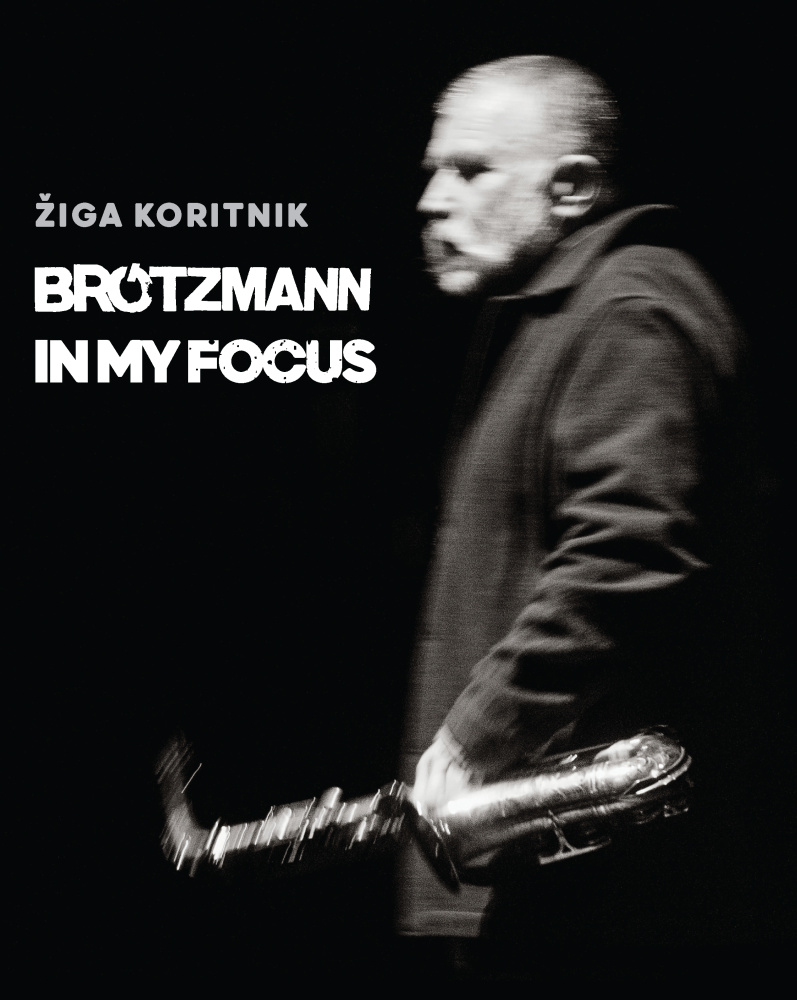 Brotzmann, In My Focus
Žiga Koritnik
152 Pages
Self-Published
2025
Some books go beyond the simple act of documentation. They do not just tell a story; they immerse you in a world. Žiga Koritnik's book on Peter Brötzmann is one of those books—a deeply personal, evocative, and visually striking tribute to a musician whose work defined the very essence of free jazz.
Koritnik, a Slovenian photographer whose work has been intertwined with jazz and improvised music for decades, brings his signature style to this book. He captures not just moments, but the raw emotion, energy, and humanity of his subjects. His lens has long been a witness to the ephemeral, translating fleeting moments into lasting impressions. In this collection, he turns his focus to Brötzmann, the late German saxophonist and clarinetist whose playing was as uncompromising as his spirit.
Brötzmann, who passed away in 2023, was a towering figure in the world of avant-garde jazz. His 1968 album Machine Gun (BRÖ, 1968) remains a landmark recording, a declaration of artistic freedom and an unfiltered outpouring of sound. His music was not for the faint of heart; it was raw, unrelenting, and deeply expressive. Over the decades, he played with a who's who of free improvisers, from Han Bennink and Evan Parker to Bill Laswell and Mats Gustafsson. Brötzmann's approach to music was pure, stripped of excess, existing entirely in the moment—a philosophy that resonates beautifully with Koritnik's photographic approach.
The book features contributions from musicians and writers who knew Brötzmann intimately. Figures like John Corbett, Mats Gustafsson, Bill Laswell, Heather Leigh, Paul Lovens, and Paal Nilssen-Love share their thoughts, alongside poetry by Steve Dalachinsky and Joe McPhee. These written contributions add depth to the visual narrative, allowing us to see Brötzmann through the eyes of those who knew and played alongside him.
One of the most touching aspects of the book is the way Koritnik captures Brötzmann beyond the stage. We see him not just as the ferocious performer, but as a contemplative traveler, a friend, a quiet observer of the world. An anecdote describes Brötzmann always carrying a camera with him, capturing landscapes from train windows or taking snapshots of everyday life—an act of seeing that echoes Koritnik's own photographic practice. In some ways, they were both documentarians of the moment, deeply engaged in their surroundings, seeking truth through their respective mediums.
The photographs are stunning. They are rich in texture, in atmosphere, in presence. Some are full of motion, catching Brötzmann in the throes of performance, his saxophone nearly an extension of his body. Others are intimate, still, reflective. One particularly moving photograph shows Brötzmann embracing Mats Gustafsson after a duo performance in Poland—an image that now holds even greater weight after his passing. These images do not just capture a musician; they capture the energy of a life fully lived.
Koritnik's approach to photography mirrors the spontaneity of improvisation. His images feel immediate, instinctive, deeply felt. There is an honesty in the way he frames his subjects, a sensitivity to the moment that gives his work a unique power. He is not an outsider looking in—he is present, part of the music, part of the energy. The book is also a meditation on memory. Brötzmann is gone, and with him, a lifetime of experiences. But as one of the texts in the book poignantly notes, photographs hold something of that energy. They preserve the atmosphere, the smell of the room, the tension in the air. They remind us of what was, but they also keep something alive. In this way, Koritnik's book is more than a tribute—it is a continuation, a way for Brötzmann's presence to remain felt, seen, known.
For anyone who has followed Brötzmann's music, this book is indispensable. Even for readers new to his work, it demonstrates the force of photography, the resonance of music, and the depth of artistic collaboration. Koritnik delivers a rare document—one that not only presents Brötzmann, but conveys the intensity of his presence. In doing so, the book captures the fleeting, potent, and enduring power of both music and life.
 FOLLOW Nenad Georgievski
and get notified whenever a new article published.
FOLLOW Nenad Georgievski
and get notified whenever a new article published.
For as long I can remember music has been a focal point in my life.
About Peter Brötzmann

Tags
PREVIOUS / NEXT

Become a Sustaining Member

Since 1995, All About Jazz has championed jazz as an art form and supported the musicians who create it. Over three decades, it has grown into one of the world's leading jazz resources, serving hundreds of thousands of readers, musicians, presenters and industry professionals each month.
Help Build the Future of All About Jazz
Your support helps us continue building All About Jazz for the next generation—expanding our editorial coverage, preserving jazz history, developing new community features and creating better ways to discover the music and the people behind it.
Become a sustaining member for as little as $20 per year and you'll immediately enjoy an ad-free experience along with access to subscriber features and future articles for a full year.
Together, we're not simply sustaining All About Jazz—we're building its future. Thank you for being part of the journey.