Home » Jazz Articles » Mr. P.C.'s Guide to Jazz Etiquette and Bandstand Decorum » Best of Mr. P.C. 2015
Best of Mr. P.C. 2015
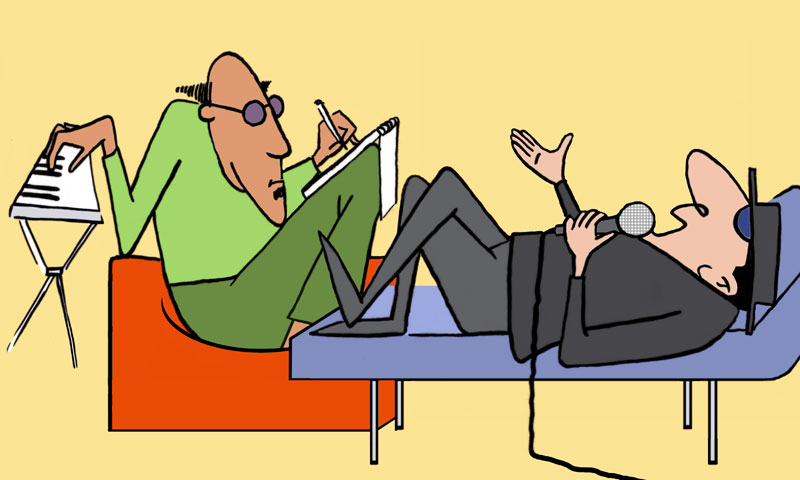
I was driving on a highway yesterday, and the person in front of me was going way too slow. But I couldn't pass her because there were double lines on the road and lots of curves. So instead I drove right up to her bumper and tailgated her until she drove at the correct speed.
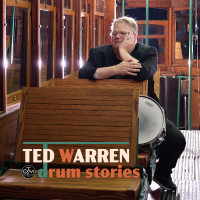
What I'm wondering is, can I do something like that to a drummer who is dragging?
—Damien, Phoenix
I suppose you could, but why would the drummer be playing in the middle of a highway? Plenty of drummers are street musicians, but most have enough street smarts to stick to lightly traveled byways.
Consider this, too: When you nudge a car ahead of you, bumper to bumper, the damage is usually minimal, but striking a sedentary drummer can kill him. On top of that, if he somehow gets snagged on your car, he'll drag worse than ever.
Incidentally, this is the derivation of "bumper music"—brief musical interludes on radio that double as elegies for dragging drummers killed by vehicular assault.
Dear Mr. P.C.:
Why are musicians so big on triad pairs all of a sudden?
—I'm Not Excited by Pairs of Triads
Know your history! In the years leading to jazz music's birth, slaves used their native rhythms as a secret language; drum messages that couldn't be deciphered by their owners. Since then, jazz musicians have continued to invent new vocabularies that allow them to covertly communicate with one another, slaveholders now replaced by the audience.
Bebop, free jazz and fusion all successfully shut out the audience when they first came along. But before long, jazz buffs got used to the new sounds and embraced them; no matter how hard musicians tried to speak privately the audience kept cracking the code.
Triad pairs offer audiences a new and formidable challenge while giving artists the exhilaration of a new insider language. The secret won't last forever, but rest assured that while triad pairs are keeping listeners at bay, jazz innovators are hard at work devising something even more obscure and incomprehensible
Dear Mr. P.C.:
What is meant by the term "Post-Bop"? Since "bop" ended in the 1950s, isn't everything since then technically "post-bop"?
—T.M. in Seattle
It sure is, and that's great news to anyone worried that jazz is becoming irrelevant. What better solution than to be massively inclusive, the biggest of all big tents!
Taylor Swift? Post-bop! Rice a Roni? Post-bop! Richard Nixon? Post-bop! Post-modernism? Post-bop!
Sure, pop, rock and country outsell jazz fifty to one, but we know the post-bop truth—we own them.
The post-bop world belongs to jazz!
Dear Mr. P.C.:
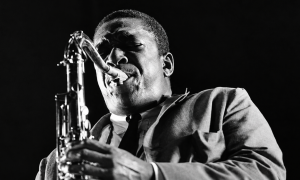
I was in the audience at a jam session. My back was to the stage, and I couldn't believe how long a solo the tenor player took. He played like watered down Coltrane, a sound I'm used to nowadays. Then I turned around and realized I'd heard three different tenor players who all sounded the same. Why do they all do that?
—Roger Overandout
If tenor players didn't all sound the same, how would they be able to find subs? This way, when a pianist who sounds like watered down McCoy needs a tenor player who sounds like watered down Trane, the bench is deep.
And "watered down" isn't a negative—if Trane were still alive, at 88, he would sound like watered down Trane too. The sax players you heard value historical accuracy, while a player who sounds like Trane at the peak of his career is nothing but a thoughtless knock-off.
Dear Mr. P.C.:
What's wrong with the people who made up the names for how to play? When you get to a section that's double-time, you would think it would take twice as long, but it's actually faster. Then you get to a part that's half-time, so it should take half as long to play, but it's slower. Am I missing something?
—Concerned Citizen
Yes, you are. Your math assumes time is a constant, but Einstein disproved that more than 100 years ago, and rhythm sections continue to disprove it every night.
In reality, double-time isn't a precise tempo, but rather a special effect designed to amplify the music's irregularities. It takes all the problems that come up when musicians are playing regular "time"—rushing drummers, uneven basslines, spastic soloists... and makes them twice as bad! It's really more of a parlor trick than a useful musical device, and it takes a terrible physical and emotional toll on the musicians.
Half-time is when the musicians get to take a long break, just like in football; it's usually called when they need to regroup and recover from playing double-time.
Dear Mr. P.C.:
I have heard the song "It Don't Mean a Thing if it Ain't Got That Swing," and have several questions:
Does the word "ain't" have a place in such a musical masterpiece?
Why would a composer write such double negatives?
What does it mean if it does have that swing?
—Stuck Wondering If Negatives Groove
"What Am I Here For?" Duke asked, but a part of him knew that there was music, and nothing more. That explains how terribly prolific he was, shadowed by the fear that the moment he put down his pen or took his hands off the keys, a life well-lived would come to nothing.
Have a question for Mr. P.C.? Ask him.
 FOLLOW Mr. P.C.
and get notified whenever Mr. P.C. has a new article published.
FOLLOW Mr. P.C.
and get notified whenever Mr. P.C. has a new article published.
Inspired by the cutting edge advice of Abigail Van Buren, the storied bass playing of Paul Chambers, and the need for a Politically Correct doctrine for navigating the minefields of jazz etiquette, I humbly offer my services.
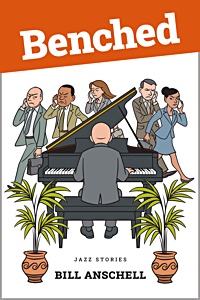
Get 'Benched!'
Benched, Bill Anschell's debut book of short stories / jazz humor. The stories are interspersed with the very best of Mr. P.C., hand-picked from the 400+ questions answered over the column's 16-year history. Benched is available on Amazon (paperback and Kindle) and most online booksellers.
Tags
PREVIOUS / NEXT

Become a Sustaining Member

Since 1995, All About Jazz has championed jazz as an art form and supported the musicians who create it. Over three decades, it has grown into one of the world's leading jazz resources, serving hundreds of thousands of readers, musicians, presenters and industry professionals each month.
Help Build the Future of All About Jazz
Your support helps us continue building All About Jazz for the next generation—expanding our editorial coverage, preserving jazz history, developing new community features and creating better ways to discover the music and the people behind it.
Become a sustaining member for as little as $20 per year and you'll immediately enjoy an ad-free experience along with access to subscriber features and future articles for a full year.
Together, we're not simply sustaining All About Jazz—we're building its future. Thank you for being part of the journey.