Home » Jazz Articles » Album Review » Miles Davis: Ascenseur pour l'Échafaud
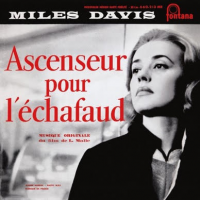
Miles Davis: Ascenseur pour l'Échafaud
The circumstances surrounding the recording are central to its mythology, and the spontaneity was real: Davis was at the peak of his powers.
The film's plot concerns the hired murder of Jeanne Moreau's husband. The professional killer realizes, after the deed is done, that he has left crucial evidence at the scene. Returning to retrieve it, he becomes trapped in the building's lift.
1957 was a landmark year for Davis. In May he had recorded Miles Ahead (Columbia) with Gil Evans. In December came the groundbreaking Lift to the Scaffold sessions—and just four days before those recordings, Davis had played a concert at the Olympia in Paris with the same musicians.
He had come to Paris under contract to appear at the Club Saint-Germain, leaving his regular group behind in New York. By this point he was famous enough to draw crowds on his own. The ensemble he assembled was formidable. Barney Wilen was just twenty, fresh to the scene but already commanding. Pierre Michelot had played with Sidney Bechet and Clifford Brown. René Urtreger was the house pianist at the club and had accompanied Lester Young. Kenny Clarke—who had helped redefine jazz drumming in the 1940s—had made Paris his home. Beyond their residency at Saint-Germain, the group also played concerts in Brussels, Amsterdam, and Stuttgart.
Writer Boris Vian captured the atmosphere of the recording session: "This recording was made at night in the studios of the Paris broadcasting station, in a most informal atmosphere. Among those present was Jeanne Moreau, the principal star of the film. She proved a very charming hostess, serving refreshments to musicians and technicians at an improvised bar. There were those responsible for the production and the technical staff, but also Louis Mall—with his braces dangling loosely—doing his utmost to encourage Miles in his musical accompaniment of the film. The orchestra members, very much at ease in this informal atmosphere, looked at images from the principal scenes and, being thus in the right mood, improvised various musical paraphrases as the reel was projected.
"In the melody 'Dîner au motel' you will notice a curious sonority in Miles' trumpet. The explanation is a strange one: while he was playing, a tiny piece of skin from his lip came loose and stuck in the mouthpiece of his instrument. Miles gladly accepted this strange new element—in the most literal sense, an unheard-of musical effect—in quite the same way as those painters who owe the quality of a particular brushstroke to mere chance."
Little preparation had been done. Davis had sketched only a few simple harmonic sequences in his hotel room and shared them with the band shortly before recording began. With the plot explained, loops of key scenes were projected in the studio while the musicians improvised directly to the images, without any pre-composed themes. Bassist Pierre Michelot later recalled: "Miles just asked us to play two chords—D minor and C7, four bars of each, ad lib." It was typical of Davis: minimal instruction paired with an unerring sense of atmosphere.
By 1957, Davis had grown weary of the dense convolutions of bebop. This challenge gave him permission to slow down—and slow down he does, the music emphasising the film's Hitchcockian tension, its fatal romanticism and nocturnal menace.
Chronologically, the soundtrack sits only months before Kind of Blue (Columbia, 1959), and in many ways it points directly toward that masterpiece. For the first time, Davis fully committed to a modal approach—accepting harmonic limitations not as a constraint but as a means of focusing on pure line, emotion, and tone. As critic Ashley Kahn has noted, "Miles liked the results, and it forever changed how he would approach music and music-making. Eventually, it also changed the jazz world."
Davis's Harmon-muted trumpet is edgy, intimate, and almost corrosive throughout. "Générique" opens the film in an evocative, unhurried mood, giving Davis space to trace the loneliness of Moreau as she wanders the streets. "L'assassinat de Carala" is dark, menacing, and brooding, coiling the film's suspense tighter. "Sur l'autoroute" and "Dîner au motel" drive hard, showcasing Kenny Clarke's crisp brushwork, Wilen's quicksilver tenor, and Michelot's fluent bass. "Florence sur les Champs-Élysées" returns to pacing and melancholic restraint.
The current reissue presents the recordings across three formats. A 180g vinyl LP reproduces the original album in a gatefold tip-on sleeve, with an English translation of Boris Vian's original liner notes. A three-10" vinyl edition expands the release to include the full original soundtrack alongside the complete session takes from December 1957, housed in a three-panel gatefold with Franck Bergerot's essay A Present from Miles Davis to Louis Malle. A limited-edition two-CD set brings together the original album and all surviving takes from the sessions of 4 and 5 December, accompanied by a 60-page hardcover book featuring notes by Ashley Kahn and Franck Bergerot.
 FOLLOW Jack Kenny
and get notified whenever a new article published.
FOLLOW Jack Kenny
and get notified whenever a new article published.
Jack was turned on to jazz by a mixture of Stan Getz, Lee Konitz and Earl Bostic.
Track Listing
CD1 Générique; L’Assassinat de Carala; Sur l’autoroute; Julien dans l’ascenseur; Florence sur les Champs-Elysées; Dîner au motel; Evasion de Julien; Visite du vigile; Au Bar du Petit Bac; Chez le photographe du motel; CD2 Nuit sur les Champs-Elysées; Nuit sur les Champs-Elysées – take 3; Nuit sur les Champs-Elysées – take 3 (Générique); Nuit sur les Champs-Elysées – take 4; (Florence sur les Champs-Elysées); Assassinat – take 1 (Visite du vigile); Assassinat – take 2 (Julien dans l’ascenseur); Assassinat – take 3 (L’assassinat de Carala); Motel (Dîner au motel); Final – take 1; Final – take 2; Final – take 3; (Chez le photographe du motel); L’Interrogatoire de Julien; Ascenseur (Evasion de Julien); Petit Bac – take 1; Petit Bac – take 2 (Au bar du Petit Bac); Voiture – take 1; Voiture – take 2 (Sur l’autoroute);
Personnel

Miles Davis
trumpet
Barney Wilen
saxophone, tenor
Rene Urtreger
piano
Kenny Clarke
drums
Pierre Michelot
bass, acousticAlbum information
Title: Ascenseur pour l'Échafaud | Year Released: 2026 | Record Label: Decca Records France
About Miles Davis
Tags
PREVIOUS / NEXT
Become a Sustaining Member

Since 1995, All About Jazz has championed jazz as an art form and supported the musicians who create it. Over three decades, it has grown into one of the world's leading jazz resources, serving hundreds of thousands of readers, musicians, presenters and industry professionals each month.
Help Build the Future of All About Jazz
Your support helps us continue building All About Jazz for the next generation—expanding our editorial coverage, preserving jazz history, developing new community features and creating better ways to discover the music and the people behind it.
Become a sustaining member for as little as $20 per year and you'll immediately enjoy an ad-free experience along with access to subscriber features and future articles for a full year.
Together, we're not simply sustaining All About Jazz—we're building its future. Thank you for being part of the journey.