Home » Jazz Articles » Extended Analysis » Art Pepper: Art Pepper: Art Pepper Live at Fat Tuesday’s
Art Pepper: Art Pepper: Art Pepper Live at Fat Tuesday’s
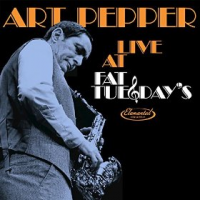
"He was living on borrowed time, and he knew it. The last time I saw him, at Fat Tuesday's a few months ago, his face was bluish white, and his lower legs—he pulled up is trousers to demonstrate—were as bloated as beer barrels. He told me he couldn't shake hands because he had cut himself that afternoon, and not feeling any pain, didn't know it until he saw the streaming blood. He was obsessed with the miracle that he was still ambulatory and breathing: difficult to be around."
Doubtless these are the performances to which Giddins refers. From stark chronology, the material on this recording was captured on April 15, 1981. Pepper's last recorded performance was a year later in Los Angeles, May 30, 1982 at the Kool Jazz Festival and captured on Art Pepper Last Concert 1982 -Final Art (Widow's Taste, 2007). Two weeks after that, on June 15th, Pepper succumbed to a cerebral hemorrhage and silence came to the last great alto saxophone stylist. Pepper out-lived them all: Charlie Parker, Johnny Hodges, Paul Desmond, and almost Sonny Stitt (who followed Pepper that July). His only possible peer living today is Lee Konitz... and he and Pepper produced the exceptional music collected on Art Pepper: The Hollywood All-Star Sessions (Galaxy, 2001).
But, there were two Art Peppers. The first one was a 1950s West Coast master with a dry-martini tone (and good gin, FDR Grade, not that shitty vodka of Bond...and cold, like Frank Sinatra's conscience) with good looks and a hip demeanor to match them. It was this Pepper that recorded masterpieces like Art Pepper Meets the Rhythm Section (Contemporary, 1957), Art Pepper + Eleven -Modern Jazz Classics (Contemporary, 1960), and Getting' Together (Contemporary, 1960). Then, there was the Art Pepper from 20 years later, the one who recorded Living Legend (Contemporary, 1975) and The Trip (Contemporary, 1976), and those staggering 1977 sides at the Village Vanguard (The Complete Village Vanguard Sessions (Contemporary, 1995). Nothing dry about them...
The difference?
Well, heroin and prison, to be sure... but that is overwrought and cliché. The big difference was Pepper's reaction to John Coltrane, a connection that Giddins, in his obit, touches on:
"Listen to the ballads, especially, "Good-Bye" and "Cherokee," on the three records he made at the Village Vanguard in 1977 (Contemporary); in their tenuous, occasionally unpleasant ways, they are as nerve-shattering as the unholy cries of late Coltrane. John Coltrane was living on borrowed time, too. Perhaps it's only in the recognition that we all are that the unpleasantness of their music become meaningful, acceptable, even beautiful."
Like Beethoven, Pepper had three creative periods, the final ones being cataclysmic. New York Times classical critic Harold C. Schoenberg, in his survey The Lives of the Great Composers (Norton, 1997) said of Beethoven's final period,
..."the so-called last period works—the last five string quartets and piano sonatas, the Diabelli Variations, the Missa Solemnis, the Ninth Symphony. Here were are on a rarified plane of music. Nothing like it has been composed, nothing like it can ever be again. It is the music of a man who has seen all and experienced all, a man drawn into his silent, suffering world, no longer writing to please anybody else but writing to justify his artistic and intellectual existence. Faced with this music, the temptation is to read things into it in some sort of metaphysical exegesis. The music is not pretty or even attractive. It merely is sublime."
These words apply to Pepper's final period, his Gotterdammerung, as well. Pepper's end-of-life performances were high-wire acts as daunting and dangerous as any physical ones. It was during this period that Pepper became less of an interpreter of the jazz canon and more of its reluctant prophet. Pepper begins his standards well enough (here, Thelonious Monk's "Rhythm-a-ning" and lengthy considerations of "What is this Thing Called Love" and "Goodbye"). But then, something like what John Coltrane did on his final tour with Miles Davis in 1960, happened. Pepper, spurred on by his enigmatic pianist, Milcho Leviev and his exceptional rhythm section rounded out by bassist George Mraz (who was there at the Village Vanguard Sessions and drummer Al Foster deconstructed these songs. He took them apart and went for a walk within their created confines. "Goodbye" is inhabited by Pepper's stuttering cries as he tries to work out the melodic kinks of the piece under a pressure denying the Ideal Gas Law. Leviev and Mraz solo with abandon when not pushing Pepper downhill at full speed.
Pepper transforms two of his most popular compositions, "Make a List, Make a Wish" and "Red Car." These pieces, when first recorded, readily demonstrate Pepper's command of R&B under the auspices of jazz and show is healthy life-and-death sense-of-humor. "Make a List" has always been a concert work out, with its best performance being that captured a month after the Fat Tuesday run on Art Pepper: Unreleased Art, Vol. III; The Croydon Concert, May 14, 1981 that performance pinned down with Bob Magnusson's amplified double bass. What Mraz does here is let Pepper and Leviev go. They are untethered and perform so. This is as far as a standard jazz performance can go before disintegrating into the ravenous particles of free jazz. Pepper becomes unhinged and plays on the edge of oblivion with Leviev there helping him do it.
"Red Car" is performed likewise. The abandon Pepper achieves is impressive and is comparable to the Village Vanguard performances... ragged glory. Live at Fat Tuesday's is an important addition to the Pepper discography. It captures the saxophonist on the far edge of inspiration... where he was meant to be.
 FOLLOW C. Michael Bailey
and get notified whenever Michael has a new article published.
FOLLOW C. Michael Bailey
and get notified whenever Michael has a new article published.
I'm Sanctified and Southern Fried / Mama tried and daddy cried / I tell the truth 'cept when I've lied / And like my huevos on the side.
Track Listing
Rhythm-a-ning; What is This Thing Called Love; Goodbye; Make a List, Make a Wish; Red Car.
Personnel

Art Pepper
saxophone, altoArt Pepper: alto saxophone; Milcho Leviev: piano; George Mraz: bass; Al Foster: drums.
Album information
Title: Art Pepper: Art Pepper Live at Fat Tuesday’s | Year Released: 2015 | Record Label: Elemental Music
About Art Pepper
Tags
PREVIOUS / NEXT
Become a Sustaining Member

Since 1995, All About Jazz has championed jazz as an art form and supported the musicians who create it. Over three decades, it has grown into one of the world's leading jazz resources, serving hundreds of thousands of readers, musicians, presenters and industry professionals each month.
Help Build the Future of All About Jazz
Your support helps us continue building All About Jazz for the next generation—expanding our editorial coverage, preserving jazz history, developing new community features and creating better ways to discover the music and the people behind it.
Become a sustaining member for as little as $20 per year and you'll immediately enjoy an ad-free experience along with access to subscriber features and future articles for a full year.
Together, we're not simply sustaining All About Jazz—we're building its future. Thank you for being part of the journey.