Home » Jazz Articles » Album Review » Mike Westbrook: The Cortège Live At The BBC 1980
Mike Westbrook: The Cortège Live At The BBC 1980
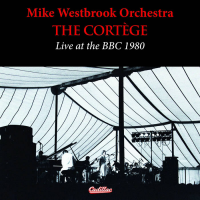
The original album is currently missing in action, so this live iteration also restores a major jazz composition to the catalogue. The music's realisation, along with the careful selection by Kate Westbrook of the accompanying texts for its libretto, took several years. The period from its gestation in the late seventies to its recording and release by Westbrook's own imprint in 1982 saw performances across the UK, in Germany, Italy, France, Switzerland and Sweden. As shown, it underwent significant changes compared with its official release.
But first, let us digress for a moment. One can imagine, if never fully comprehend, how it might feel for an acknowledged classical music composer of significance in their field to know that their third symphony or second piano concerto was absent from the catalogue. Sadly, the experience of jazz composers like Westbrook suggests that, in the jazz world, this is all too typical. Make no mistake, The Cortège is a work of major significance and one of great imagination that offers proof of the transformative power of jazz. At its heart are the themes of life and death, with the notion of a New Orleans funeral procession with brass band accompaniment adding another dimension—one of legacy, of life well-lived but seen as if looking back at that life through a series of images. In the original sleeve notes, Westbrook refers to "a dream journey past Fairground sideshows." It is as apt a description as one could imagine.
Digressing again, the possibilities of digital downloads through the inestimable resources of such as Bandcamp may in due course compensate for such absences, though that is often dependent on major record companies' willingness to release the rights. The digital release of jazz works and albums that might otherwise be unavailable offers opportunities for new listeners to discover such works and allows for a greater sense of the music's history and rich diversity.
At the same time, one cannot help but regret the decline of the LP and CD, despite the re-emergence of a niche market for new and reissued vinyl. After all, the LP or CD involved an artifact that was real in the world. One could visualise its whole chain of production, of its beginnings in the mind or minds of its composer or musicians, through its performance in the studio or on stage, through the design of a cover and perhaps writing of sleeve notes and even through the processes of production and distribution. The LP or CD was in all senses the product of human work—and thought. Can one say the same about the digital download? Does the absence of a physical product, at some unconscious level, even imply another absence, here of human agency? It becomes an abstracted manifestation from a digital ether. That being so, its value both monetarily and as art is devalued, while the mobile phone or tablet that delivers it becomes the fetish object of value.
Thankfully, The Cortège Live at the BBC 1980 is available as a physical product and a beautiful one at that. The colors of black, red and white of the sleeve and notes are repeated on the CDs themselves, and the black and white in-concert photographs transport the purchaser to those moments along its journey. After all, The Cortège is nothing if not the journey of life itself. Then there is the sound of the music and its production values. Someone has worked— yes, 'worked'—damned hard to ensure that the music is heard as its composer would wish.
Digressing once more, the appearance of this work on the revitalised Cadillac label is surely apt. The label was formed originally by Westbrook and John Jack to release a small band album, Live (Cadillac SGC1001), in 1973. John Jack continued to release albums over the years by the likes of Stan Tracey, Harry Beckett, Joe Harriott, Johnny Dyani and, even, David Murray. Jack himself deserves more than a footnote in British jazz history. In many ways, he was an ever-present figure aiding the birth of any number of projects. There was something distinctly Dickensian about the man, somewhat curmudgeonly but totally committed and guided by a warm and generous spirit. The label's revival by John Jack's sometime assistant, Mike Gavin, restores some key British jazz releases to the catalogue, as well as providing an outlet for performances such as The Cortège Live at the BBC 1980. These reissues are in every sense artifacts, things of beauty to be cherished.
Returning at last to the music itself: That there are differences between this performance and the original studio release is inevitable, As Westbrook's peer, Graham Collier oft insisted, "Jazz happens in real time—once!" The gorgeous "Erme Estuary" is absent, as is "Kyrie," the composition that would provide a bridge from the work's mighty showpiece "Santarcangelo" and the closing pieces "A Heath Burns" and "Graffiti." While some compositions, "A Hearth Burns" for example, offer versions shorter than the earlier release, others, like "Knivshult/Ash Wednesday," are expanded. These structural differences aside, on this listening, Westbrook had finalised most of the settings for the individual sections of the suite by the time of the BBC recording. The other most apparent differences between the two lie in the solos and the performance itself, which here have an even greater immediacy than the original offering. The playing is truly magnificent throughout, sometimes as on trombonist Malcolm Griffiths' solo on "Leñador" surpassing even his exalted standards.
The Cortège is a vast work, and it is difficult to cover this hugely successful and coherent suite in detail here. However, the final sentence here, which references the New Orleans funeral procession as a metaphor for life, says it all:
"Should there be a heaven and should I get an invite, may this be the music to carry me there."
 FOLLOW Duncan Heining
and get notified whenever a new article published.
FOLLOW Duncan Heining
and get notified whenever a new article published.
Based in the UK, Duncan Heining has been writing about jazz for 24 years.
Track Listing
It Starts Here; Democratie; Berlin-16.2.79; Knivshult/Ash Wednesday; Ruote Che Girano; Piano; Lenador; July ‘79; Enfance; Cordoba; Santarcangelo; A Hearth Burns; Graffitti.
Personnel

Mike Westbrook
composer / conductor
Brian Godding
guitar, electric
Kate Westbrook
vocals
Phil Minton
vocals
Dave Barry
drums
Steve Cook
bass, electricDave Plews
trumpet
Guy Barker
trumpet
Dick Pearce
trumpetNick Patrick
tubaAlan Sinclair
tuba
Malcolm Griffiths
trombone
Chris Hunter
fluteAlan Wakeman
saxophoneLindsay Cooper
bass
Chris Biscoe
saxophoneGeorgie Born
celloAdditional Instrumentation
Mike Westbrook: piano; Lindsay Cooper: oboe, bassoon, soprano and sopranino saxophone.
Album information
Title: The Cortège Live At The BBC 1980 | Year Released: 2025 | Record Label: Cadillac Records
About Mike Westbrook
Tags
PREVIOUS / NEXT


Become a Sustaining Member

Since 1995, All About Jazz has championed jazz as an art form and supported the musicians who create it. Over three decades, it has grown into one of the world's leading jazz resources, serving hundreds of thousands of readers, musicians, presenters and industry professionals each month.
Help Build the Future of All About Jazz
Your support helps us continue building All About Jazz for the next generation—expanding our editorial coverage, preserving jazz history, developing new community features and creating better ways to discover the music and the people behind it.
Become a sustaining member for as little as $20 per year and you'll immediately enjoy an ad-free experience along with access to subscriber features and future articles for a full year.
Together, we're not simply sustaining All About Jazz—we're building its future. Thank you for being part of the journey.