Home » Search Center » Results: Leonard Bernstein
Results for "Leonard Bernstein"
The Smithsonian Jazz Masterworks Orchestra explores the vast, diverse repertoire of legendary composer Leonard Bernstein on stunning, revelatory new album

Legendary composer Leonard Bernstein once called jazz “the ultimate common denominator of the American musical style.” The music made a profound impact on Bernstein’s work, not only in the more explicit “jazziness” of his work in musical theater, but throughout his “serious” orchestral music as well. Jazz artists in turn felt the influence of Bernstein’s innovations, ...
Ran Blake: Gray Moon, When Soft Rains Fall and Northern Noir

by John Ephland
I'm a sucker for musical duets. Duets that make me feel like I'm in the same room with the two of them. Here we have three recent releases with the iconoclastic, legendary Ran Blake, now 83, in what is his most typical setting. Yes, to hear Blake paired up like this is to hear ...
Horizons Jazz Orchestra: Plays the Music of Lee Harris: The Brite Side

by Edward Blanco
The south Florida-based Horizons Jazz Orchestra (HJO), present their debut album, The Brite Side, performing five original Lee Harris compositions and also five standards sporting fresh new Harris arrangements, for a compelling package of big band music that is a pleasure to hear. Founded in 2016 by Stan Kenton alumnus Dennis Noday, and former baritone saxophonist ...
Ian Shaw, Iain Ballamy, Jamie Safir: What's New

by Chris May
What's new? Not the dozen songs on this enchanting trio album. Most of them have been around for well over fifty years and people will likely still be enjoying them in another fifty. The composers include Duke Ellington, Richard Rodgers, Burt Bacharach, Jimmy Van Heusen, Michel Legrand and Leonard Bernstein. Musically sophisticated and lyrically literate, the ...
Gabriele Coen Quintet: Leonard Bernstein Tribute
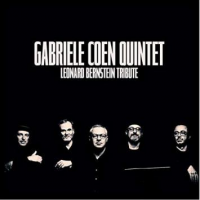
by Claudio Bonomi
Gabriele Coen sa come smarcarsi all'interno di uno spesso scontato scenario jazz contemporaneo che ama mimetizzarsi sotto i veli di un'apparente originalità o modernità tout court. Aveva già dato prova in passato del suo savoir faire interpretativo nei tributi a Kurt Weill e a John Zorn e anche nel caso di Leonard Bernstein il sassofonista e ...
About Leonard Bernstein
Results for pages tagged "Leonard Bernstein"...
Leonard Bernstein

Born:
A presence on Broadway, in Hollywood, at Carnegie Hall and the New York Philharmonic, Leonard Bernstein was a major force in twentieth century music. His exuberant and dramatic style caught the heart of America, bringing classical music to thousands of people from diverse backgrounds. More than any American conductor before him, Bernstein expanded the audience of classical music while maintaining a deep artistic integrity. Bernstein was born in Lawrence, Massachusetts in 1918. His parents were first generation Jewish immigrants from Russia. Though he began learning the piano at age ten, his family hoped he would follow a more practical route, and sent him to the Boston Latin School. After graduating, he attended Harvard University, where he majored in music. His interest was in becoming a concert pianist, but upon graduating he began to seriously study orchestration at the Curtis Institute of Music in Philadelphia. More important than any of the formal training, however, were the summers he spent in Tanglewood, Massachusetts, studying with the great conductor Serge Koussevitzky. In 1942, Koussevitzky invited Bernstein to be the assistant conductor at Tanglewood. Though very young for a conductor, his flamboyant style and emotionally charged performances caught the attention of others in the classical music community--one of whom was Arthur Rodzinzki, who appointed him assistant conductor of the New York Philharmonic. It was at the New York Philharmonic that Bernstein got his big break. Asked to fill in for an ailing guest conductor, Bernstein (then only twenty-five) conducted a difficult and energetic performance with only an evening's preparation. Impressing all who came, Bernstein found himself on the cover of The New York Times--an instant celebrity. Within two years he was named the director of the New York City Symphony. He spent much of the 1950s conducting, teaching, and becoming involved in composing for non- classical genres. Of his many popular efforts of the time, On the Waterfront (1954), Candide (1956), and West Side Story (1957) are the best known. For On the Waterfront he received an Academy Award, and for nearly everything he did, he received the acclaim of an adoring public. In 1957, Bernstein returned to the New York Philharmonic, where he was to make his greatest contribution to the music world. The versatile musical genius that had made him a success on Broadway and in the classical concert halls of the world, found its true home at Lincoln Center. For the next eleven seasons, Bernstein would energize the Philharmonic and American classical music in a way no other director had done. Taking advantage of the recent technological advance of television, Bernstein presented classical music to a wider audience. While he toured throughout the world, visiting seventeen different countries, he also concentrated on creating accessible performances for the average American. For both children and adults, he created shows which were both entertaining and educational. By the time of his resignation from the Philharmonic, he had conducted nine hundred and thirty nine concerts with the orchestra--an unprecedented amount.
The Very Singular Mr. Ran Blake

by Duncan Heining
There have been few American composers and musicians, with the ability to encapsulate their country's music in all its racial and ethnic complexity. We might perhaps point to Aaron Copland, Leonard Bernstein, Charles Ives and perhaps, in their own distaff ways, Harry Partch and Steve Reich. In jazz, their number is fewer still--Duke Ellington and George ...
Gabriele Coen: Incontro con Leonard Bernstein in chiave Jazz

by Paolo Marra
Parlando del padre Leonard Bernstein la figlia Jamie in un occassione disse “Ogni anno la sua musica sembra sempre essere migliore, forse il suo momento arriverà, dopo tutto." In effetti la modernità delle composizioni è una delle caratteristiche che hanno reso la musica del grande direttore d'orchestra parte del patrimonio artistico del '900 tanto da risultare ...
Marcus Roberts And The Modern Jazz Generation At The Kimmel Center

by Victor L. Schermer
Marcus Roberts and the Modern Jazz Generation Kimmel Center for the Performing Arts Perelman Theater Philadelphia, PA October 11, 2019 Marcus Roberts is one of the great jazz pianists of his generation, coming up in the 1980s in Wynton Marsalis' band and since then more ...
Jacopo Ferrazza e il Questionario di Proust

by Paolo Peviani
Il tratto principale della mia musica La Sincerità. La qualità che desidero nei musicisti che suonano con me Sono diverse: La sincerità, l'impegno e la puntualità! Come musicista, il momento in cui sono stato più felice Probabilmente quando sono salito sul palco del Blue ...

Trending
 Interview
Bill Bruford And Pete Roth: A One-Of-A-Kind Juxtaposition
 Interview
Miles Okazaki's Monkathon: The Complete Thelonious...
 Interview
Scott Kinsey: Thought Distortions and the Art of the Left...
 Reanimating Conversations Past
John Scofield: Meant To Be
 From the Inside
The Quiet Cruelty of the Music Business
 Live Review
Arcanum at Victoria Nasjonal Jazzscene, Oslo
 Phil Schaap's Jazz Room
Franc Williams: Live From The West End
VOTE!