Home » Jazz Articles » Live Review » Ron Carter New Jazz Trio And Foursight Quartet At Birdland
Ron Carter New Jazz Trio And Foursight Quartet At Birdland
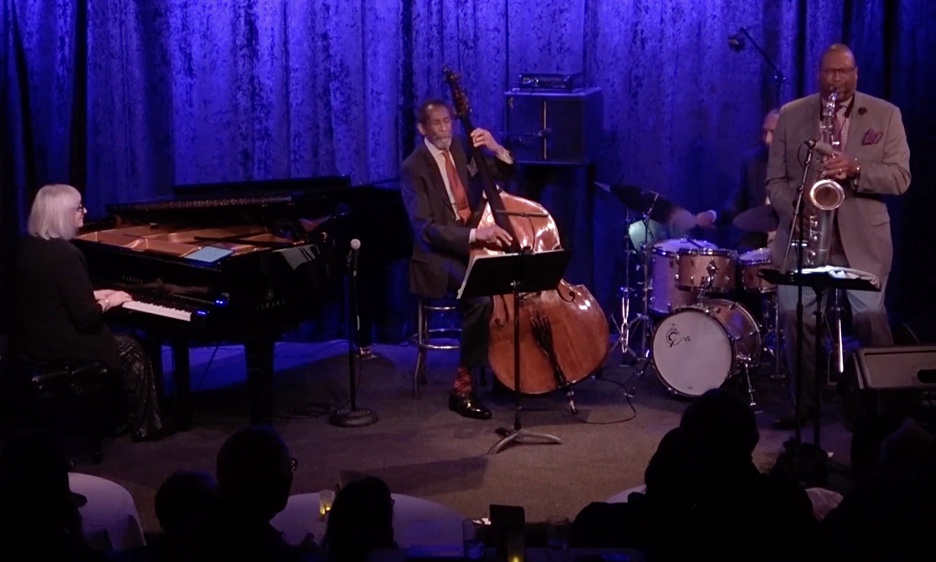
Carter writes little of the repertoire for these groups, but his organizational and arranging stamp is all over them.
Birdland
New York, NY
October 16 and 23, 2025
Ron Carter turned 88 in May, 2025. That fact is hard to reconcile with the continuing vitality and frequency of his performances, including those with two small groups at Birdland Jazz Club this month—as part of his customary October residency at the midtown Manhattan venue.
Carter's age was underlined, though, by an anecdote he told after a tender, restrained take on "Body and Soul" (made famous by the 1939 Coleman Hawkins recording) at the October 16 trio set. He recalled the 1960 recording date for Night Hawk (Sound Grammar, 1961), before which Hawkins picked up the bassist, then just 23, outside his Manhattan apartment building, after which the legendary saxophonist and the upstart crossed the river to the New Jersey studio of Rudy Van Gelder. Carter recalled standing, intimidated, as "my '50s jazz heroes," including "Hawk" and Eddie "Lockjaw" Davis, waited for him "to play his first note."
Carter's 2025 Birdland residency began intimately—a duo engagement with guitarist Bill Frisell—and ends two weeks later at the other lineup extreme, with a run by the 17-piece Ron Carter Great Big Band. In between were shows in the two formats that have dominated Carter's 2,000-plus recordings, mostly as a sideman.
First up were four days of performances by Carter's New Jazz Trio, with the bassist joined by Donald Vega on piano and altoist Donald Harrison—the latter being a replacement within Carter's trio for guitarist Russell Malone, who died a little over a year before, shortly after a duo performance reviewed here.
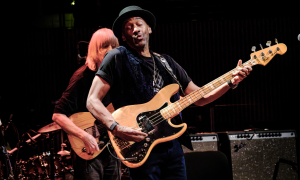
The drummerless lineup forced Carter to sustain the groove, which he did unfailingly. Yet he was also very much the musical leader, finding the bandwidth for such busy embellishments as triplets and frequent excursions up the neck of his instrument. When Vega soloed, Carter sometimes locked in to provide a conversational counterpoint to Vega's fine, fluid piano solos.
Harrison, whose playing with own bands can lean to Crescent City spiciness, mostly exuded low-to-medium fire here to match the moderate tenor of this trio. He also brought the night's best party trick by following his own take on "Body and Soul" with a short, note-perfect impersonation of Hawkins' deliberate, breathy delivery.
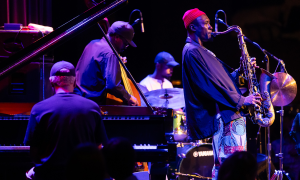
The following week came the Ron Carter Foursight Quartet, featuring pianist Renee Rosnes, tenorist Jimmy Greene, and drummer Payton Crossley. Despite adding percussion, the quartet shared the restrained elegance that characterized Carter's trio—indeed, that of Carter himself, both musically and otherwise.
Crossley locked in subtly with Carter, often favoring brushes over sticks, and rarely playing fills that ramped up the dynamic level. A case in point: his earliest solo in the set was a marvel of minimalism played entirely on his hi-hat, conjuring up the solos that drum master Max Roach would play entirely on those pedal-controlled cymbals.
The surefooted Greene more than held his own in the up-tempo parts of the set—nearly an hour of which was played continuously, segueing from number to unannounced number. But as a particularly soulful player, Greene brought emotional depth to the set's more reflective segments.
Rosnes, a long-time bandleader in her own right, dazzled with her subtlety and technique. In particular, she played plenty of glistening arpeggios, with each note beautifully articulated.
The Birdland engagements underline that the bassist best known as a sideman is also a formidably talented leader. Carter writes little of the repertoire for these groups, but his organizational and arranging stamp is all over them. Each soloist is allowed their space, but their excursions never rise to self-indulgence or outstay their welcome. The feel is not one of politeness to a fault, only of a consistently harmonious balance.
At the center of both sets was an unaccompanied—mostly so, anyway—solo by Carter, of eight or so minutes, which used the simplest of musical vehicles—the country standard "You Are My Sunshine." It offered a demonstration of Carter's still-pristine technique, with its many drops and pulls, and such eclectic asides as playing a snippet of Bach's "The Goldberg Variations" on during the quartet set.
Few, if any, other bassists could sustain such a lengthy solo without losing listeners or running out of ideas. As he approaches his tenth decade, with his skills still razor-sharp, Ron Carter is not only the continuing dean of the jazz bass but a treasure to American music.
 FOLLOW Paul Reynolds
and get notified whenever a new article published.
FOLLOW Paul Reynolds
and get notified whenever a new article published.
Journalist and programmer in jazz, folk, country and other musics
About Ron Carter

Tags
PREVIOUS / NEXT

Become a Sustaining Member

Since 1995, All About Jazz has championed jazz as an art form and supported the musicians who create it. Over three decades, it has grown into one of the world's leading jazz resources, serving hundreds of thousands of readers, musicians, presenters and industry professionals each month.
Help Build the Future of All About Jazz
Your support helps us continue building All About Jazz for the next generation—expanding our editorial coverage, preserving jazz history, developing new community features and creating better ways to discover the music and the people behind it.
Become a sustaining member for as little as $20 per year and you'll immediately enjoy an ad-free experience along with access to subscriber features and future articles for a full year.
Together, we're not simply sustaining All About Jazz—we're building its future. Thank you for being part of the journey.