Home » Jazz Articles » Live Review » The Macedonian National Jazz Orchestra with Rambo Amadeu...
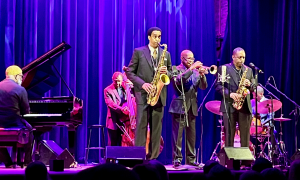
The Macedonian National Jazz Orchestra with Rambo Amadeus, Darko Rundek, and Vlatko Stefanovski at the Philharmonic Hall
Courtesy Maja Argakijeva
Philharmonic Hall
Rock 'n' Roll in Jazz
Skopje, Macedonia
December 8, 2025
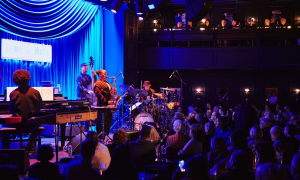
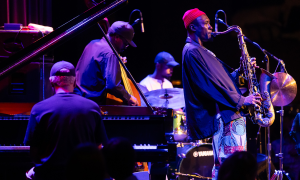
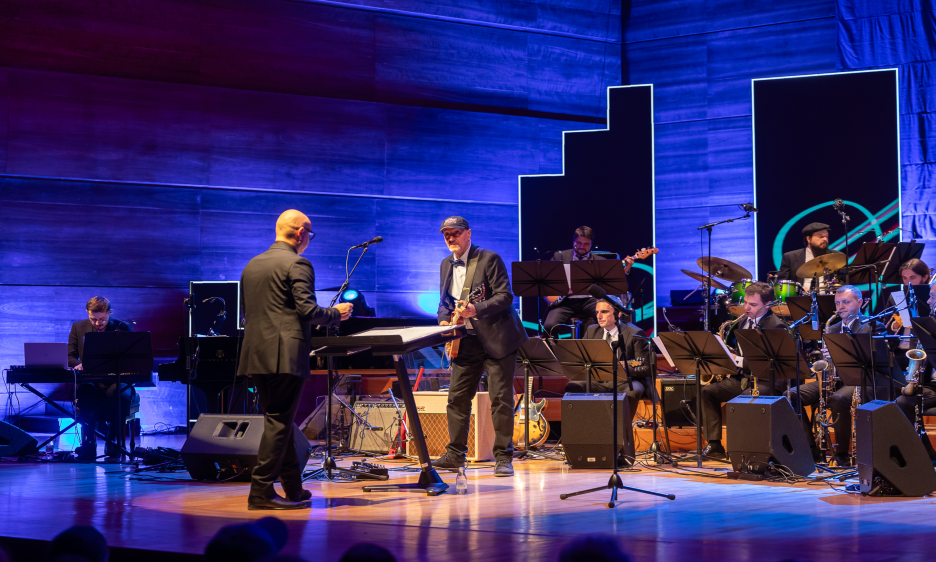
December has become a month of special programs for the National Jazz Orchestra—concerts that close the year with ambition and bring audiences together for something memorable. On the eve of its 10th anniversary in 2026, the orchestra stepped into this celebratory season with confidence, delivering a strong, sold-out concert at the Macedonian Philharmonic Hall. For the occasion, it staged a program titled "Rock 'n 'Roll in Jazz," inviting three artists whose careers have stretched across decades and whose connection to jazz has always been part of their musical DNA.
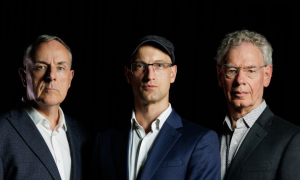
Rambo Amadeus, Darko Rundek, and Vlatko Stefanovski come from different generations of the regional Balkans rock scene. Vlatko's career predates everyone else's, yet all three remain fully active and widely popular, with enough edge and vitality to command any stage. None of them is a relic from the past—they are still shaping the present.
The National Jazz Orchestra has a history with Rambo, having toured with him in earlier years, and it has also collaborated with Rundek. Vlatko, though deeply rooted at home, has not performed a full concert with the orchestra before; their only previous encounter was during a pandemic-era outdoor performance in 2021, where he joined them for a single piece at the "ZJM Big Band Orchestra & Macedonian Guitar Heroes" event. Bringing all three together for one evening felt like a natural evolution of those earlier collaborations and a bold statement of intent as the orchestra approaches its anniversary year. Guiding them through this convergence of styles was conductor Dzijan Emin, whose poised and precise baton kept the entire ensemble unified and detailed, allowing the orchestra to move confidently through every shift in style and mood.
Rambo Amadeus: A Theatrical Spark and Controlled Chaos
To describe Rambo Amadeus is to accept that no single description will ever be enough. He is a songwriter, guitarist, entertainer, composer, performer, sailing champion, and environmental activist. Add to that the self-bestowed, entirely tongue-in-cheek title Svetski megacar (Tsar Megastar), and the picture becomes clearer: there is only one Rambo, and he has never fit into a category defined by someone else.Often compared to Frank Zappa—perhaps the closest parallel he has—Rambo shares that same combination of sharp intellect, sharper humour, and an instinct for turning every song into a small musical theatre piece. From the earliest days of his career, his work has been a collision of funk, jazz, hip-hop, satire, and improvisational spirit. The National Jazz Orchestra knows this well; the collaboration that began in December 2022 with the project "The Miracle in the Balkans" is where this current program first took flight.
Rambo opened the evening with a revitalized "Beton," transformed into something almost New Orleans—like. A walking bass line set the pace, while Louis Armstrong-inspired brass ornaments carried the melody. Senad Husein's trumpet shone with immediacy, and Ivan Ivanov delivered a bright, clean saxophone solo that cut through the arrangement with ease. The orchestra's General Manager, Goce Stevkovski on drums and Darko Muchev -Mucho on bass have been partners in rhythm since the early '90s, making them the oldest rhythm section in the city of Skopje. They anchored everything with the kind of chemistry that only years of shared stages can produce. The result was a dynamic, playful opening that instantly energized the hall.
"Fantasticne glasovne mogućnosti" shifted the tone into something louder and more theatrical. Bombastic drums rolled underneath bursts of funk, and the harmonies bent in Rambo's familiar, mischievous way. His guitar turns were twisted and cheeky, and at one point, he slid into a clear nod to Carlos Santana's "Oye Como Va" riff. A brief drum duel with Stevkovski followed—good-natured, humorous, and executed with perfect timing. With "Hipishizik Metafizik," the orchestra stepped into a sharper, more groove-driven funk idiom. Mucho's juicy electric bass lines gave the piece a deep pulse, while Gordan Spasovski's piano solo rose and expanded with confidence and complexity. The energy remained high through "Higsov Bozon," built around tight big-band funk and Rambo's humorous spoken-word commentary on mathematics, bankers, and yachts—a satire delivered with charm rather than cynicism. The large ensemble made the piece feel even more theatrical, turning it into a miniature stage play.
He closed his set with "E moj Rambo" leaning fully into operatic flair with guest opera singer Biljana Josifovska. The sly melodic contrast with Rambo's vocal lines, taken from "The Girl from Ipanema" earned laughter and applause—classic Rambo Amadeus, self-aware and completely committed to the bit. For the grand finale, "Hali Gali Invalid" brought the house down: a riotous, playful culmination of the set, combining funk, big-band power, and Rambo's signature irreverent humour. It was a reminder of why he continues to have such a presence onstage: bright, unfiltered, inventive, and, above all, impossible not to enjoy.
Darko Rundek: Film-Noir in Full Orchestra
Croatian singer and songwriter Darko Rundek, a defining figure of the regional music scene since his days with the iconic band Haustor, brought his signature blend of lyricism, wit, and melancholy to the Philharmonic Hall alongside the National Jazz Orchestra. Known for a career spanning over four decades and crossing multiple genres and formations, Rundek has consistently reinvented his songs while preserving their essence.The mood shifted as the lights dimmed and a film-noir palette settled over the stage. Viktor Filipovski stepped in on drums, bringing lighter, suspenseful touches to the grooves, complemented by Kiril Tufekcievski and the supporting vocals of Maja Rivić and Igor Pavlica. The opening number, "Bi mogo da mogo," unfolded with calm authority, setting the tone for the evening. "Shejn" followed, anchored by a recognisable beat and enhanced by Kire Kuzmanov's elegant soprano sax solo. While much of Rundek's set drew from Haustor classics, the program also included solo-era gems such as "Apokalipso" and "Ruke," blending nostalgia with fresh energy.
The brass section shone during "Šal od svile," giving the central riff a fullness that made the arrangement feel alive and expansive. "Ena" stood out as a communal highlight: midway through the song, the orchestra shifted into clave rhythms, and the audience instinctively joined with hand-claps. It was spontaneous, joyful, and a perfect illustration of how Rundek's music can connect people in an instant.
A bluesy, Tom Waits-like number followed, "Uhode" featuring Valentin Vidovic on baritone saxophone, whose smoky solo lines earned applause even from Rundek himself. Spasovski's Hammond organ hummed underneath, adding depth and atmosphere. "Apokalipso" brought the room to a heightened energy, and the audience's enthusiasm compelled Rundek to return to the stage with an acoustic guitar for "Ruke." Against an acoustic bass intro, the song unfolded with a meditative intimacy, reminiscent of Leonard Cohen—low, reflective, and tender—a quietly perfect ending to his set.
These songs are not just fan favorites or regional classics—they belong in the wider pantheon of truly great songwriting. Rundek's catalogue has a durability and emotional precision that places it alongside some of the most finely written songs anywhere, and the big band setting only underscores how timeless and structurally rich these compositions are.
Vlatko Stefanovski: Precision, Warmth, and That Unmistakable Tone
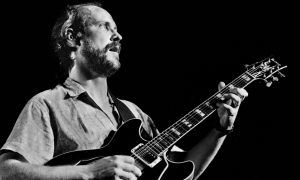
Vlatko Stefanovski took the stage with his sunburst Gibson Les Paul, opening with "Stratus" in a performance that immediately revealed his effortless command. Every phrase seemed to glide across the instrument as if he were testing the air in the hall, playful yet precise, setting a tone of relaxed virtuosity. The groove was infectious, and the interplay between guitar and brass hinted at the possibilities of what a big band could add to his music."Mamurni Ljudi" followed, kicked forward by the brass section, giving the piece a broader, more dynamic presence than the studio version. "Talasna Dužina" slowed the pace, flowing lyrically and meditating in the space between notes, a reminder of Vlatko's melodic sensibility.
The evening's highlight arrived with "Gypsy Song," whose rhythmic elements and embellishments made it arguably the finest live arrangement of the song. Ivan Ivanov's saxophone solo shone here, creating a vivid dialogue between guitar and brass that the audience clearly relished. In "Bistra Voda," the orchestra doubled the trumpet line on Vlatko's melody, adding lift and sparkle, while Gordan Spasovski's arrangements subtly reshaped each classic tune. Spasovski didn't simply decorate the songs with surface flourishes; his work revealed hidden structural elements, emphasizing emotional undertones and lending depth to every phrase. The result was a dual marvel: listening to Vlatko's masterful guitar tone, phrasing, and fluid embellishments, while simultaneously witnessing the dance of his fingers on the fretboard.
Even with a relatively short selection of songs, he demonstrated exactly why he is regarded as one of the finest guitarists of our time. It is no coincidence that he stands in the pantheon of great players—an artist in a class of his own, still releasing new work each year and continually expanding the language of the instrument.
Vlatko closed his main set with "Skopje," a popular pop-funk number that quickly became a party in the hall. At one point, a beautiful New Orleans-inspired street party section was woven into the song, transforming it into a mini-celebration of jazz and rock. The fun escalated as Rambo Amadeus joined the stage with an enormous tuba, soon followed by Rundek and his singers in the background, turning the finale into a joyful, spontaneous jam.
The encore, "Kao Kakao," was a pure kick of rock 'n' roll, energized by the full big band, with Vlatko's guitar leading the charge. It was the perfect closing statement: a blend of virtuosity, groove, and collective joy, reminding everyone that Vlatko Stefanovski remains a powerhouse both in skill and in the sheer pleasure of live performance.
At the centre of it all was conductor Dzijan Emin, whose elegant, precise, and remarkably fluid direction held the evening together. Whether navigating Rambo Amadeus' theatrical unpredictability, Rundek's shifting moods, or Vlatko's technical intricacy, Emin kept the orchestra balanced, focused, and sonically cohesive. His ability to shape the dynamics, pace, and colour across such diverse material was a defining force of the concert—authoritative and indispensable.
The concert ran for more than two hours, a demanding duration for any ensemble, but especially for a brass section working at full intensity. Its stamina, discipline, and fortitude was remarkable. The musicians delivered with consistency and spirit, sustaining both the energy of the music and the emotional arc of the night.
"Rock 'n' Roll in Jazz" turned out to be an apt name. It was not about looking back at something lost; it was about recognizing how much creative force still lives in these musicians. On this night, surrounded by brass, reeds, percussion, and a responsive audience, that force felt as strong as ever.
 FOLLOW Nenad Georgievski
and get notified whenever a new article published.
FOLLOW Nenad Georgievski
and get notified whenever a new article published.
For as long I can remember music has been a focal point in my life.
About Vlatko Stefanovski

Tags
PREVIOUS / NEXT

Become a Sustaining Member

Since 1995, All About Jazz has championed jazz as an art form and supported the musicians who create it. Over three decades, it has grown into one of the world's leading jazz resources, serving hundreds of thousands of readers, musicians, presenters and industry professionals each month.
Help Build the Future of All About Jazz
Your support helps us continue building All About Jazz for the next generation—expanding our editorial coverage, preserving jazz history, developing new community features and creating better ways to discover the music and the people behind it.
Become a sustaining member for as little as $20 per year and you'll immediately enjoy an ad-free experience along with access to subscriber features and future articles for a full year.
Together, we're not simply sustaining All About Jazz—we're building its future. Thank you for being part of the journey.