Home » Jazz Articles » Live Review » In the Mood for Love (Songs): The Red Pavilion Jazz Band...
In the Mood for Love (Songs): The Red Pavilion Jazz Band at The Red Pavilion
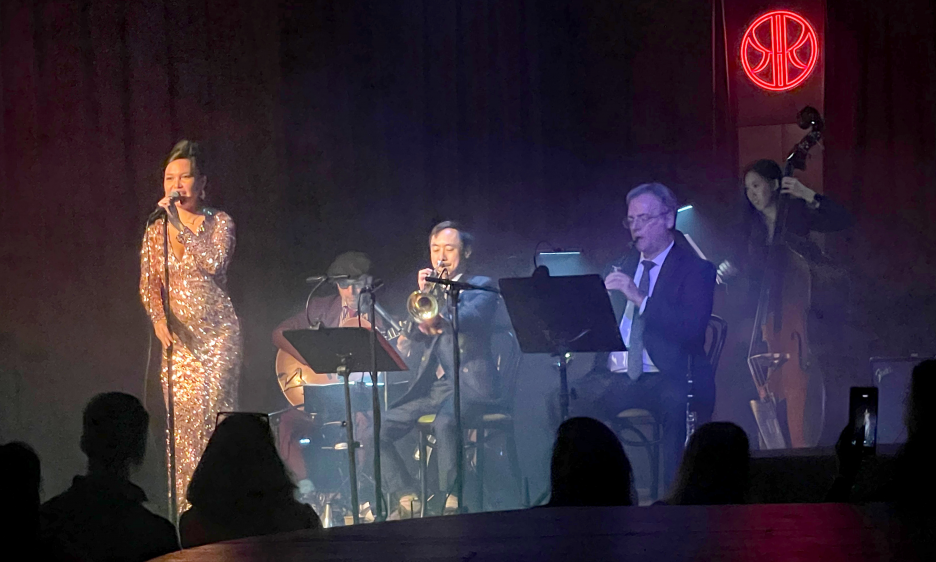
Courtesy Tamara Yadao
The Red Pavilion
In the Mood for Love (Songs)
Brooklyn, NY
December 5, 2025
The Red Pavilion Jazz Band, a quartet with trumpeter Gordon Au at the helm, set the tone for an immersive, intercultural music experience. Cradled by love, longing, nostalgia, and educational flair, these musicians performed a diverse set of songs and arrangements, spanning Chinese, Filipino, Afro-Cuban, and American love songs and jazz standards.
Peering through a smoky, luxuriant atmosphere adorned with mirrors, lanterns and red curtains, the audience watched the quartet lead the night with 1930 ballad, "Memories of You" by Eubie Blake. The band followed the slow, quiet movement of the smoke filling the space, with each instrumentalist showcasing their voice through gentle solos: first, the trumpet; then the clarinet; followed by the guitar and bass. Suddenly, the clarinet returned, this time joined by the bartender's martini shaker, acting as a teleporter for the audience to another time.
Since opening in May 2023, venue co-founder Shien Lee, born and raised in Taipei, has developed performances centered around Shanghai Jazz (or Chinese Jazz). Rooted in Shanghai's late 1920s-1930s clubs, this genre was influenced by American, Filipino, Russian, and Japanese musicians. One of their highly successful nights, In The Mood For Love (Songs) beautifully embodied its mission to spotlight Asian creative voices in jazz and cabaret. The stylish Asian-themed nightclub borrowed its title from Wong Kar-wai's 2000 film, enticing audiences with Hong Kong-inflected visions of vintage glamour made real inside its red-curtained interior. Even at the pre-show door time of 7:30 PM, the line stretched out the door and down the block.
Notably featured was the classic "时代曲" ("Shidaiqu"), a first-wave Chinese pop love song, "得 不到的愛情" ("De Bu Dao De Aiqing") or "Without Your Love," written in 1948 by Yao Min for his sister to sing. With a knowing tenderness, Malaya Sol's beautiful, bright tone and clear vocal quality during this song evoked the spirit of Min's sister, Yao Lee, who was often described as having a "silver voice." Nick Russo craftily played his banjo to a slow syncopated foxtrot, reproducing plucking sounds reminiscent of the pipa, a four-string Chinese lute, part of the song's original instrumentation.
Throughout the night, Au and occasionally Sol provided context for the works performed, sharing historical and cultural narratives or anecdotes that created an educational yet sensual experience of these pieces.
The 1938 classic Filipino kundiman (art song about love) written by Miguel Velarde, titled "Dahil Sa'yo" or "Because of You," was fittingly introduced by the sultry Filipina chanteuse, Malaya Sol. Her mesmerizing vibrato over lyrical bossa nova rhythms captivated the hearts of an audience as she sang the Tagalog phrases: "Dahil Sa'yo" and "Mabuhay," both icons of Filipino cultural identity that express devotion, longing, and camaraderie.
Drawing inspiration from elements of Brazilian bossa nova in "Dahil Sa'yo," Au infused Afro-Cuban grooves in his arrangement for the band's next piece, "You Stepped Out of a Dream," a 1940 American jazz standard by Nacio Herb Brown and Gus Kahn. Bassist Allison Lee gave an impressionistic, expressive solo that accompanied the dark, quiet milieu with her delicate, pianistic finger work, adding an air of balletic mystery to the smoky room. Her synesthetic playing, dancing along the bass neck, gave the tune a light, nearly translucent quality, without sacrificing any gravity.
In a clever cultural reclamation of the next piece, Au noted, "We took it upon ourselves to do some... precise surgery on this song and we removed the fake Chinese... put in a little bit of real Mandarin..." in Bernie-Goering-Bullock's "A Bowl of Chop Suey and You-ey" from 1934. In the context of the musical trends of the era, it is well-documented that American singer Kenny Baker, known for his vaudeville and novelty songs, used cultural appropriation by making up Chinese words in the original recording.
The first set concluded with a cabaret performance featuring Nicanor Abelardo's "Bituin Marikit" or "Beautiful Star." In the center of the room, Ashley from Subtle Asian Polers showcased her graceful strength and agility with aerial silks. She continuously climbed and interwove herself through the flowing lengths of fabric, transforming her body into a living sculpture high above the audience's heads.
The star of the evening's second set was the primary motif from Wong Kar-wai's In the Mood for Love composed by Shigeru Umebayashi. Matt Koza's fluid clarinet work, alongside Au's bright trumpet, shone in "Yumeji's Theme." In Au's arrangement, the intricacies of their lines intertwined like partners dancing in waltz time. While playing their melodies, a sense of sweet togetherness was belied by a marked counterpoint. This dynamic powerfully reflected the film's theme of unrequited love.
The evening culminated in a heartwarming cultural exchange, with audience members leaving with a Mandarin phrase as a memento. The Red Pavilion Jazz Band rendered Jon Hendricks' 1957 version of "I Want You to Be My Baby," with English lyrics translated and adapted by Si Tu Ming. In a call-and-response chorus, vocalist Sol playfully taught the audience how to call out for love in Mandarin: "我要你的愛" ("Wo Yao Ni De Ai"), which loosely translates as "I Want Your Love." Through teaching the audience this Chinese expression of love, Sol and the band not only bridged cultures but also cultivated a sense of community, wrapping the night in an enchanting and intimate atmosphere that epitomized the spirit of the Red Pavilion.
 FOLLOW Tamara Yadao
and get notified whenever a new article published.
FOLLOW Tamara Yadao
and get notified whenever a new article published.
An artist and writer defined by constant motion in process and practice.
About Gordon Au

Tags
PREVIOUS / NEXT

Become a Sustaining Member

Since 1995, All About Jazz has championed jazz as an art form and supported the musicians who create it. Over three decades, it has grown into one of the world's leading jazz resources, serving hundreds of thousands of readers, musicians, presenters and industry professionals each month.
Help Build the Future of All About Jazz
Your support helps us continue building All About Jazz for the next generation—expanding our editorial coverage, preserving jazz history, developing new community features and creating better ways to discover the music and the people behind it.
Become a sustaining member for as little as $20 per year and you'll immediately enjoy an ad-free experience along with access to subscriber features and future articles for a full year.
Together, we're not simply sustaining All About Jazz—we're building its future. Thank you for being part of the journey.
Near

New York City Concerts