Home » Jazz Articles » Album Review » Helen Sung Big Band: Oracles
Helen Sung Big Band: Oracles
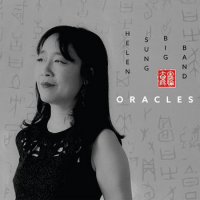
As her first big-band offering, the album is Sung's response—to Heath and Clark Terry, Ron Carter, Wayne Shorter, Barry Harris, Kenny Barron, Herbie Hancock, and Sir Roland Hanna—which, as she put it, "expresses my deep gratitude and is a tribute to the masters who made room for me and entrusted me with a tradition they helped build." Her compositions affirm lessons she has learned and values she has internalized.
In "A Little Bird Watchin' (for Jimmy Heath)," the ensemble leads the way. What begins with one voice (Nicole Glover's tenor saxophone) quickly becomes lively counterpoint as independent lines are layered in, followed by full-voiced harmonious homophony. Improvisation is the order of the day, with Vicente Archer's bass, Sung's piano, and Adam Cruz's drums coming to the fore as textures and tempos shift. Soloists dominate. There is plenty of composition, but it serves and is led by individual voices (those of "the people," to use Heath's metaphor).
Taking Ron Carter's advice to heart, that "in order to find your voice in this music, you have to write your own music," she uses material by her mentors as jumping-off points for creations that are very much her own. Terry's "Samba da Gumz" (track 2) becomes a prelude to her "Positively C.T." (track 3), which highlights her trumpets (Mike Rodriguez, Tatum Greenblatt, Alex Norris, Nathaniel Williford). And Shorter's gorgeous "Diana" (track 4), which Shorter so memorably offered in his 1974 collaboration with Milton Nascimento (Native Dancer, Columbia), here becomes a dreamy prelude for soprano sax (John Ellis) and Fender Rhodes, leading to Sung's quixotic "Wayne's World" (track 5). Sung's "Mr. Virtuoso" (track 6), written for Carter, opens with bass, piano, and drums in an out-of-time misterioso before she employs the full range of the ensemble, from flutes on top to the lower realms of her reed and brass sections. She plumbs the depths with solos from Andrew Gutauskas' baritone saxophone and Gina Benalcázar López's bass trombone then uses Carter's own "R.J." as a postlude, picking up the tempo and again centering on the rhythm section.
Sung followed Hanna's counsel to "not forget her classical roots" in composing Pianism, a piano concerto in tribute to Harris, Barron, and Hancock. The first movement, "I: Barry Harris," opens with a non-blues pentatonic passage in parallel harmony that is gradually reshaped metrically against a changing set of backdrops, finally settling—two minutes into the performance—into a bop melodic, rhythmic, and harmonic milieu reflective of Harris' position as "keeper of Bud Powell's legacy and the bebop flame." The timbres soften in the second movement, "II: Kenny Barron," which honors the "modern master of melody" with Rhodes, flute, and muted trumpet lines that sail on a cool groove that navigates swing and straight eighths. "III: Herbie Hancock," comes on strong with percussion hits and horns in a pentatonic canon that recalls the concerto's opening while heralding a funkier feel with a finely calibrated 16th-note subdivision and blues mode in its melodic backbone.
In keeping with her view of Hancock as "transcendence personified," Sung closes the concerto with a finale that aligns conceptually with aesthetic and formal norms of classical composition. She reminds us who and what we have heard in earlier movements, recapping themes, playing with and intertwining elements, transcending stylistic boundaries to create a work that—while it respects the "without you, no me" jazz principle—is undeniably, joyfully original.
 FOLLOW Katchie Cartwright
and get notified whenever a new article published.
FOLLOW Katchie Cartwright
and get notified whenever a new article published.
Ethnomusicologist, singer-flutist, writer, radio host (KRTU San Antonio 91.7FM).
Track Listing
Convergence; Samba da Gumz; Positively C.T.; Diana; Wayne's World; Mr. Virtuoso; R.J.; A Little Bird Watchin'; Pianism: I. Barry Harris, II. Kenny Barron, III: Herbie Hancock; Peace.
Personnel
Helen Sung Big Band
band / ensemble / orchestra
Helen Sung
piano
Vicente Archer
bass
Adam Cruz
drums
Samuel Torres
percussion
Tatum Greenblatt
trumpet
Mike Rodriguez
trumpet
Alex Norris
trumpet
Nathaniel Williford
trumpetJames Burton III
tromboneSara Jacovino
tromboneWillie Applewhite
trombone
Gina Benalcázar López
trombone
Dave Pietro
saxophone, alto
Alejandro Aviles
saxophone, alto
John Ellis
saxophone
Nicole Glover
saxophone, tenor
Andrew Gutauskas
saxophone, baritoneAdditional Instrumentation
Alan Ferber: conductor.
Album information
Title: Oracles | Year Released: 2026 | Record Label: Sunnyside Records
About Helen Sung Big Band
Tags
PREVIOUS / NEXT
Become a Sustaining Member

Since 1995, All About Jazz has championed jazz as an art form and supported the musicians who create it. Over three decades, it has grown into one of the world's leading jazz resources, serving hundreds of thousands of readers, musicians, presenters and industry professionals each month.
Help Build the Future of All About Jazz
Your support helps us continue building All About Jazz for the next generation—expanding our editorial coverage, preserving jazz history, developing new community features and creating better ways to discover the music and the people behind it.
Become a sustaining member for as little as $20 per year and you'll immediately enjoy an ad-free experience along with access to subscriber features and future articles for a full year.
Together, we're not simply sustaining All About Jazz—we're building its future. Thank you for being part of the journey.