Home » Jazz Articles » Album Review » Tania Giannoul and Nik Bärtsch: Metakosmos
Tania Giannoul and Nik Bärtsch: Metakosmos
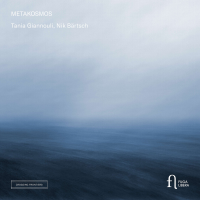
The circumstances of their meeting gave this exchange time to find its footing. Having each served as an artist in residence at Germany's Enjoy Jazz festival in 2022, the Greek and Swiss pianists returned the following year at director Rainer Kern's invitation to perform as a duo. That concert began the collaboration documented here, with Enjoy Jazz also contributing to the album's production. Giannouli's classical grounding and expansive improvisational sensibility meet Bärtsch's devotion to the physical intelligence of repetition. Their respective paths converge around an understanding of ritual, where the discipline of returning to a phrase can reveal possibilities that freedom alone might overlook. Under such attention, repetition develops a curious instability. The fingers recognize their route while the ear discovers that its destination has moved. Giannouli's melodic luminosity draws depth from Bärtsch's darker rhythmic undertow, and the piano's percussive ancestry carries traces of Balkan traditions through their chamberedness. Even the instrument's familiar geography becomes negotiable. A string can harbor a voice that the keyboard has spent its entire life withholding.
That estrangement trembles through the dampened strings and sustained notes of "Willow Wind," whose fluttering gestures seem to remember distances the hands have never traveled. A knocking accent troubles the earth beneath our feet. Souls might be pressing against its underside, waiting for a touch of music they have not heard since their deaths centuries ago. Yet the sound also finds a cavity within the listener, and the question of its origin rests at the tip of the tongue, unable to purchase a body with which to speak. By the time the groove of "Then When" gathers force, those subterranean petitions have acquired muscular weight. Hand-altered clusters crowd the pulse, making the piano's interior palpable through the resistance of its strings. Metaphysics develops joints as the music's modally inflected hands reach us with desires inseparable from their articulation, while sudden flashes in the upper register scatter the imagination into planetary nebulae. Across that extravagant distance, matter continues its intimate labor of changing state. The body carries its own beyond, tucked into the smallest motions that keep it alive.
Within the spiraling configurations of "Intonal," this bodily knowledge enters the confines of the mind, where dreams exchange their credentials with memories and neither can establish priority. Compact gestures seem capable of encoding a lifetime, their almost genetic density unfolding into textures of astonishing orchestral breadth. Two instruments occupy the room, yet the ear keeps discovering recesses for which the room has made no provision. Tensions gather in that discrepancy until their friction gives birth to light, enough for the nighttime to draw illumination over its sleeping shoulders. The tender drift into "Electric Sea" carries this image toward exhausted consciousness. Behind closed eyelids, the day continues projecting its damaged footage; the brain searches for somewhere its accumulated images can loosen their claims. Here, the duo's lullaby gives those images room to lose their edges. A remembered face slips free of the glass that held it, and the electricity of attention turns aqueous. Sleep becomes a difficult act of hospitality toward everything consciousness has been unable to accommodate.
The circulations of "Spiral Spirit" give that hospitality a recurring shape. Repetition supplies the conditions under which variation can become perceptible, each return exposing a difference that the previous circuit had no means of recognizing. Giannouli and Bärtsch pursue this principle through the piano's inner possibilities, amplifying voices whose proximity to the mechanism has kept them hidden from conventional hearing. There is something moving in the care with which these marginal sounds are granted consequence. A finely granulated pulse holds the overt against the obscure, gradually developing the wooden articulation of a marimba. Its accumulating detail changes the identity of the figure that carries it. What began as a pattern becomes a history of the pressures exerted upon that pattern, and the spiral earns its name through an inability to return to an untouched beginning. Even the most exact recurrence must pass through the changed body of the person who hears it.
Such changes find their most profound suspensions in "Glass Labyrinth," where an ebb and flow of resonance gives rise to bioluminescent figures. Some approach the shapes of letters, only to dissolve before the mind can assign them a word. We follow a script whose alphabet is being consumed by the act of reading it. That friction between appearance and interpretation deepens the album's philosophical wager: a cosmos made audible through relation must allow its meanings to remain vulnerable to further contact. The siren calls and submerged strummings of "Door 13 / Pink Athens" carry this vulnerability into architecturally suspect spaces. Staircases take on the obligations of walls; a surface we trusted to enclose us develops an appetite for passage. Throughout this Escherian interior, the duo negotiates an unstable relation between shelter and movement. Each shift makes the shape of the encounter answerable to what passes through it. The piano's wooden enclosure opens onto impossible volumes, and the listener must inhabit them without the reassurance of a floor plan.
The dancing comportment of "Bela's Move" brings these spatial uncertainties back into the precision of touch. Its Bartókian contours appear loosened from their inherited frame, glistening with the cellular brightness of a flower opening beneath the moon. An energetic surface conceals a calm and collected heart, allowing the most animated gestures to retain an inward poise. The virtuosity feels sustained by that poise, drawing its freedom from a center willing to remain unclaimed. Here, the duo's ritual understanding becomes especially persuasive. A phrase can move farther when the hands relinquish the need to demonstrate how far they have moved it. In the quiet intelligence beneath this dance, Metakosmos acquires the force of a proposition about creation itself. To bring a world into being requires enough concentration to sustain its form, and enough tenderness to let that form develop intentions of its own.
Yet the pianos harbor another history, one that unsettles even this generous account of encounter. Their wood belonged to living trees before it became a chamber for human thought. Beneath every articulated intention lies matter whose existence preceded our reasons for touching it. The album's imagined beyond might extend into that prior life, toward a root's blind persistence and the years a trunk spent thickening without an audience. What would it mean to grant the wood a life independent of everything we have persuaded it to say? The question turns listening toward an existence that owes us no revelation. Giannouli and Bärtsch make the piano newly strange through their attention to its overlooked possibilities; following that attention far enough, we reach the edge of our entitlement to call anything an instrument. There, the title's promise becomes difficult and immense. A cosmos beyond our own would have to contain things whose value survives our inability to use them. Somewhere inside the piano, a tree is entitled to a history in which we never appear.
 FOLLOW Tyran Grillo
and get notified whenever a new article published.
Music writer, singer, translator, scholar.
Track Listing
Willow Wind; Then When; Intonal; Electric Sea: Spiral Spirit; Glass Labyrinth; Door 13/Pink Athens; Bela’s Move.
Personnel

Tania Giannouli
piano
Nik Bärtsch
pianoAlbum information
Title: Metakosmos | Year Released: 2026 | Record Label: Fuga Libera
About Tania Giannouli
Tags
PREVIOUS / NEXT


Become a Sustaining Member

Since 1995, All About Jazz has championed jazz as an art form and supported the musicians who create it. Over three decades, it has grown into one of the world's leading jazz resources, serving hundreds of thousands of readers, musicians, presenters and industry professionals each month.
Help Build the Future of All About Jazz
Your support helps us continue building All About Jazz for the next generation—expanding our editorial coverage, preserving jazz history, developing new community features and creating better ways to discover the music and the people behind it.
Become a sustaining member for as little as $20 per year and you'll immediately enjoy an ad-free experience along with access to subscriber features and future articles for a full year.
Together, we're not simply sustaining All About Jazz—we're building its future. Thank you for being part of the journey.